Image courtesy of the Ellen MacArthur Foundation
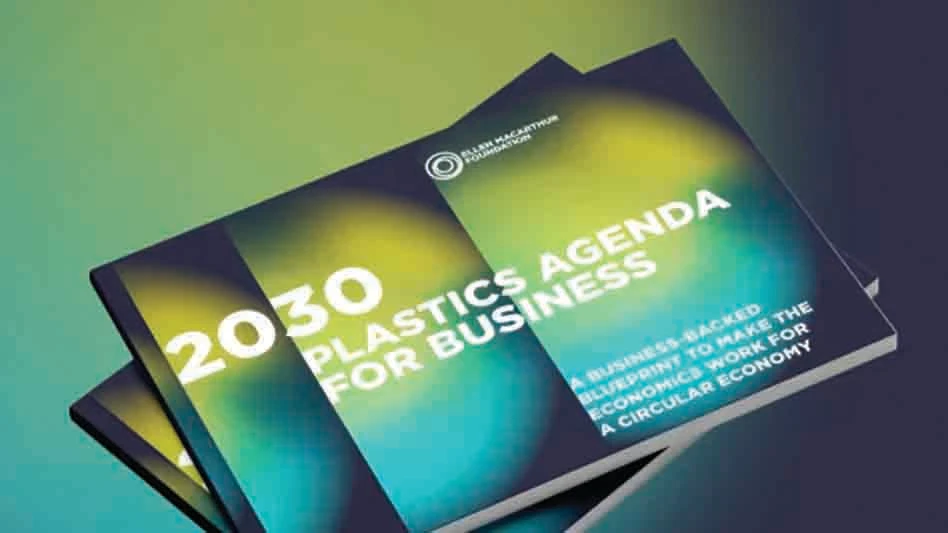
The United Kingdom-based Ellen MacArthur Foundation has released its 2030 Plastics Agenda for Business, which calls on businesses to work together to “drive market transformation.” The organization says the guide defines what’s needed to tackle plastic waste and build a circular economy, setting out three key levers:
- collective advocacy by businesses to help shape ambitious, effective policy;
- collaborative action to share risks, costs and innovation to tackle barriers; and
- aligned individual action to “keep pushing boundaries” within businesses today to inspire policy and market change
“By acting early and collectively, leading businesses will be in a position to shape regulation, lower transition costs and speed up progress through shared advocacy and innovation,” the foundation says, adding that the evidence-based report highlights the progress made by a group of companies that represent one-fifth of the world’s plastic packaging market through their backing of the foundation’s Global Commitment Initiative.
The foundation reports that, collectively, signatories have avoided 14 million tons of virgin plastics, have tripled their use of recycled content and have eliminated billions of problematic packaging items.
The foundation also highlights major challenges that still exist, with 80 percent of the market “yet to step forward, and on average, lagging behind those who have.” In addition, the foundation says even the most ambitious businesses face systemic barriers they cannot overcome alone, such as scaling reuse models, tackling flexible packaging waste and building effective collection and recycling infrastructure.
The 2030 agenda calls for mainstreaming proven solutions, addressing systemic barriers and creating enabling government policy that aligns incentives with circular outcomes.
“Many business leaders ask me what comes next,” says Rob Opsomer, executive lead for plastics and finance at the foundation. “My answer is simple: don’t wait. The companies that act now can help shape effective policies and make circular solutions the new normal.
“By working together, they’ll cut transition costs and build resilience in a fast-changing world. They can make what once seemed impossible not only possible but, ultimately, inevitable.”
The Foundation also is calling on the rest of the global plastic packaging market to sign on to the global commitment, which was launched in 2018 in partnership with the United Nations Environment Programme.
“Nestlé will continue to contribute towards the common vision of a circular economy for packaging,” says Antonia Wanner, the company’s chief sustainability officer. “Building on years of effort to evolve our packaging, we look forward to collective action on the 2030 Plastics Agenda for Business, working with the Foundation and value chain partners. Together we aim to overcome systemic barriers by building broader systems and a policy landscape for the circular economy.”
Commitment update
The Ellen MacArthur Foundation has updated its Global Commitment figures with its 2025 progress report, which includes actions taken by plastic packaging producers in 2024 to reduce virgin plastic usage, increase postconsumer recycled (PCR) content usage and design more products for reuse and recycling, among other targets.
According to the foundation, the Global Commitment has brought together more than 1,200 organizations behind the shared goal of a circular economy. Companies representing 20 percent of all plastic packaging produced globally have committed to 2025 targets, and the updated report shows results at both the aggregate level and the company level, and benchmarks signatories’ performance against broader market trends.
The progress report highlights several key trends:
- Signatories have “bent the curve” on virgin plastic use in packaging. The Foundation says that while the global market has increased virgin plastic use by 13 percent compared to 2018, brand and retail signatories have, on average, decreased their use by 6 percent.
- Signatories tripled their use of PCR
- They eliminated more than 775,000 tons of packaging commonly identified as “problematic or unnecessary.”
- Systemic barriers, such as scaled reuse models, continue to hold back further progress.
Compared to 2023, signatories reduced virgin plastic usage by 1.5 percent while increasing PCR usage by 2 percent. Also, they developed 2 percent more packaging that was designed for recycling.
Per foundation data, of the top 10 fast-moving consumer goods (FMCG) companies by revenue that also are commitment signatories, Nestlé, PepsiCo Inc., Unilever and L’Oréal all recorded reductions in virgin plastic use from 2018-2024, based on the baseline year each joined the initiative.
For example, Unilever led those companies with a 23 percent reduction, though it still lags behind its 50 percent commitment for 2025. Nestlé and L’Oréal each reduced virgin plastic use by 21 percent, but both have set goals to reach a 33 percent reduction by 2025.
Of the top 10, The Coca-Cola Co. and Mars Inc. recorded 10 percent and 1 percent increases in virgin plastic use over the time period, respectively. Each of the six companies listed in the top 10 increased PCR content in their packaging from 2018-2024, though none have reached their 2025 targets. Each increased the percentage of packaging designed for recycling and packaging that is reusable, recyclable and compostable compared to their baseline years.
Among other large FMCG companies, Mondelez International Inc. (5 percent), Diageo (16 percent), SC Johnson & Son Inc. (33 percent), Essity (20 percent) and FrieslandCampina (28 percent) met or surpassed their 2025 virgin plastic reduction goals a year early, while Diageo and SC Johnson both also surpassed their 2025 PCR content goals.
Diageo set 40 percent PCR target for 2025 and reached 43 percent, and SC Johnson reported meeting its 25 percent PCR goal.
“We’ve made real progress, but as I often say, I wish we were even further along,” SC Johnson Chairman and CEO Fisk Johnson says in a news release. “We’ve learned that voluntary actions, such as using more recycled plastic in our products, can only go so far, unfortunately. The solution to the plastic waste crisis requires strong national standards like federal extended producer responsibility [EPR] to make companies, including ours, accountable for improving recycling systems, driving innovation and funding effective collection programs.
“EPR works. Around the world, it’s raised recycling rates and reduced waste. But it takes all of us working together to make it succeed.”
The foundation notes that businesses representing 20 percent of the plastic packaging market have recommitted to the next phase of its Global Commitment, setting 2030 targets and publicly reporting their progress. It adds that this initial group of businesses is expected to expand during the 12-month signup window.
“The Global Commitment is now more explicitly embedded in a broader market transformation approach, recognizing individual business action is a critical component, but not enough by itself,” the foundation says. “It is therefore complemented by a program of collaborative action and collective advocacy to unlock systemic barriers and help signatories achieve their goals, as outlined in the Foundation’s 2030 Plastics Agenda for Business.”
Latest from Recycling Today
- Phoenix Technologies closes Ohio rPET facility
- EPA selects 2 governments in Pennsylvania to receive recycling, waste grants
- NWRA Florida Chapter announces 2025 Legislative Champion Awards
- Goldman Sachs Research: Copper prices to decline in 2026
- Tomra opens London RVM showroom
- Ball Corp. makes European investment
- Harbor Logistics adds business development executive
- Emerald Packaging replaces more than 1M pounds of virgin plastic