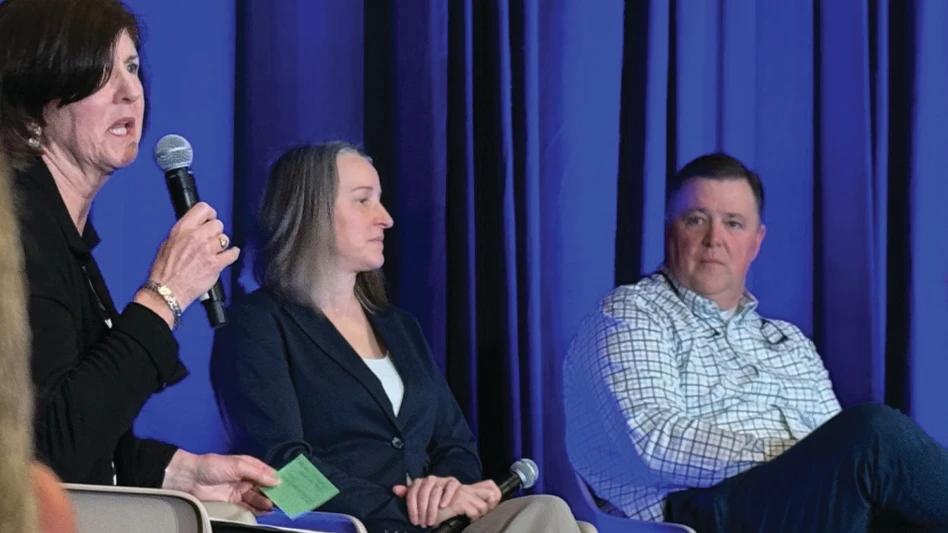
Panelists representing
Sego Jackson of Snohomish County Public Works, summarized electronics recycling legislation that
The idea behind the NW TPO was to create a central body to coordinate electronics manufacturers’ participation in the formation of a third-party organization for electronics recycling, Linnell said. The project received seed funding through the EPA and recruited eight manufacturers to fund and sit on the steering committee that directs the process.
Linnell said the major findings of the study show that $1.5 million in start-up fees to set up the TPO would be needed before collection could begin and that the total cost for the first four years would range from $29 million to $30 million. The costs cover the anticipated collection volumes of 1.35 pounds per capita in the first year, growing to 2.6 pounds per capita in the fourth year. Linnell said these figures were based on the collection numbers for a pilot project in
A hybrid TPO model would allow for “true multi-state administration” of the recycling program, which would enable economies of scale, Linnell said. Also, the special-purpose state agency would have more authority on the collection of fees than a private TPO. A hybrid TPO would also avoid the need for an existing state to add fee collection and recycling management to its responsibilities.
Linnell said that this model would leave control of funding at the state level; allow a multi-state entity to gain operational, administrative and scale efficiencies and improve information flow in the commerce chain.
More information on the NW TPO is available from the Northwest Product Stewardship Council at www.productstewardship.org.
Gov. Christine Gregoire signed the Washington State Electronics Recycling Bill into law March 24, 2006. The law requires manufacturers of computers, monitors, laptops and televisions to create and finance a system for the collection, transportation and processing of material by Jan. 1, 2009. Manufacturers have the option of participating in the state plan or of developing an independent plan that must provide the same standard of service as those participating in the standard plan,
Retailers will not be permitted to sell products from non-participating manufacturers and must provide information to consumers on how and where to recycle the covered devices.
The state’s Materials Management and Financing Authority will plan and implement the standard take-back program and contract with service providers for collection, transport and recycling. The Washington Department of Ecology will register manufacturers, review recycling programs and set annual fee levels as well as set guidelines for processing and export.
In neighboring
Willd-Wagner said the state has approved more than 400 collectors and 45 recyclers/collectors. The recyclers receive a payment of 48 cents per pound from the Board of Equalization and they are responsible for paying the collectors they receive material from 20 cents per pound. She added that the California Integrated Waste Management Board can revise the payment amount every two years if needed.
According to data that Willd-Wagner provided, $31.1 million in claims were submitted in 2005 and $7.6 million in claims have been submitted to date in 2006. Of the claims received, 78 percent have been processed, with 40 days being the average time to process a claim.
She also shared information regarding the result of recycler inspections. According to Willd-Wagner’s figures, 39 percent of inspected recyclers had no violations, 61 percent has some form of violation and 7 percent had Class 1, or nonconformance, violations, such as releasing hazardous waste into the environment.
He said there are three key elements to the program:
- Regulated fees ensure “a level playing field” ad provide reliable funding;
- Revenues are held separately to ensure accountability and transparency as well as the dedicated use of funds; and
- Stakeholder management allows participation by industries, municipalities, non-government organizations, the public and the government.
Wright said the fees are used for collection, transportation and recycling, public information, research into recycling technology, market development and program administration.
The Alberta Recycling Management Authority administers the program, which assess fees ranging from $5 to $12 for computer equipment, including laptops, printers, computers and peripherals and monitors, and $15 to $45 for TVs ranging from 18 inches and under to 46 inches and over.
Wright said the regulation passed in May 2004 and that implementation was phased in, with collection and processing beginning in October 2004, environmental fees introduced in February 2005 and the first program review in fall of 2005.
The program includes an annual processing environmental audit that examines applicant evaluations, processor program audits, waste tracking reviews and downstream processor reviews.
The Electronics Recycling Summit was May 8-11 at the
Latest from Recycling Today
- Greenwave raises revenue but loses money in Q2 2025
- Recycled steel prices hold steady
- EY says India’s need for scrap imports will continue
- Coming full circle
- Amcor, DCM introduce fertilizer packaging with 35 percent recycled content
- Comstock Metals gets closer to commissioning commercial-scale solar panel recycling facility
- Washington selects Circular Action Alliance as PRO
- Smurfit Westrock expands in Latin America