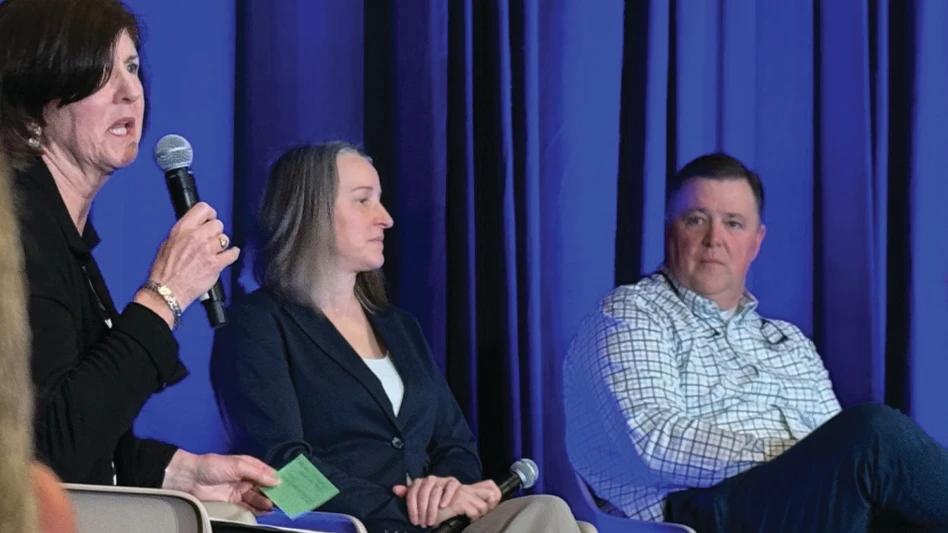
With the rapid obsolescence of consumer technology and the demise of analog television, are recyclers facing a flood of material at their facilities? Speakers at the session titled “Riding Tides for Collection” offered their insights into this question during the Electronics Recycling Conference & Trade Show June 22-24 in
While the number of electronics heading for disposition is growing, recyclers have yet to be inundated with material, as reaching consumers still remains difficult.
Edo Cohen, vice president of business development for Flipswap,
While some states, such as
Demand for refurbished phones is expected to increase, reaching $6 billion in sales by 2012, according to Cohen, who noted that the secondary market was “huge and growing.”
David Thompson of Panasonic Corp of
Thompson said, “We believe it’s our job to take the responsibility for collecting and managing these products, and we are trying to do that through this organization.”
Since the launch of MRM, Fujitsu, Funai,
The MRM program provides free electronics recycling to consumers that includes free transportation to an approved recycler. MRM pays 2 cents per pound to collectors to offset some of the collection costs as well as provides Gaylord boxes and pallets.
Thompson said MRM had 75 collectors in the state of
- Possess the ability to clean CRT glass in the
- Do not export product for recycling;
- Do not use prison labor;
- Offer full transparency into downstream markets; and
- Follow EPA Environmental Management Practices.
“Manufacturers face significant challenges in that we have several states that have passed these types of laws," he stated. "It is our belief at Panasonic that no individual manufacturer is going to solve this alone and that we really can best address it through some sort of collaborative or collective effort where we step up to the plate and manage this process of collection and recycling.”
Jake Player, president of TechTurn,
Player noted that the Microsoft Authorized Refurbisher (MAR) program was a key component to the reuse of personal computers and laptops in that it allowed the use of such a product to be extended by enabling the installation of Microsoft operating systems on these devices at a reduced cost.
Player also noted the divide that exists between consumer and corporate attitudes about computer recycling. “There is a huge divide between the business side of retirement disposition and the consumer side of retirement disposition,” Player said. On the business side, customers were essentially interested in data erasure, asset level reporting and environmental metrics, he said. Because of these concerns, corporations often perform compliance audits of their recyclers.
Consumers, however, were looking for convenience and low cost, Player said. “Consumers are not willing to pay to recycle responsibly,” he added.
The Electronics Recycling Conference & Trade Show is organized by the Recycling Today Media Group. The 2009 event will be in
Latest from Recycling Today
- Charter Next Generation joins US Flexible Film Initiative
- Vecoplan to present modular solutions at IFAT 2026
- Terex Ecotec appoints Bradley Equipment as Texas distributor
- Greenwave raises revenue but loses money in Q2 2025
- Recycled steel prices hold steady
- EY says India’s need for scrap imports will continue
- Coming full circle
- Amcor, DCM introduce fertilizer packaging with 35 percent recycled content