.gif) |
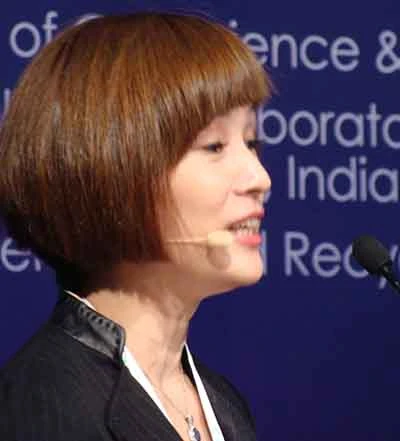
| Crystynna Ewe of Dell Corp. |
Original equipment manufacturers (OEMs) of consumer and office electronics operate globally, and thus when they are involved in recycling they must think on that same scale.
Presenters representing OEMs at the Electronics Recycling Asia conference, held in Singapore in mid-November, discussed the differing ways their companies try to adhere to recycling best practices to meet both regional and global standards.
In a session entitled “Closing the recycling loop,” Crystynna Ewe of the Singapore office of Dell Corp. said Dell has determined that a “one-way path” toward disposal “cannot be sustained,” and thus the company has made a commitment to “seriously embracing concepts of the circular economy and closed-loop recycling.”
That includes designing products for recycling and using recycled materials, said Ewe, who added that Dell has as a corporate goal to use 25,000 tons of “sustainable materials” in its newly manufactured products by 2020.
Ewe’s co-presenter Patrick Lin of Taiwan-based contract manufacturer Wistron Corp. provided descriptions of Wistron’s recently opened end-of-life disassembly plant and secondary precious metal refinery in Texas. Dell is a key supplier of materials to both facilities.
Some of the plastic scrap baled in Texas is sent to Wistron Advanced Materials (WAM) Plastic Refinery Plant in Kunshan, China. At that plant, end-of-life electronics plastic scrap is shredded and sorted using automated optical and density separation equipment. Purified plastic is then compounded and pelletized and often goes right back into electronics manufacturing applications.
Stephen Rodgers of commercial equipment maker Ericsson, based in Sweden, says his company relies on a global network of recyclers to serve its business-to-business customers. He said the company applies the standards in Europe’s WEEE (Waste Electrical and Electronic Equipment) directive “in the 180 countries in which we do business globally.”
He said Ericsson works closely with four large recycling companies “who give us global coverage.” Working in the business-to-business rather than the consumer sector, Rodgers said, “makes [product] take-back a lot easier.”
Monina De Vera-Jacob of the Hewlett-Packard (HP) office in Singapore said HP’s goal has been to make the recycling of its products “free and convenient” and that take-back services through HP Recycling Solutions are available in 70 countries.
The company also focuses on data destruction services, including hard drive wiping, degaussing, hole-punching or shredding. “Our business-to-business customers need to comply with data protection laws,” she commented.
Regarding designing products for recycling, Ewe noted that Dell was honored by the Institute of Scrap Recycling Industries Inc. (ISRI), Washington, with its 2014 Design for Recycling award. De Vera-Jacob said HP’s designing for recycling efforts “started in 1992” and that it has subsequently reduced the different types of plastic resins it uses by 74 percent.
Electronics Recycling Asia was organized by Switzerland-based ICM AG and held at the Shangri-La Hotel Singapore Nov. 11-14.