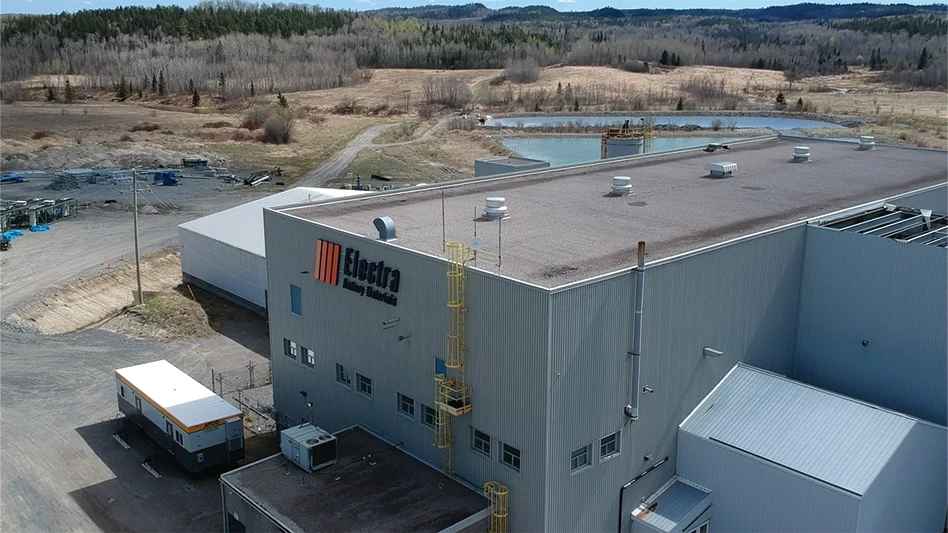
Photo courtesy of Electra Battery Materials Corp.
Battery recycler Electra Battery Materials Corp., Toronto, has started metallurgical testing on cobalt feedstock from two North American sources with the aim of strengthening and diversifying its cobalt refinery feedstock pipeline by integrating domestic sources alongside existing global supply partners.
The company says its initiative supports the development of a robust, flexible and resilient North American critical minerals supply chain while maintaining strategic relationships with partners such as Glencore and ERG. These domestic feedstock sources, gathered from the company’s Cobalt Camp in Ontario—also the home of the company’s refinery—and its Iron Creek cobalt and copper project in Idaho, are intended to supplement its existing international feedstock agreements.
RELATED: Electra working toward restarting cobalt refinery construction
Preliminary results from Electra's North American feedstock program are expected by the end of this year and will inform potential front-end flowsheet modifications, such as the proposed addition of a pressure oxidation (POX) circuit to enable processing of a broader range of complex concentrates.
Electra says its in-house laboratory is in the process of installing equipment required to evaluate these new feedstocks.
Backed by its technical team, the company's lab will conduct bench-scale testing and analytical work to validate and refine proposed flowsheet enhancements to the leach circuit designed to process North American materials at the company’s hydrometallurgical refinery, including arsenic-bearing polymetallic sulfide materials.
“These tests will give us a clearer picture of how North American cobalt-bearing concentrates can be processes using Electra’s hydrometallurgical technology,” says Dr. George Puvvada, Electra’s vice president of metallurgy and technology. “North American concentrates often contain elevated levels of arsenic and other impurities, which have made them difficult to process using conventional methods. Building on the successful completion of the company’s black mass recycling test program, I believe we can responsibly recover critical metals from North American feeds and significantly expand the range of materials our refinery can process.”
Electra CEO Trent Mell says that many North American cobalt-bearing mineral resources have remained underdeveloped due to mineralogy that is “incompatible with conventional smelting and refining,” adding that the company’s hydrometallurgical process “offers a potential domestic solution to that challenge, aligned with the battery market and geopolitical imperatives.”
“With critical minerals independence now a clear policy priority, we are focused on developing localized midstream solutions that support both the U.S. and Canadian supply chains,” Mell says. “Our facility is designed to evolve alongside market needs, and this initiative positions Electra to play a leading role in that transformation.”
The company says initial testing includes feed from legacy deposits in its cobalt mining camp near the refinery, as well as cobalt-bearing material from the Iron Creek project in the Idaho “Cobalt Belt,” which it claims is one of the few known primary cobalt resources in the U.S.
Electra says test results will guide potential front-end modifications to its leach circuit that would allow for broader acceptance of arsenic-bearing polymetallic sulfide concentrates. While the current focus is on cobalt-copper and cobalt-silver feedstocks, Electra says it believes its proposed flowsheet enhancements also may be applied to custom treatment of gold concentrates with elevated arsenic levels.
Electra’s refinery project is backed by a long-term offtake agreement with LG Energy Solution for up to 80 percent of output over the first five years. The company says the facility is designed to process cobalt hydroxide feedstock from the Democratic Republic of Congo and convert it into battery-grade cobalt sulfate for use in lithium-ion batteries and energy storage. Early site work currently is underway to prepare for a resumption of full-scale construction, with future growth phases targeting battery recycling and expanded feedstock sourcing opportunities.
Latest from Recycling Today
- Nth Cycle signs offtake agreement with Trafigura
- WeSort.AI recovers critical raw materials from recycling plants
- ReMA provides economic impact report, industry update
- Collective Waste Solutions acquires Alcop Resource Recycling transfer station
- Volatility continues in nonferrous metals
- Neste chemical recycling plant is ready to scale up
- Indonesia’s nickel pig iron spigot reopens
- Ecore says study backs crumb rubber use on sports surfaces