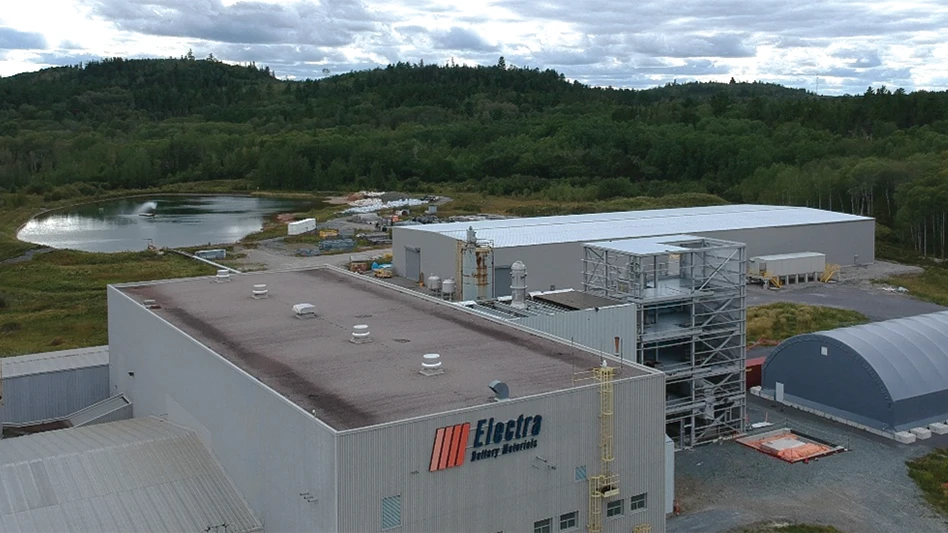
Photo courtesy of Electra Battery Materials Corp.
Electra Battery Materials Corp., Toronto, recently announced the approval of a $73 million ($100 million Canadian) construction budget for its planned cobalt sulfate refinery in Ontario, as well as an execution schedule to reach its mechanical completion.
The company says it expects commissioning to begin in the fourth quarter of this year, with mechanical completion targeted for the second quarter of 2027. Production ramp-up is expected to start in the third quarter of 2027, with commercial production expected for the fourth quarter.
“Our mandate is clear,” Electra CEO Trent Mell says. “We are advancing this refinery to completion with a defined budget, schedule and execution plan. This is a fully permitted brownfield asset with substantial infrastructure in place and funding commitments from allied governments. With major equipment procured and construction sequencing defined and baselined, we are positioned to transition from reactivation to full execution.”
Electra notes that the construction budget reflects updated, detailed engineering, contractor input and current market pricing and is intended to fund all remaining construction activities through mechanical completion. Also, the company says the majority of major mechanical and electrical equipment has been procured and long-lead items delivered to the site.
Funding and support
Electra says it has arranged approximately $82 million in aggregate financial support to fund the refinery’s construction, including $48 million in government grants and loans and $34 million in equity financing completed in October 2025. The refinery has secured funding from the U.S. Department of Defense, the government of Canada and the province of Ontario.
The company says it also has begun discussions with the lenders of its senior secured credit facility to amend certain terms of its existing credit agreement dated Oct. 22, 2025. Electra says the proposed amendments are intended to support ongoing negotiations to implement the previously announced construction funding by allowing the company to incur up to $27 million of debt financing from government entities, some or all of which may be secured. Electra adds that there can be no assurance the lenders will agree to any such changes to the current terms of the loan agreement.
Electra says capital requirements beyond mechanical completion primarily will relate to commissioning, operational readiness, initial working capital and corporate costs as the refinery transitions to commercial production. Commissioning and ramp-up expenditures are expected to be approximately $15 million.
Refining capabilities
Electra says its refinery is designed to initially produce 5,120 tons of battery-grade cobalt sulfate per year and expects its nameplate capacity to generate “meaningful revenue” from the cobalt sulfate product it plans to supply to the North American and allied markets.
The company says its crystallizer circuit has a nameplate capacity of 6,500 tons per year, providing a pathway to expand production by approximately 27 percent beyond initial nameplate capacity. The company says it is targeting optimization toward the full 6,500-tons-per-year level in 2028 through incremental capital investments, operational improvements and debottlenecking initiatives.
Engineering studies to evaluate expansion to full crystallizer capacity will be completed during initial commissioning and ramp-up and will incorporate plant performance data and operating insights generated during early production, Electra says.
Once fully ramped up to 6,500 tons, Electra says it expects its refinery to represent an estimated 27 percent of world supply excluding China, and approximately 5 percent of total global cobalt sulfate supply, based on current market data provided by United Kingdom-based Darton Commodities.
Electra claims it has feedstock supply arrangements with “leading global cobalt producers and trading counterparties,” including minerals mining and recycling giant Glencore Plc and others. Electra also has entered into a long-term tolling agreement framework with LG Energy Solution, which is expected to account for about 60 percent of initial production over the first five years of refinery operations.
Electra says the refinery is a fully permitted brownfield site that previously produced nickel and cobalt and retains “substantial” existing infrastructure, including utilities, process buildings and site services. The company claims the site will be North America’s lone battery-grade cobalt sulfate production facility upon commissioning and address a key vulnerability in the regional battery materials supply chain, adding that much of the world’s refining capacity for battery-grade cobalt is concentrated in Asia.
“Cobalt refining is a strategic capability for North America,” Mell says. “By bringing this facility into commercial operation in 2027, we will establish the only battery-grade cobalt sulfate production capacity in the region, strengthening allied supply chains and anchoring critical minerals partnerships within North America. The United States and allied governments have increased engagement with producing nations to support secure and responsible cobalt supply chains. This refinery provides the midstream capability required to convert upstream resource partnerships into domestic cobalt supply for North American markets.”
Latest from Recycling Today
- Novelis' Greensboro, Georgia, plant site of fire
- NWRF named to “Best of CES” list
- Glass Recycling Foundation releases 2025 Impact Report
- Qatalum curtailing aluminum production
- Baltimore launches ‘oops’ tag recycling initiative
- Cullet acquires Repeat Glass assets, establishes Cullet Ohio
- Nucor announces executive retirement
- Permit approved for C&D transfer station, recycling center in Georgia