Image courtesy of Ascend Elements
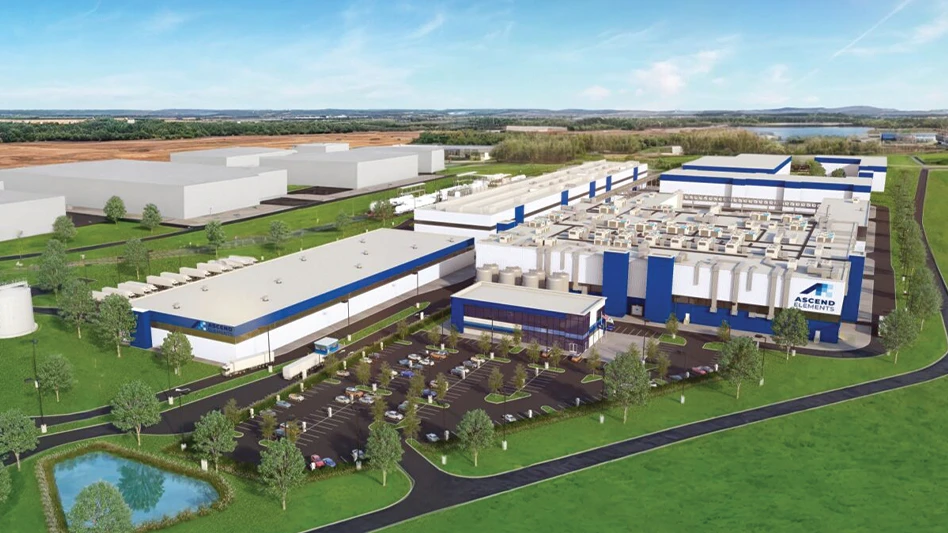
The Trump administration has canceled part of a $316 million grant the Department of Energy (DOE) awarded lithium-ion battery recycler Ascend Elements for construction of its Apex 1 plant in Hopkinsville, Kentucky.
According to federal grant information provided by USASpending.gov, Ascend had received $206 million for the Hopkinsville site. The company says it will use other means to make up for the loss of about $110 million.
RELATED: Ascend produces recycled lithium carbonate from used LIBs | Minding the mission
“The DOE’s decision regarding the grant doesn’t change our trajectory,” Ascend President and CEO Linh Austin says in a statement. “We’re moving forward.”
Austin notes the company already is producing recycled lithium carbonate at commercial scale at its Base 1 facility in Covington, Georgia, with a purity of more than 99 percent, and is scaling output in the U.S. and Europe toward approximately 15,000 metric tons annually by 2027.
He adds that the company’s funding path is diversified beyond the DOE.
“We are replacing the remaining unused portion of the DOE grant with a mix of other sources of funding available to the company, including equity, project finance, municipal bonds and other forms of debt,” Austin says.
Ascend was included in a recently announced wave of DOE funding cuts totaling $7.5 billion. In all, 321 financial awards were terminated for 223 projects. Awards were issued by the Biden administration via the Offices of Clean Energy Demonstrations, Energy Efficiency and Renewable Energy, Grid Deployment, Manufacturing and Energy Supply Chains, Advanced Research Projects Agency-Energy and Fossil Energy.
“Following a thorough, individualized financial review, DOE determined that these projects did not adequately advance the nation’s energy needs, were not economically viable and would not provide a positive return on investment of taxpayer dollars,” the department says in an Oct. 2 announcement of the cuts.
According to Secretary of Energy Chris Wright, the department has reviewed billions of dollars in financial awards, “many rushed through the final months of the Biden administration with inadequate documentation by any reasonable business standard.”
Of the 321 terminated awards, the DOE claims 26 percent were awarded between election day in November and inauguration day in January. Affected award recipients have 30 days to appeal a termination decision, and the DOE says some of those recipients have begun that process.
Headquartered in Westborough, Massachusetts, Ascend was awarded the DOE grant in October 2022 and broke ground on its 140-acre Hopkinsville site soon after. At the time, the company said it planned to invest nearly $1 billion in the project, claiming Apex 1 would be the largest electric vehicle (EV) battery recycling and engineered materials manufacturing facility in the U.S.
The sprawling campus initially was expected to create 400 full-time jobs—making it the single largest investment in Western Kentucky—and produce enough cathode active material (CAM) and precursor cathode active material (pCAM) to power 250,000 EVs per year, though that trajectory has changed somewhat over the past year. Materials the company specializes in developing include lithium carbonate, nickel sulfate, cobalt sulfate and manganese sulfate from black mass.
“While construction at Apex 1 is paused, we will restart beginning in 2026, with both lithium extraction and pCAM lines aligned with commercial offtakes,” Austin says in his statement regarding the DOE funding cut. “Our business economics are not predicated on grants, but by customer demand, operational excellence and our patented Hydro-to-Cathode technology.”
Construction of the Apex 1 campus has been on hold since late 2024. In April, the company told area media outlets that changing market conditions led to several major customers requesting to push back the start of the facility’s pCAM deliveries by 12 to 18 months, prompting the pause. At a Hopkinsville City Council meeting the same month, Plant Manager Mark Fern said construction would resume once the facility’s design phase is completed.
In February, Ascend came to a mutual agreement with the DOE to cancel a $164 million grant intended to fund CAM manufacturing infrastructure at Apex 1, citing changing market conditions that caused demand for domestic pCAM to exceed demand for CAM. Going forward, the company said it would focus on producing only pCAM and lithium carbonate in Hopkinsville.
“By voluntarily returning the CAM grant, we are freeing up $164 million of federal funding for the current administration to reallocate as it deems most appropriate,” Ascend Vice President of Government Affairs Roger Lin said at the time, adding that the Apex 1 project “squarely aligns” with the Trump administration’s goal of increasing domestic production of critical materials. “We are committed to creating good jobs in Kentucky, providing a domestic supply of lithium-ion battery materials and enhancing U.S. energy independence.”
Latest from Recycling Today
- Fleetio launches AI capability to accelerate fleet maintenance approvals
- The Metals Agency receives approval for export credit insurance
- Recycle Ann Arbor extends drop-off station operating hours
- Sybilion seeks to help manufacturers confidently address volatility
- Rio Tinto, Prysmian partner on low-carbon aluminum solutions for data centers
- Unilever criticized for plastics approach
- USTR to study additional steel, aluminum tariffs
- Electrified Materials adds processing capacity