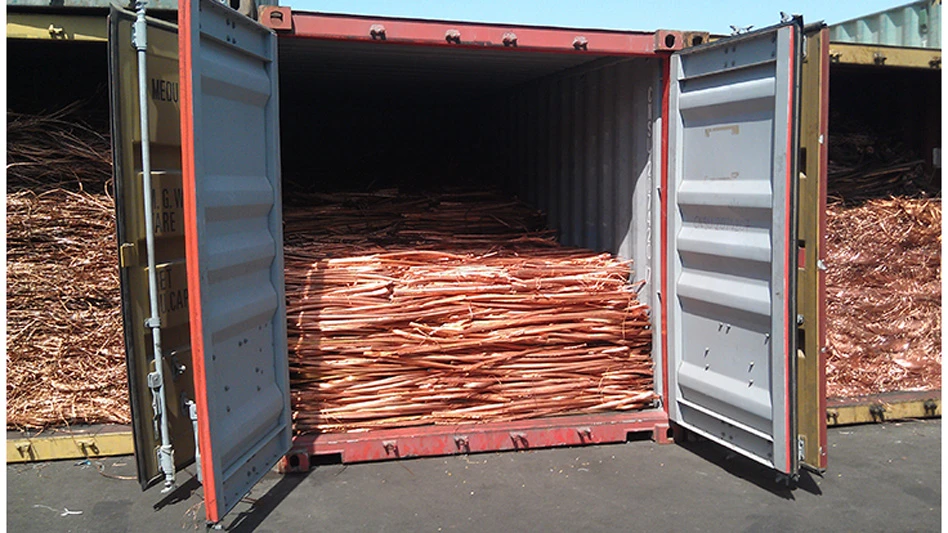
Demand for copper should regain momentum globally in 2002, but an overhang of supply is likely to keep a lid on prices.
Speaking to attendees of the Spotlight on Copper at the Institute of Scrap Recycling Industries Inc. (ISRI) Annual Convention in Las Vegas, Steven J. Butler of Asarco was blunt in saying it is a difficult time to be in the copper industry.
Phoenix-based copper mining and smelting company Asarco experienced “consistent losses and negative cash flow in 2001,” said Butler, who added that “no one anticipated a three percent to 3.5 percent decrease in demand in 2001.”
Butler said there is an upside potential for copper, however, with the resurgence of the economies of the former Soviet Union as one hopeful factor. “I believe they’re about five years behind the Chinese in terms of [developing] a market,” said Butler. “The infrastructure is there for those countries to experience tremendous growth.”
He noted that a few years ago Chinese buyers would go in and out of the market quickly, much like Russian buyers today.
John E. Gross of J.E. Gross & Associates, Huntington, N.Y., predicted that copper consumption will be back on the rise this year, but that the increased demand will not lead to rapidly rising prices. “Copper consumption should rise, reflecting a stronger economy, but the bad news is there are still record high inventories,” he remarked.
With the exception of Japan, the economies of the major industrialized nations are being forecast to demonstrate growth in 2002, Gross noted.
Speculators may also play a factor in copper prices in 2002, Gross predicted. Many speculators began buying in late 2001, with many of them pegging October and November as being the trough in base metals demand. “You can’t ignore the influence they have on the market,” said Gross.
Gross predicted that copper prices would average slightly higher in 2002, perhaps in the 75 cents per pound range. Once current inventories are worked through, recent production cutbacks could again lead to the days of $1.00 per pound copper, he remarked. “It’s not unrealistic to say we could see $1.00 per pound copper again—maybe in a year or two.”Latest from Recycling Today
- 2026 Plastics Recycling Conference: Diving into SB 54
- Commentary: Plastic recycling isn’t working; what are we going to do about that?
- Environmental groups urge Indonesia to return e-scrap shipments
- Foodservice Packaging Institute opens applications for 2026 foam recycling grant program
- Worn Again Technologies unveils Accelerator plant to advance polycotton recycling
- Nashville Waste Services launches new digital route system
- Arconic expands in Iowa
- Cascades invests $6.9M in recycled boxboard plant