A flurry of mergers and acquisitions leading to paper mill consolidation was one of the clearest patterns noted by panelists at a session on secondary fiber trends held at the Paper Recycling Conference & Trade Show. The event, hosted by the Recycling Today Media Group, was held in Chicago in late June.
Paper companies are also increasingly choosing to use scrap paper as their feedstock of choice, moderator Pete Grogan of Weyerhaeuser, Federal Way, Wash., noted. “The majority of new production in the mill industry—at least 65%--will be based on recovered fiber,” he commented.
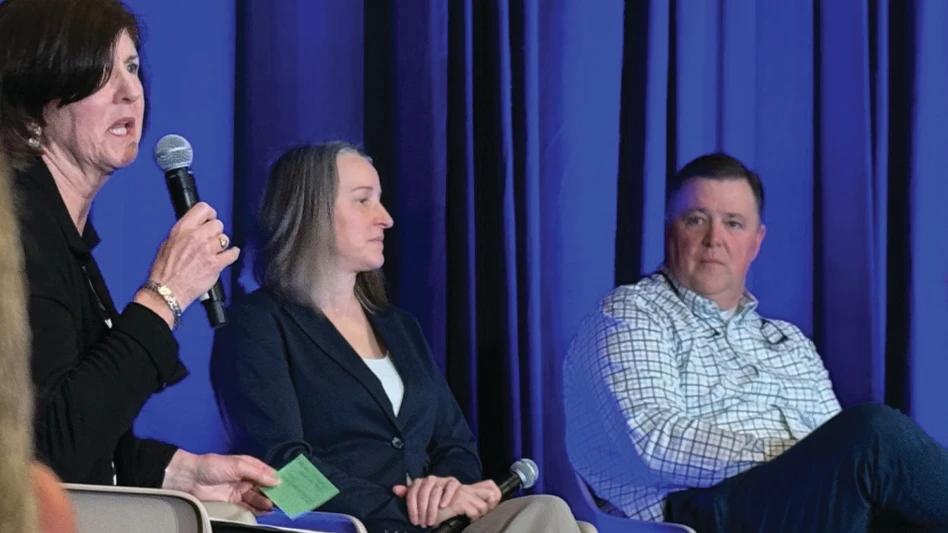
The consolidation of the once-fragmented paper industry was observed by panelists Bruce Fleming, of recycling company Canusa Corp.; Ben Harvey of solid waste and recycling company E.L. Harvey and Sons Inc., Westboro, Mass.; Baltimore, and David Niessner, of International Paper, Stamford, Conn.
“The bottom line is, look for more consolidation and fewer suppliers,” Fleming told attendees. To both compete with consolidating recycling companies and to serve smaller mill customers, Fleming outlined some of Canusa’s partnership strategies with generators and paper mills that have helped the company keep its volume procurement and pricing competitive. (A complete look at Fleming’s presentation can be found in the July 2001 issue of Recycling Today.)
Independent recycler Harvey credited technology improvements for helping his company stay competitive with publicly traded consolidators in the solid waste and recycling industries. Harvey’s company is also moving toward the expanded use of long-term contracts with consumers. “In a market like today’s, movement is the critical key.”
The New Englander noted that his company strives to achieve a familiarity with customers similar to what patrons enjoyed at the tavern in the television show “Cheers.” “Our customers want to be known, and our familiarity with them can help counter the confusion caused by consolidation. We strive to maintain a one-on-one relationship with our generators and on the mill side. Service is even more important than price.”
While E.L. Harvey & Sons has been competing with consolidating waste haulers for some time, Ben Harvey says the ability of large recyclers to offer floor pricing to generators “is something our company cannot do. That could change the whole dynamic of what we do.”
International Paper’s Niessner, who is the company’s manager of recycled fiber procurement, noted that even after the recent mergers, the paper industry is “still pretty fragmented next to the oil industry or the auto industry.”
The four largest containerboard companies held 40% of the U.S. market in 1996, while by 2000, the four largest companies had 55% of the market, according to Niessner.
Centralized buying by mill companies is an issue of concern to brokers and to independent recyclers like Harvey, the panelists noted. “The role of the brokers is really being diminished as we handle more of our fiber internally,” said Niessner.
Latest from Recycling Today
- Greenwave raises revenue but loses money in Q2 2025
- Recycled steel prices hold steady
- EY says India’s need for scrap imports will continue
- Coming full circle
- Amcor, DCM introduce fertilizer packaging with 35 percent recycled content
- Comstock Metals gets closer to commissioning commercial-scale solar panel recycling facility
- Washington selects Circular Action Alliance as PRO
- Smurfit Westrock expands in Latin America