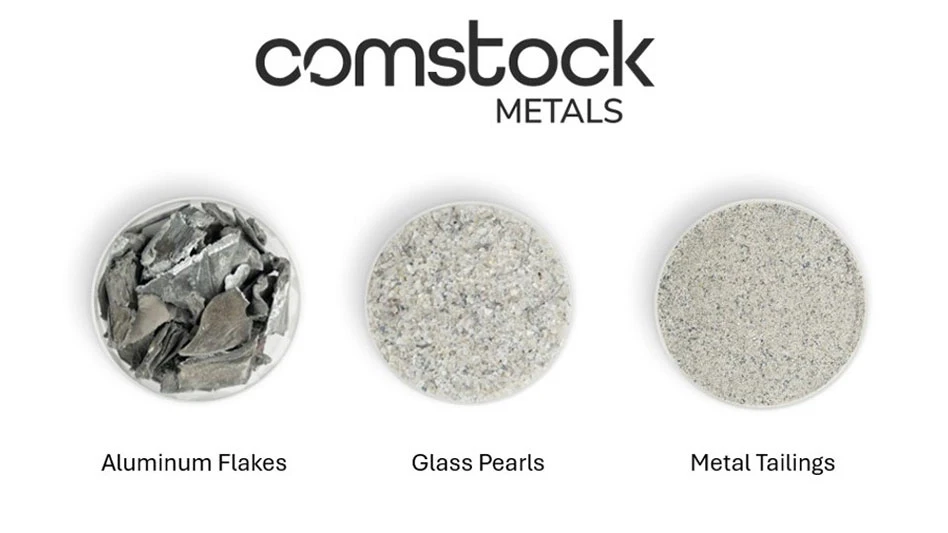
Photo courtesy of Comstock Metals
Comstock Metals LLC, a subsidiary of Comstock Inc., Virginia City, Nevada, was founded a little more than two years ago to provide full-service zero-landfill recycling of solar panels, including cylindrical, monocrystalline, polycrystalline, thin film, bifacial, concentrator and double glass.
The company, led by President Fortunato Villamagna, commissioned a 5,000-ton (200,000-panel-per-year equivalent) commercial demonstration facility in Silver Springs, Nevada, in January 2024 and has worked to secure a permit that will allow Comstock Metals to store panels. It still is awaiting the permit to construct its 100,000-ton commercial sale facility adjacent to its current facility, which the company expects to receive in September or October.
Villamagna, who has decades of experience working in different sectors of the waste and recycling industry, including more than 10 years as CEO of Paragon Waste Solutions & Paragon Southwest Medical Waste, founded Comstock Metals in March 2023, having approached Comstock Inc. with a proposal for a solar panel recycling solution that could eliminate heavy metal contamination before final separation, a problem that has plagued the solar industry nationwide.
Villamagna, who has a Ph.D. in physical and computational chemistry, holds 35 patents and successfully commercialized numerous technologies, particularly in emission control and waste destruction.
“I was looking at getting into the battery recycling business like everyone else,” he says. “I had been looking at the space for some time, but the waste stream wasn’t going to mature at a volume that would make that business work for some time.”
However, the solar panel recycling waste stream already had hit that inflection point, he says, and the environmental problem is much more urgent as most panels were winding up in landfills and no one had a solution that would eliminate the heavy metal contamination.
“It was still being crushed and sent downstream back into the environment,” he says. “I saw that opportunity to solve an industrywide challenge and help bring peace of mind to solar operators and owners by removing that legacy liability problem.”
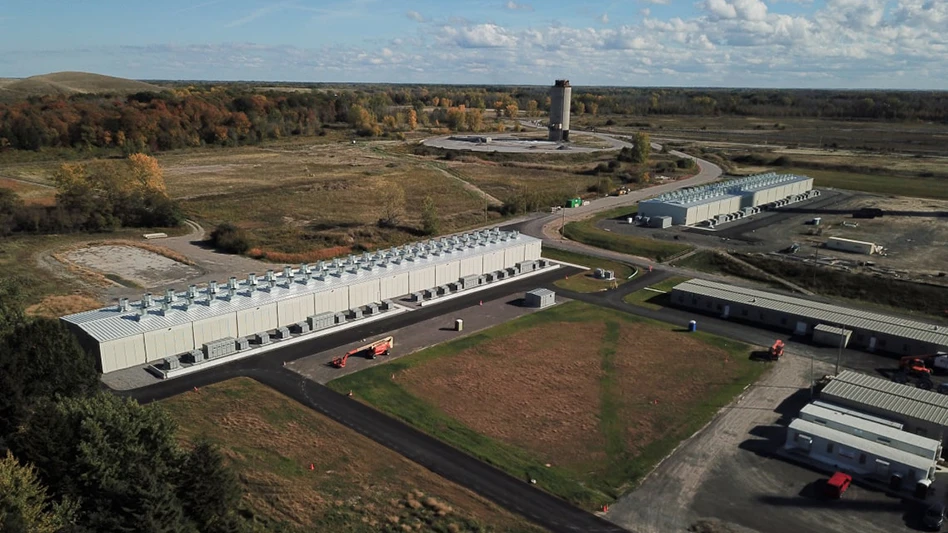
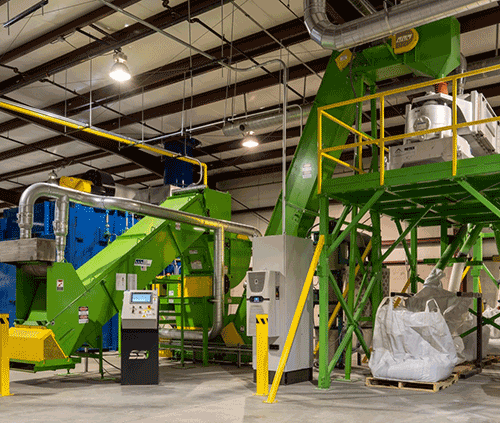
Comstock Metals began processing panels in early 2024 at its Silver Springs demonstration facility, and the 7,500-square-foot site uses the company’s proprietary delamination technology.
“It is currently what we define as a batch system, so the panels go through controlled, consecutive stages with low operator intervention in between,” Villamagna says.
The process
Comstock Metals’ process involves primary size reduction, which shreds incoming panels to a certain particle size, he says, before the material enters delamination reactors. That is followed by a second size reduction process, mechanical screening and separation and bagging.
Solar panels generally are comprised of silicon wafers, a layer of plastic, a layer of wiring, a layer of plastic and a layer of glass that also can be laminated with plastic. These plastic layers are about 100 microns thick.
“So, while it isn't a huge amount of plastic, it's highly problematic," Villamagna says.
He says the plastics are fully decomposed to carbon dioxide and water vapor in Comstock Metals process, and eliminating those plastic layers frees all those components, and the secondary particle size reduction process enables them to fall apart from one another.
“The aluminum comes out clean. The glass comes out clean," Villamagna says.
Comstock Metals says its process eliminates all the heavy metal contamination that sticks to adhesives, encapsulant and plastic laminates in solar panels, which Villamagna says is the real problem, prior to final material separation.
Comstock Metals’ system will not require operator intervention at any stage in the process, apart from loading the panels into the system. Villamagna says the company is investigating using robotics for that job.
“So, once an operator brings a pallet with panels, an arm will transfer them on the conveyor," he says. “It's a little more convoluted to do the offloading robotically, but there are systems out there that we're looking at.”
The key is speed and throughput in terms of panels per hour and the ability to eliminate heavy metal contamination. Additionally, the company’s process, from decommissioning and recycling to where the clean materials are shipped, is third-party certified and audited.
Running the system today requires two people per shift. Other facility personnel handle maintenance and logistics, which is the most complex part of the process. By way of illustration, Villamagna mentions an 80,000-panel job near Fresno, California, that Comstock Metals recently handled that involved receiving more than 150 trucks in the space of two weeks.
The expansion plan
Its experience to date has allowed the company to obtain design data for future plants and learn more about the various makes and models of solar panels, with Villamagna saying they all behave differently in the recycling process.
With the knowledge and experience Comstock Metals has captured by operating its commercial demonstration facility, and developing a national network of partners and customers, the company is positioned to build out its first large-scale facility on the same campus within the next 18 months, he says.
The new facility will occupy a 120,000-square-foot building equipped to process roughly 100,000 tons per year of solar panels. In addition to its larger scale, the commercial facility will have a continuous rather than batch-fed process.
“The only manual intervention will be at the very front end and at the very back end where we take the offtake,” Villamagna says.
“The world is plowing ahead, really, at an unprecedented speed installing panels,” he adds, with few companies that are installing panels thinking about what will happen to them when they reach their end of life. “Effectively, that's what we're offering.”
The decommissioning process can involve generating tens of thousands of solar panels at once at a site.
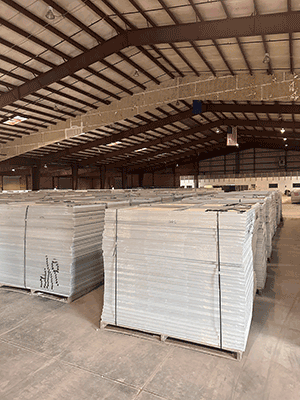
“You don't get 100 panels a day. You get 100,000 panels in one shot until the next decommissioning project," Villamagna says. "Clearly, any operating facility will need a number of satellite aggregator facilities to simplify the logistics.”
Such sites also can act to buffer the flow of panels until the primary facility can process them, he adds.
“We've been very successful at permitting a secondary storage facility for us that buffers our flow,” Villamagna says, noting the regulatory constraints around universal waste, which is how California and Nevada categorize end-of-life solar panels. “Believe it or not, there's an arcane EPA [Environmental Protection Agency] rule still in effect that if a facility is operating, destroying universal waste, you can't store it on the same site.”
Despite being on 25 acres in Silver Springs, this rule required Comstock Metals to site a separate storage facility, which the company did in Lyon County.
Comstock Metals’ Nevada location is strategically located.
“Roughly half of the panels in the entire country that are ready to come offline and into the recycling market are sitting in California,” Villamagna says. “If you do California, Arizona [and] Nevada, it's almost 70 percent.”
He adds that roughly 90 percent of solar panel waste is coming out of the states that are closest to its Silver Springs location, though Florida also is generating end-of-life panels and represents a growing market.
“Shipping material from Florida to Nevada is not the best solution, so the sooner we can put a plant on the ground, the better it will be for both parties,” Villamagna says, adding that logistics can account for one-third of the cost of recycling solar panels. “If the customer’s in the Northeast, and all the recycling assets are in the Southwest, that may be as much as half of the total cost. So that proximity and that distribution network are critical.”
In addition to Florida, the areas Comstock Metals is targeting for additional processing and aggregation sites are southern Nevada, Texas, the Carolinas and the Northeast.
“Our 100,000-ton-a-year facility represents what we believe is about 10 percent of the market by 2030,” Villamagna says. “So, in principle, we would need 10 of those plants.
“The numbers I've quoted are actually conservative,” he adds. “If you look at the total installed base in the U.S., there are over a billion panels out there, so even those 10 plants aren't going to cut it in terms of capacity.”
He adds that Comstock Metal is selling peace of mind above all else.
“So, if you send your panels to Comstock Metals for recycling, you know they will be recycled and heavy metal contamination will be eliminated; they're not going to show up as some modified product six years from now, oozing lead and contaminating the surroundings. And we wanted to provide that with supporting evidence that we are recycling. It's real. We can show you where the materials go. We can show you what happens to them.”
That desire led Comstock Metals to seek and obtain R2V3 Appendix G – PV Modules and RIOS (Recycling Industry Operating Standard) certifications, which the company received in June.
Villamagna says the company opted for RIOS certification, which was developed by the Recycled Materials Association, because of its rigor relative to ISO 14001.
“RIOS is by far the better product,” he says. “If we were ISO certified, I would say we're sending the material to X, and as long as it always goes to X, you can tick the box. Whereas in the other system, they actually evaluate X. They audit X, and they have continual annual audits of X so that you can provide that guarantee in terms of a real circular process.”
In terms of the startup of its Silver Springs commercial-scale facility, Villamagna expects to have all facility permits sometime in the third quarter of this year.
“As soon as we're somewhat confident about Q3, we'll start ordering the equipment, which will arrive towards the end of Q4—lead time on the equipment's about three months—and then we'll start the integration process, the commissioning and start up," he says. "If everything goes well, we should be operational in that facility this time next year.”
Comstock Metals recently signed a master services agreement (MSA) with RWE Clean Energy, the U.S. subsidiary of leading global energy company RWE, serving as a preferred, strategic partner for the recycling, disposal and decommissioning services for RWE’s solar installations. The company says it also has been engaged by other companies to decommission and dispose of their end-of-life solar panels.
Latest from Recycling Today
- Murphy Tractor partners with Humdinger Equipment
- Shapiro announces promotion
- Carton recycling scrutinized in California
- SACO AEI Polymers recognized for sustainability practices
- ArcelorMittal says France EAF remains on track
- Greenwave appoints chief financial officer
- Commentary: A turning point for flexible plastics recycling
- EcoATM announces 7.5M devices collected in 2025