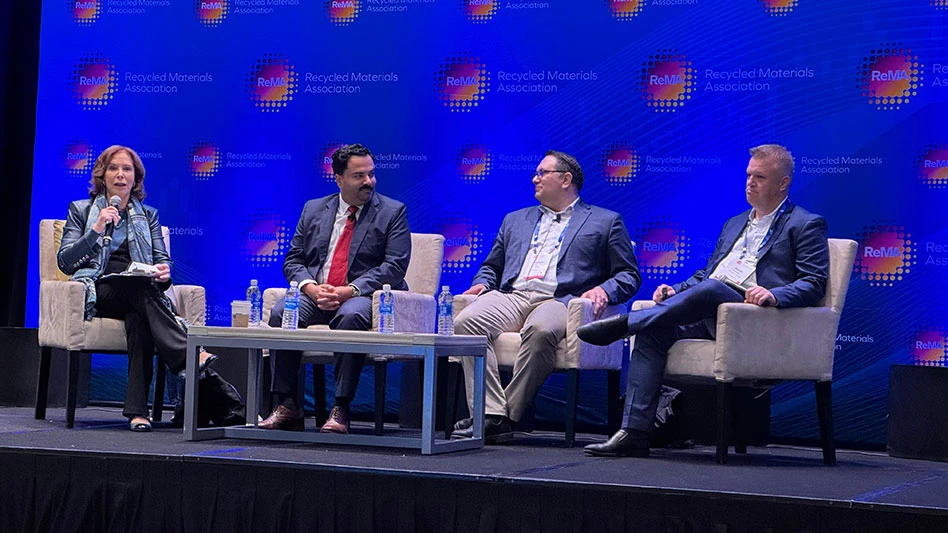
From left: Terry Savage, Naveed Moghadam, Joshua Werner and David Brooks
Copper has an intimate link with the economy given its use in the building and construction sector, power generation and transmission and manufacturing. Data centers for artificial intelligence and electric vehicles also require copper, likely increasing future demand for the red metal, according to financial journalist Terry Savage, moderator of the Copper Roundtable during the ReMA (Recycled Materials Association) Roundtables 2025, Sept. 10-12 in Chicago.
The red metal’s value should increase with its demand, but recent events introduced considerable volatility to the COMEX copper price and were not connected to true physical demand but to the anticipation of constrained cathode flow into the U.S.
Pittsburgh-based David Brooks, global head of metals at Argus, said copper’s value spiked considerably in early July when President Trump announced that a tariff on copper imports would be introduced the following month because the market assumed cathode would be included. “The market went crazy in the U.S.,” he said. “People started delivering copper into the U.S. as fast as they possibly could. And the price of copper on COMEX, on the CME, diverged from the LME [London Metal Exchange] price,” reaching a historically wide arbitrage of more than $1.25 as a result.
“And then, barely three weeks later, it turned out that we weren’t talking about a tariff on copper cathode but on copper products. And so that obviously has an altogether different meaning,” Brooks said, which resulted in a steep decline in the value of copper on the COMEX.
While Brooks said it should have been obvious that cathode would not be included in the Section 232 tariffs given the U.S.’ dependence on these imports, it appears no one expected that based on how the market behaved.
He added, “Obviously, the tariff on products is designed to encourage new mills … and encourage more domestic production of tubes and wires and everything we’re going to need for the energy transition.”
U.S. cathode inventories grew over the month of July to reach 300,000 tons compared with 40,000 tons a year ago, Brooks said, adding that this material can leave the U.S. market as quickly as it entered it. Brooks noted that U.S. CME copper inventories increased again the week of Sept. 8 when the CME recognized a new warehouse in New Orleans.
“It’s important to note that this is not a global increase in inventories,” he said, but rather a moving around of inventories from Shanghai Exchange and LME warehouses to CME warehouses.
China, a major consumer of U.S.-generated copper scrap, placed a 34 percent duty on these imports in April as part of its retaliatory tariff package, Brooks said, which led to an increase in the discount seen for copper scrap prices relative to the COMEX price. “I think we’re starting to see the Chinese sort of return to the market, albeit not necessarily directly,” he added. “Some of the U.S. exports are finding their way to China by Japan or Korea and so forth” as those discounts have contracted from 60 cents per pound to a typical range of about 20-30 cents per pound.
Naveed Moghadam, commercial director at Germany-based Aurubis, which has a U.S. scrap-fed multimetal smelting facility it is starting up in Georgia, said the run-up in the COMEX copper price in anticipation of the Section 232 tariffs had a tremendous impact on the market because suppliers who were used to buying and selling on COMEX at very steady discounts “had the rug pulled out from under them.
“If you were stuck without a place to sell your material and a building inventory because your scrap buyers continue to buy, it could have been very painful. It was very painful for some of our suppliers in the market. Those suppliers that, let’s say, are actively participating in the export market were able to balance their positions by increasing their LME hedges and reducing their COMEX hedges. But it was still painful. It’s just the degree of pain that you felt depending on whether you had access to the export market or not.”
Regarding Aurubis’ $800 million investment in Augusta, Georgia, he said the company wanted to have first-mover advantage in the U.S., which it sees as a key and growing market. Additionally, the U.S. energy prices are advantageous compared with the E.U., and the reshoring initiative lends positive tailwinds.
Aurubis has invested in industry-leading sampling and assay capabilities at the site, allowing the company to give the most scientifically accurate representation of elements contained in incoming material, Maghadam said.
“We’re very excited to open our doors and bring in a variety of feeds that otherwise go for export right now, typically to Southeast Asia,” he continued. “We’re looking at the copper fraction that comes off of auto shredding and separating—the ReMA term is zebra—some people call it shredded reds.” Printed circuit boards also will be accepted, as well as insulated wire.
He adds that the copper scrap market is vast, with material moving in waves. “Sometimes copper chops are at a great price because the domestic mills are full. Sometimes they’re not because of the way that the market’s turned. Our job is to be flexible. We don’t reject materials because it’s got a little bit of silver. We don’t reject materials because it’s got a few [parts per million] of tin, or whatever it might be. But we want to be the catchall. We want to be the company that doesn’t reject the load. And that’s how we work with our partners.”
Also speaking on the panel was Joshua Werner, CEO of Recyera, a Kentucky-based company that offers a range of technical and engineering services, including recycling and refining solutions and services, process development, techno-economic analysis, consulting and workforce development.
Recyera has developed technology to sort material that traditionally has been too fine for hand or sensor sorting. The company operates two pilot plants producing 1-centimeter-by-1-centimeter and 1-meter-by-1-meter material.
It is developing technology that allows operators to tune the control system to handle variations in feedstock, an assay system and technology to remove additional elements to tune the available feedstock to yield the desired performance.
Latest from Recycling Today
- Fleetio launches AI capability to accelerate fleet maintenance approvals
- The Metals Agency receives approval for export credit insurance
- Recycle Ann Arbor extends drop-off station operating hours
- Sybilion seeks to help manufacturers confidently address volatility
- Rio Tinto, Prysmian partner on low-carbon aluminum solutions for data centers
- Unilever criticized for plastics approach
- USTR to study additional steel, aluminum tariffs
- Electrified Materials adds processing capacity