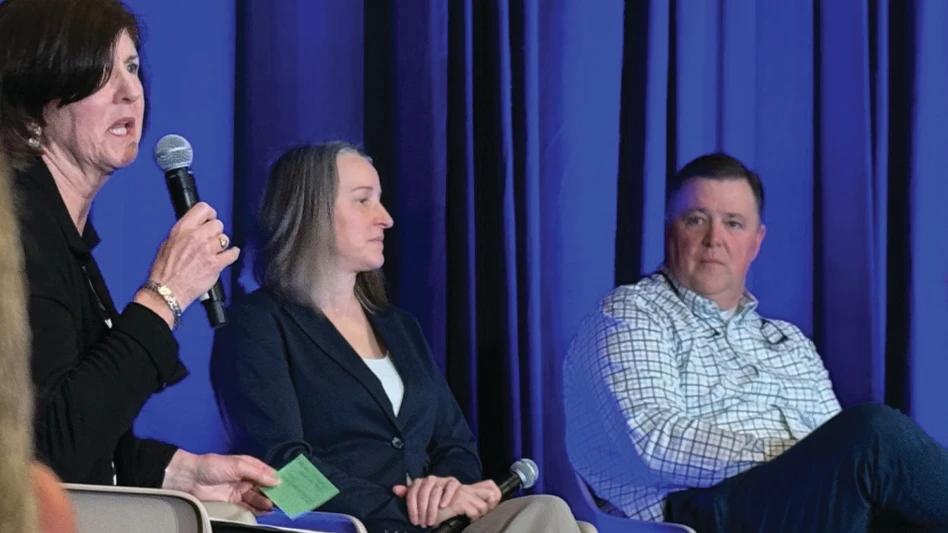
Chinese nonferrous metals producers have been scaling back their purchases of imported scrap, and this may be partially because of trade policies in China, said some members of a panel discussion at the 2015 Annual Convention of the China Nonferrous Metals Industry Association Recycling Metals Branch (CMRA). The event took place in early November in Ningbo, China.
Increased inspection regimens and fees imposed by a coalition of China’s customs and environmental agencies have been necessary to stem the shipment of substandard materials, said panelists, but several policies and procedures are unnecessarily burdensome or even off-target, according to some participants.
Robin Cai of Hong Kong-based Alter Metal Recycling Ltd., a subsidiary of United States-based Alter Trading Company, said Chinese regulators are considering allowing wider (non-licensed) importation of higher, cleaner grades of scrap, such as No. 1 and No. 2 copper.
The grades have not been problematic, are valued by metals producers and if misclassified shipments arrive the buyers will be as eager to reject them as any government inspector would, said Cai. She urged regulators to allow Chinese metals producers to have wider access to these materials, saying it would improve the competitiveness of Chinese companies in that sector
The current inspection regimen to ship these non-troublemaking materials can add $1,000 of cost per container, said Cai. “This is creating a higher cost for Chinese metals producers. These are high-demand quality products. If they do not come to China, they will flow to other countries.”
Robert Stein of Alter Trading Company expressed the same viewpoint. “It is not as if there are mountains of scrap looking for homes,” said Stein. For scrap exporters, “Rising costs in China have made this less of an attractive market for [many] materials,” he added.
Javier Ingles Fenoli of Spain-based Hermanos Ingles S.A. was more sympathetic to the existing China Certification & Inspection Group (CCIC) system, saying CCIC “plays a positive role” in dictating “who can do business in this field. CCIC plays a core role in protecting our environment.”
Cheng Jianhong of Yuyao, China-based copper producer Ningbo Shimao Copper Industry Co. Ltd. offered her perspective that current scrap inspection fees and processing requirements have caused her company to shift its focus away from using scrap as feedstock and instead to use cathode.
“We have used copper scrap for many years, but we have closed down that part of the business,” she stated. “China has lost its cost advantage as a scrap consumer,” she added. As a copper producer, Cheng said she is obligated to compare the value of scrap from different countries and also the value of using copper cathode.
Panelists agreed that regulators in China, as in all nations, will continue to change the regulatory climate in response to environmental and economic factors. Salam Al Sharif of United Arab Emirates-based Sharif Metals International supported China’s mission to regulate as it sees fit, but encouraged it to favor “regulations that boost business and are not suppressors.”
The 2015 CMRA Annual Convention was Nov. 7-9 at the Shangri-La Ningbo in Ningbo, China.
Latest from Recycling Today
- Charter Next Generation joins US Flexible Film Initiative
- Vecoplan to present modular solutions at IFAT 2026
- Terex Ecotec appoints Bradley Equipment as Texas distributor
- Greenwave raises revenue but loses money in Q2 2025
- Recycled steel prices hold steady
- EY says India’s need for scrap imports will continue
- Coming full circle
- Amcor, DCM introduce fertilizer packaging with 35 percent recycled content