The world’s leading recycling organizations can paint a compelling portrait of the scale of the global recycling industry, yet they also say the industry can do more to tell its own story. That was one of the messages they imparted in presentations at the 2015 Annual Convention of the China Nonferrous Metals Industry Association Recycling Metals Branch (CMRA). The event took place in Ningbo, China, in early November.
Alexandre Delacoux, director general of the Brussels-based Bureau of International Recycling (BIR), described the global recycling industry as consisting of 1.6 million employees collecting, processing and trading 800,000 metric tons of materials each year. The industry’s collective activities provide “50 percent of the world’s raw materials needs,” stated Delacoux.
Yet somehow, said Delacoux, the industry remains relatively hidden. “We suffer from a lack of recognition, despite the fact we [comprise] the center of the industrial world,” he stated. “We tell ourselves [about the industry’s scale], but how do we communicate with the rest of the world?” he asked CMRA attendees.
Delacoux urged Chinese recyclers and scrap consumers to be part of the solution. “China is going the right way, toward more recycling,” he commented, adding that informing the public “that recycling at their level is important” will be an ongoing task.
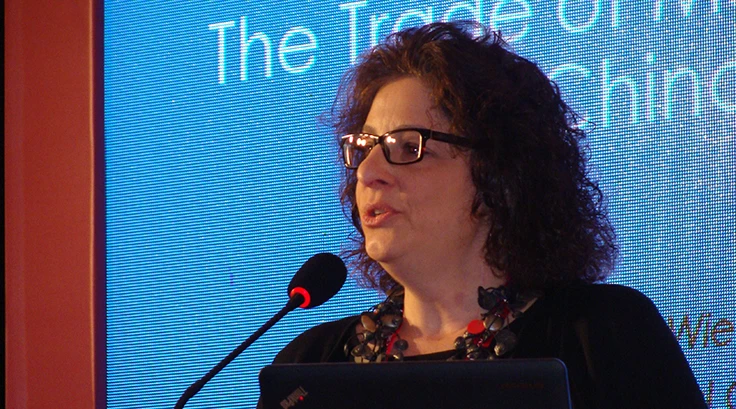
Robin Wiener, president of the Washington-based Institute of Scrap Recycling Industries (ISRI), urged Chinese recyclers to beat the drum for the “scrap is not waste” message that ISRI has preached for nearly two decades.
“Scrap is not waste is a very important concept,” she stated. “We believe very firmly the material you process every day is not a waste but a commodity. You are not processing it to avoid the landfill, but because it is a resource with value.”
When regulators and policymakers in China or anywhere else do not understand the distinction between scrap and waste they will regulate scrap as if it is a waste with no value, Wiener emphasized.
Salam Al Sharif, president of the Dubai, United Arab Emirates-based Bureau of Middle East Recycling (BMR), said the Chinese government’s emphasis on the “One Belt, One Road” initiative linking China with Europe through Central Asia and the Middle East, can only strengthen ties between the Middle East and China.
Sharif said some 20 million TEUs (20-foot equivalent units) of shipping containers are already handled at Dubai’s Jebel Ali trade zone each year, many of them traveling back and forth between the Middle East and China.
The Middle East’s growing economies with an active construction and automotive sector are likely to continue to serve as a source of nonferrous scrap for China, said Sharif, including aluminum extrusions and copper wire and cable.
With 2015 having presented challenges, Sharif noted, “It is a cyclical economy; we cannot expect good times always ahead of us. There is no business without challenges, but with a lot of teamwork we can overcome the barriers and difficulties.”
The 2015 CMRA Annual Convention was Nov. 7-9 at the Shangri-La Ningbo in Ningbo, China.
Latest from Recycling Today
- Equipment from the former Alton Steel to be auctioned
- Novelis resumes operations in Greensboro, Georgia
- Interchange 360 to operate alternative collection program under Washington’s RRA
- Waste Pro files brief supporting pause of FMCSA CDL eligibility rule
- Kuraray America receives APR design recognition for EVOH barrier resin
- Tire Industry Project publishes end-of-life tire management guide
- Des Moines project utilizes recycled wind turbine blades
- Charter Next Generation joins US Flexible Film Initiative