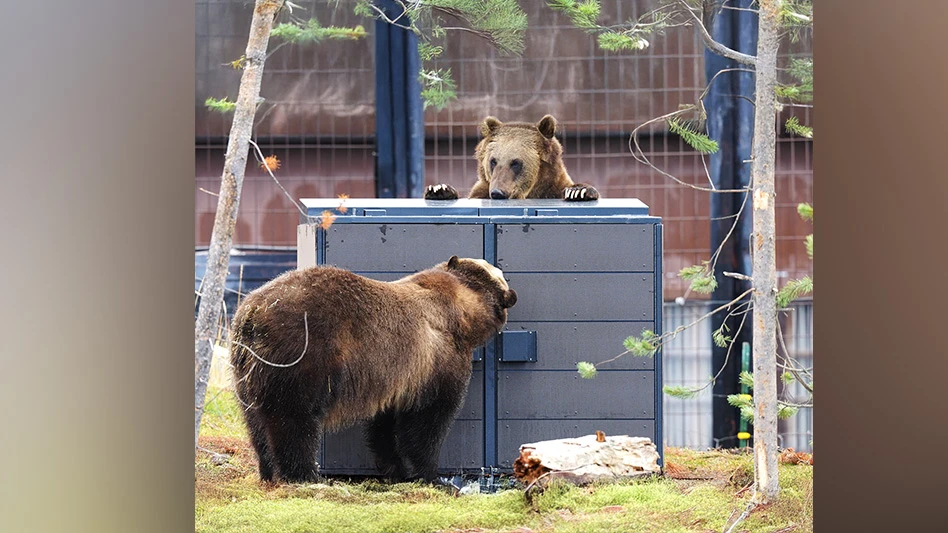
Photo courtesy of Citibin
Citibin, a New York-based manufacturer of storage containers and receptacles for waste and recycling, as well as other materials, has been certified as bear-resistant by the Interagency Grizzly Bear Committee (IGBC).
IGBC evaluates products for use in a grizzly bear habitat, such as campgrounds or national parks, and verifies the product has met the minimum standards relative to the effort a grizzly bear expends to access the contents of the product.
Citibin adapted its modular waste enclosure design to keep the wildlife out prior to the tests, earning its IGBC certification in August. The company has since released GrizzBin, a waste enclosure with each module capable of holding 3-5 full bags in a 96-gallon can designed for style and strength.
RELATED: Baltimore replaces litter baskets with Citibin waste enclosures
“It took us three years to get certification,” Citibin founder and CEO Liz Picarazzi says. “I was embarrassed by that at first, but now I’ve come to understand that’s exactly what the test is for. The first two times we failed we saw exactly why it failed, because we could see what the bear did to it, we had video of it.”
Part of IGBC’s process for a product to become bear-resistant certified includes a live grizzly bear test. In the test, a food or scent item is placed inside the test item as an attractant. Containers will also have a small amount of attractant (e.g., honey, peanut butter, fish oil, etc.) applied to the outside of the product at vulnerable areas, such as seams, gaps or latches.
Citibin’s primary markets include multi-family homes, HOAs, resorts and cities with ordinances requiring certified bear-resistance by IGB, Picarazzi says.
Citibin began as a residential waste solution for New York City residents, creating enclosures that could keep out rats. Picarazzi says GrizzBin was the next logical expansion, as people in areas with bears had requested Citibin create the enclosures after seeing the company's work in New York.
“If you put out food, rats are going to come,” she says. “If you put out food, bears are going to come. They're just doing what they do; they're driven to eat, to find food. If we don't secure the food, it's our own fault as humans."
Latest from Recycling Today
- Fleetio launches AI capability to accelerate fleet maintenance approvals
- The Metals Agency receives approval for export credit insurance
- Recycle Ann Arbor extends drop-off station operating hours
- Sybilion seeks to help manufacturers confidently address volatility
- Rio Tinto, Prysmian partner on low-carbon aluminum solutions for data centers
- Unilever criticized for plastics approach
- USTR to study additional steel, aluminum tariffs
- Electrified Materials adds processing capacity