Florida landfill operator discovers new processing system provides increased runtime with less maintenance
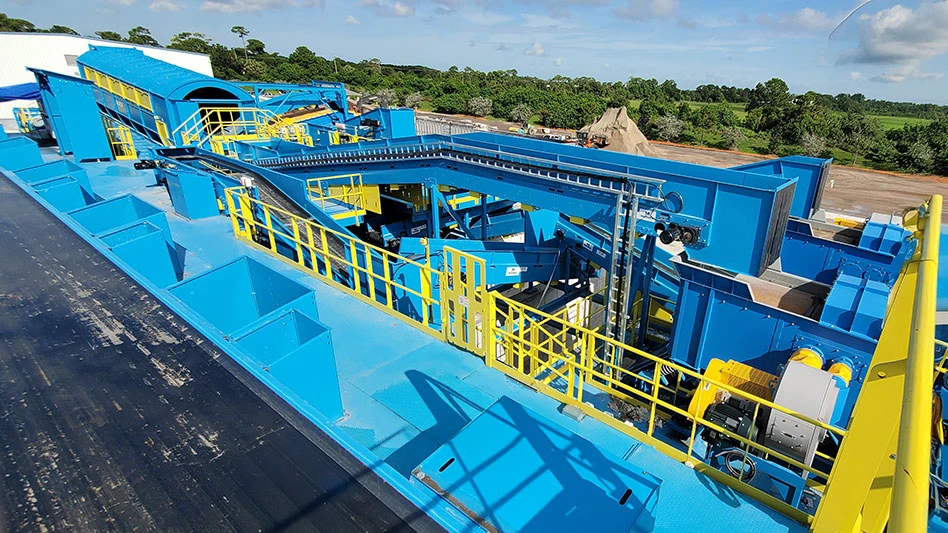
Florida. A northern Florida landfill operator recently began operating a construction and demolition debris processing system designed and manufactured by Bulk Handling Systems, Inc. (BHS). The new equipment replaced an existing trommel screen. Since installing the equipment, the facility has experienced a significant increase in runtime due to reduced equipment maintenance, as well as improved screening capacity.
A heavy-duty, ten cubic yard hopper accepts and conveys the incoming material to a Debris Roll Screen for removing dirt, sand, small concrete and other fine material at high throughput volumes. A collection conveyor positioned below the screen collects the Unders Material and discharges directly into a roll off container for use as Alternative Daily Cover (ADC) at their landfill. The large recyclables, or Overs Material, are conveyed across the screening surface and discharged to a sorting conveyor for manually removing wood, ferrous, concrete, and other materials, based on current market conditions.
Depending on the specific material load, the Unders Material can represent up to fifty percent of the incoming material stream, by weight. Removing this material at the beginning of the system mechanically improves sorting efficiency downstream. More importantly, this material is not subject to tipping fees at the landfill, resulting in a significant cost savings to the facility operator.
Innovative Screen Design Enhances Recovery
BHS began manufacturing conventional disc screens with overlapping discs approximately 25 years ago for the Wood Products and Pulp -n- Paper Industries. Several years ago, BHS developed and obtained a patent for a superior disc design, the BHS Debris Roll Screen¨ (DRS). The DRS design circumvents many of the problems associated with the conventional disc screen or starscreen. Higher material throughput volumes can be attained while achieving a more accurately sized material fraction or Unders Material. The increased efficiency and quality of the screened product can be attributed to the aggressive bouncing action of the rotating discs, coupled with a unique configuration for improved material sizing.
The patented Compound Disc Configuration creates a more precise, defined opening size without the undesirable secondary slot produced by the overlapping disc design. This defined opening prevents oversize material from being pulled through the screening deck. These Debris Roll Screen¨ features are exemplified in construction/demolition screening, but are also advantageous in fiber, greenwaste, municipal solid waste, and container processing.
New Mexico. The City of Albuquerque recently commissioned a state-of-the-art material recovery facility designed for processing Single-Stream or Single-Pass recyclables. Although the city is not currently processing the projected capacity of 10 tons per hour, daily processing capacity has nearly doubled with the updated equipment. The system's successful implementation allows the facility to process mixed residential recyclables collected by single bin collection trucks. This installation follows an industry-wide trend geared toward aggressively reducing the costs associated with collection and hauling.
The mixed recovery stream, containing residential curbside containers, newsprint, and corrugated containers, is dumped on the tipping floor and pushed by loader into the pit section of a chainbelt infeed conveyor. The chainbelt conveys the mixed material stream to a BHS OCC Separator¨ (Patented) designed to mechanically separate the corrugated containers from the other materials. Two pre-sort stations are positioned on the incline section of the chainbelt for removing plastic film and strapping that occasionally enters the recovery stream. The OCC Separator¨ conveys the clean cardboard over the screening surface, while simultaneously releasing the mixed containers and newsprint, or Unders Material, through the screening surface.
The Unders Material is collected and transported via chainbelt conveyor to a BHS NewSorter¨ (Patented) for mechanically separating the newsprint from the containers. The NewSorter¨ creates a clean fiber stream, containing predominantly newsprint. A quality control station allows any contaminants to be positively removed from the fiber stream, resulting in a #6 or #8 newsprint negatively sorted off the end of the conveyor belt. The mixed container stream is conveyed to a sorting line for further processing.
The success of Single-Stream or Single-Pass collection is due in large part to the high separation efficiency achieved by the OCC Separator¨ and NewSorter¨ units. This proprietary equipment performs the labor saving function of 'bulk sorting' the incoming mixed material into smaller, more manageable recovery streams containing similar materials.
Latest from Recycling Today
- Greenwave raises revenue but loses money in Q2 2025
- Recycled steel prices hold steady
- EY says India’s need for scrap imports will continue
- Coming full circle
- Amcor, DCM introduce fertilizer packaging with 35 percent recycled content
- Comstock Metals gets closer to commissioning commercial-scale solar panel recycling facility
- Washington selects Circular Action Alliance as PRO
- Smurfit Westrock expands in Latin America