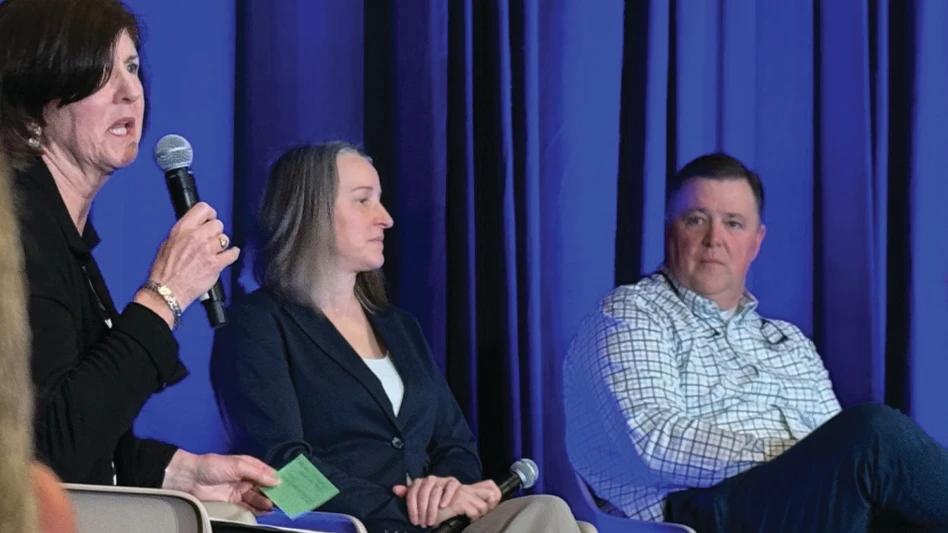
The future of independent paper brokers was in question during the Paper Recycling Conference & Trade Show, held in New Orleans this week. To some, the future is a question of adaptation and changing direction in the face of consolidation.
Jerry Rose, a senior associate with More & Associates working out of Stamford, Ct., began the Tuesday morning session by saying that consolidation, a stronger U.S. dollar, reduced recovery rates, global paper industry growth and the disconnection between the U.S. paper industry and the country’s current economic growth have negatively impacted the paper recycling industry in the U.S., affecting each of the four broker categories – independent broker, independent packer/broker, integrated packer/broker and export broker – in varying ways.
Rose said as the U.S. economy shifts to a service orientation, he expects the paper industry will head the way of the steel industry, adding that he expects exports will drive the industry.
Rose said he believes the solid waste handlers and independent packer/brokers will continue to grow to dominate the market in the future; whereas, the mill companies and the independent brokers will decline in prominence. Rose added that small independent brokers “won’t have the wherewithal to handle integrated companies” as they will have to offer additional services. The strength of personal relationships will no longer be enough, he said.
Ethan Hershman, CEO of Canusa-Hershman Recycling Corp., Branford, Ct., said that he expects independent packing plants to decline as the industry further consolidates. “It’s hard to run a plant efficiently when it’s producing less than 3,000 to 5,000 tons per month,” he said.
Hershman added that his independent brokerage company gives independent packers as much support as possible, which includes financing their equipment purchases and working capital, providing timely payment for material and developing partnerships.
To shore up operations in response to changes within the industry, Canusa-Hershman exports paper grades to India and the Far East through its International Fiber Exchange. The company also has started brokering recovered plastic because of the higher margins it provides compared to waste paper and the growing markets. Hershman said the this segment of the company is growing at a rate of 8 percent a year and could use the tools the company implements on the paper side, such as quick payment of a fair price and good service.
Hershman also explained his view of the Internet in relation to brokerage services. He said he sees the Internet as a means of providing easy access to information, improving the efficiency of information flow and eliminating the need to place a call to sales support and reducing the number of customer service staff needed.
Arnie Peltz, co-owner of the Peltz Group, Milwaukee, said that his company thrives on change. “We’d feel very uncomfortable if there was no change.”
Recently, the Peltz Group divided its executive management of the brokerage business, providing a focus for each individual of the executive team, which Peltz noted as the most effective change the company has implemented in the last two years.
Peltz also noted five advantages that help the company to maintain its customer base: leveraging and negotiating tonnage; acting as a consolidator of volume and information; reducing transaction costs; management of credit and risk and accessing global markets.
Edward Tucciarone, Jr., vice president of eastern sales for the recycling division of Smurfit-Stone Container Corp., St. Louis, said that most integrated recycling companies sell mill direct, eliminating the need for brokers.
The advantages of an integrated company such as Smurfit-Stone, Tucciarone said, is extensive sales account representation, marketing expertise, a one-stop-shopping approach and an equipment placement program in which Smurfit-Stone provides needed equipment in exchange for waste paper. He added that sole supplier agreements have proven very successful for Smurfit-Stone and that relationships built on honesty and fairness are integral to its success. “What’s was true yesterday is still true today,” he said.
Tucciarone also said that the failure of the dotcoms within the industry has helped to cement the historical relationship between brokers and customers.
James Derrico vice president of CellMark Recycling, Norwalk, Ct., said that small, independent mills are doing well overseas, using grades that U.S. companies would deem inferior. He suggested that U.S. brokers could find niche end users overseas as the demand increases and new, large plants go online.
Latest from Recycling Today
- Charter Next Generation joins US Flexible Film Initiative
- Vecoplan to present modular solutions at IFAT 2026
- Terex Ecotec appoints Bradley Equipment as Texas distributor
- Greenwave raises revenue but loses money in Q2 2025
- Recycled steel prices hold steady
- EY says India’s need for scrap imports will continue
- Coming full circle
- Amcor, DCM introduce fertilizer packaging with 35 percent recycled content