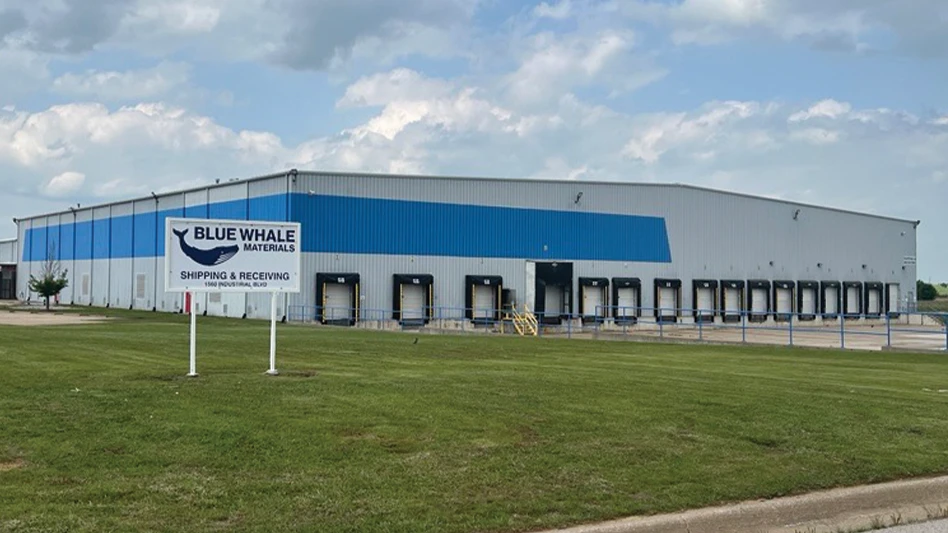
Photo courtesy of Blue Whale Materials
In August 2025, lithium-ion battery recycling company Blue Whale Materials (BWM), a portfolio company of Ara Partners, opened the doors of its first recycling facility in Bartlesville, Oklahoma.
The facility currently has a nameplate processing capacity of 14,000 tons per year, and discharges and separates batteries and production scrap into a unique product BWM calls Blacksand, containing high concentrations of lithium, cobalt and nickel. Blacksand can be used by refiners, battery manufacturers and other recyclers as the material makes its way into new battery cells.
RELATED: A Whale to watch
Through its own fundraising efforts and a $55 million grant from the United States Department of Energy (DOE) awarded in January of this year, BWM now is able to expand its 50-acre Bartlesville campus to add additional processing lines, in-house testing capabilities, upgraded infrastructure and more.
The company’s expansion, expected to take place over the next four years, will enable the facility to process up to 50,000 tons of feedstock per year and convert 3.5 times more batteries and production scrap into Blacksand while creating more than 100 permanent jobs.
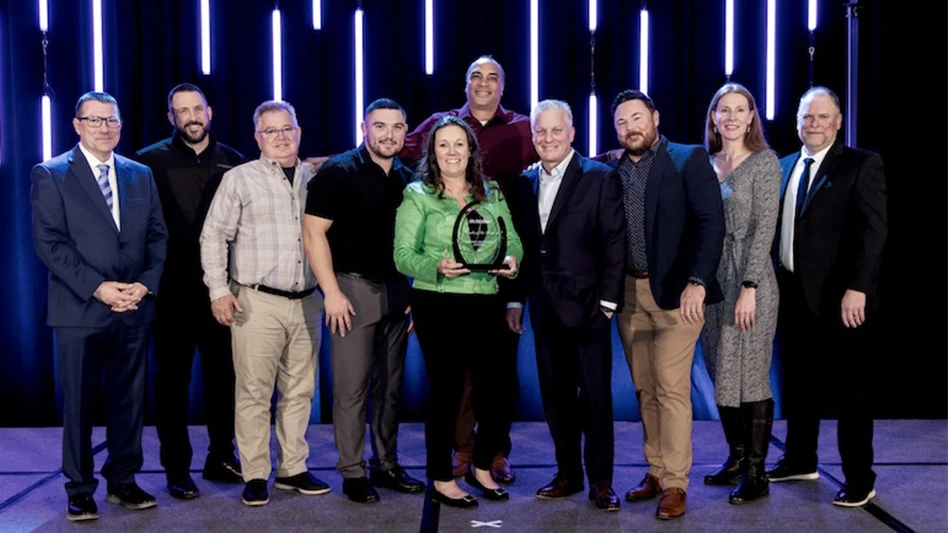
BWM hosted a beam-signing ceremony Nov. 10, 2025, to celebrate the start of its expansion in Bartlesville, which included members of Oklahoma’s federal and state leadership, the Bartlesville and Tulsa, Oklahoma, business communities and the company’s executives and stakeholders.
“This milestone builds on the foundation we laid at commissioning,” BWM co-founder and Chief Strategy Officer David Fauvre said in a news release marking the occasion. “The expansion will enable us to serve more partners, increase recovery volumes and accelerate the circular supply chain for lithium-ion batteries.”
In the following interview, Fauvre details expansion plans for the Bartlesville facility and discusses challenges facing the battery recycling industry as it continues to grow.
Recycling Today (RT): How have things progressed since the opening of the baseline black mass plant back in August? What have you learned and what stands out?
David Fauvre (DF): I think it’s been going really well.
We’ve commissioned the baseline plant we’re running now. We’re operating, producing black mass and we’re getting good, high-quality material that meets our specifications and the specifications of our customers.
We’re doing some tolling projects, which is something that we’ve been wanting to try to achieve in the industry. We think it’s a nice way to have a balance of tolling and also other types of commercial relationships where we’re buying and selling material.
We’re in the expansion process now to add additional capacity, and that is in line with our DOE grant project. That’s ongoing and we marked that expansion with the event we had in November. We got a really good response from that, and I think we see a lot of support in Oklahoma from the state officials and the federal officials who came out to the event and are supporting us. We are really encouraged by that.
RT: It seems that Oklahoma has been very welcoming to your company. Can you expand on that partnership, and what is the benefit of being located in Bartlesville?
DF: It’s been a very welcoming administration. Gov. Stitt has been a real advocate for bringing critical mineral projects to Oklahoma, and we’ve been a beneficiary of that effort. He’s written on it and he talks a lot about it. I think it’s really important not just to Oklahoma’s energy economy, but also to the nation’s national security and focus on really boosting our domestic capacity to produce critical minerals for all sorts of industries, from batteries to aerospace to, say, all the data centers that need to be built. We’re right in the middle of that, and I think Oklahoma has really been a leader in that effort.
We see that support from the senators, Sen. Lankford and Sen. Mullen are very supportive and focused on these issues, as well as the state’s administration, from the secretary of energy in Oklahoma through the Department of Environmental Quality, which I would say is really a partner in what we’re doing in a way that’s really helpful to be able to continue to grow the business and have the impact that we’re looking to have.
RT: More recently, it seems there’s been an increased emphasis on the national security aspect of critical mineral recovery, as well as their use in data centers and artificial intelligence applications, for example. There are a lot of different uses for these materials beyond EV batteries, so where does Blue Whale help meet those needs?
DF: What we do is produce cobalt, nickel, lithium and copper. So, any uses of those metals, we’re meeting [needs]. And those are all identified as critical minerals by the U.S. government.
There’s a huge push to make sure that we have capacity and capability to produce those minerals here in the U.S. China is really the behemoth in this space and controls a lot of the critical mineral refining and processing in the world for those critical minerals, in addition to a host of others.
For the metals we deal with, there’s really been a push to make sure that we’re building up U.S. capacity. And [the Trump administration] has really prioritized that and made real inroads to building out the programs and the investments that we think are needed to grow the nation’s ability to meet that challenge of producing critical minerals that we’re going to need for those industries.
It's not just EVs that are continuing to grow. Batteries are ubiquitous. They’re in our cell phones; they’re in the data centers that are popping up everywhere that we need to win the AI race. They’re in drones, military applications, airplanes. It seems like everything needs batteries. And so, the minerals that we’re producing really do find their way into all of those applications, but also other uses of the metals. Nickel’s used in a lot of applications. Copper is sort of the backbone of our electrical grid and the electrification economy that’s happening. So, we think it’s critical that we have these sources of material, and there’s still work to do to build out our infrastructure in this area, but we’ve really been encouraged by all the activity on the policy front that really pushes these things forward.
RT: As far as the baseline plant goes, how much material are you currently processing? Is it in line with what you thought it would be before you opened your doors?
DF: I think we’re ramping up production. We have a 14,000-ton-per-year nameplate capacity, and we’re running at the rate that we need to run on a per-hour basis to hit that nameplate capacity.
We’re essentially adding shifts as we grow, so we’ll get one shift up and running and that’s about one-fourth of that nameplate capacity. Right now, we’re running two shifts for a good bit of the month, then we’ll add shifts as we grow. That’s how we approach it. We expect full ramp-up to take several months, but we’re making good progress to get there.
RT: How long have expansion plans been in the works?
DF: The DOE grant we received allows us to get that expansion from our baseline plan. We got the grant in January 2025, and that’s been the framework that we’re executing to build that out, expand from there. It gives us a nice roadmap of expansion for about four years that we’ll be executing on to grow our capacity.
RT: What will you be adding in the expansion, and what will that allow you to do?
DF: The first part of our expansion will come online in March, and that will allow us to process full batteries from the cell all the way through the pack. We’re adding some pack shredding capabilities as part of that expansion. Then, we’re really just growing capacity, adding additional lines to the site.
What we’ve produced, it’s one continuous line that can run. We’re going to be adding additional lines over time to build up our capacity to hit, ultimately, that 50,000 tons per year and higher mark that we’re aiming for with the grant, the full expansion.
RT: The expansion also includes an enhanced testing and grading center. Can you describe the capabilities there?
DF: We have a business now that runs in Greenfield, Indiana, called BW Energy and Innovation. We do battery testing for manufacturers and pack assemblers. Currently, we have about five people who are running that operation with two locations in Greenfield. We do performance testing, abuse testing—we see what happens when a battery gets pierced and lights on fire—and we’re essentially providing data to those manufacturers that engage us in that work.
And then, with our recycling business, we’re also doing testing and grading of the material that comes through the recycling stream. Some of the material that we get we shred immediately, and that’s part of the relationship we have with our customer. But, for some of the material we get that could have a second life, we have testing capability in our Oklahoma facility where we can test for state of health, disassemble packs and pull out modules and test those. And we’re seeing a relatively robust market for batteries that can be used in a second application.
So, we’re not remanufacturing batteries and selling a new product into the market, but what we’re doing is providing this service of taking in the batteries, testing them and then selling batteries that can be repurposed and remanufactured to others that then take them and use good batteries for new applications, for BESS [battery energy storage systems] systems or for remanufactured packs. We do see that as a vertical and as a market that is growing.
RT: There’s also a logistical component to the expansion. How important are logistics in your work?
DF: When we’re building out these facilities, the amount of material that we’re bringing in just keeps growing and growing, and so a really big part of what we’re doing is adding the capacity to store and handle material. Batteries are still dangerous. They’re considered hazardous waste. So, you need to have the capabilities to handle and store those safely. Part of what we’re doing in the expansion is making sure that we’re building out that capability as we build out our processing capability.
We have outdoor storage where we store batteries, and full fire mitigation systems there. That’s a big feature of how we make sure that we’re doing things safely and carefully to handle these materials.
RT: How has the response been to your Blacksand product, and have any partners or customers asked about making additional products? Are there plans for the future to make some new packages on top of Blacksand?
DF: The features of our Blacksand that I think are attractive in the market are really the low impurities, and the fact that it’s dry and that we’ve removed a lot of the other organics and electrolytes from the material. So what we end up producing is a really high-grade mixed-metal concentrate that has low copper content, low aluminum content, low fluoride content, and it’s a dry product.
For refiners, particularly hydrometallurgical refiners that are using a chemical process, those impurities impact cost and time for their refining process. So, the lower impurities we can produce in our product, the easier it is for the refineries to process our material and convert it into battery-grade cobalt and battery-grade nickel. The response to that has been very positive. We see quality in the product as a real key aspect of what we’re doing and our value proposition in the market.
In terms of other products, we also produce a copper product. We’re essentially separating all the copper from black mass and we’re selling a higher-grade copper product that’s over 90 percent copper content, typically. That is sold to somewhat different customers, but there’s a huge need for copper currently. It’s in high demand, and we’re producing that. We also produce an aluminum product.
What we’re looking at into the future is being able to extract additional minerals into separate streams. We’re looking at lithium, we’re looking at graphite, and those are things that I would say are more in the R&D [research and development] phase, but eventually we do see some need for being able to further extract minerals from the products that we see.
RT: As far as the battery recycling industry overall, what are the biggest challenges or opportunities you see currently?
DF: I would say the biggest challenge right now is really around execution. I think it’s just making sure that folks are able to process and do what we set out to do.
In terms of the opportunity, I would also say it’s in the challenges, and that’s that we need additional refining capability. We need to make investments in the full infrastructure around the supply chain. We take the first step of taking batteries and converting them into this mixed metal product, but what we think we really need, ultimately, is to have refining and then additional battery material supply chain players building capacity here in the U.S. in order to feed the cell manufacturing process here.
Materials are still traveling to Korea or Japan and then coming back into the U.S. to make batteries, so I think we’d like to see that really get built out domestically. And we see this administration is a big proponent of that, and there are a lot of things happening to build that out. I think that’s still a challenge for the industry as we grow.
I think it’s still a very young market. We really see opportunities to develop a true closed loop in the industry because right now, most of the OEMs [original equipment manufacturers] and the cell OEMs want to get to that closed loop where their scrap is traveling directly back into metal units that they’re producing batteries from.
We see a huge opportunity in being able to fulfill that promise of creating a true closed loop for batteries in the U.S., but that will require some of that investment in the refining and pCAM [precursor cathode active material] and CAM [cathode active material] capabilities here.
We think our product is well positioned for that because it’s a high-quality product that can really go to any refiner. And so, as a cell manufacturer or an auto OEM picks its suppliers through that supply chain, those intermediate suppliers are going to be able to take our Blacksand and utilize it effectively to be able to help create those closed loops. We see that as a huge opportunity and are really designed to be able to serve that future.
RT: How would you describe the state of the battery recycling industry currently?
DF: I think we need time to mature.
I think we’re still building out a collection infrastructure to support this. We’re still developing best practices on handling and shipping material. I think we’re still at a point where we have assets and services and what we’re trying to do is bring a high-quality product to the market. I think we’re seeing that really resonate in the market.
And I think it’s challenging. Battery recycling is a challenging business. Fluctuations in the commodity metal pricing impact the recycling business, and just the ability to execute effectively. I think there is a real market that we all need to try to make sure we’re meeting, and that’s really what we’re setting out to do effectively now as we come online.
Latest from Recycling Today
- Vermeer announces plan to build new facility in Des Moines metro area
- PureCycle, Toppan partner on packaging containing PCR
- LKQ to focus on simplification, productivity in uncertain demand environment
- Supreme Court strikes down IEEPA tariffs
- Redwood expands San Francisco R&D footprint
- Constellium posts record Q4 adjusted EBITDA
- QCC torches include customizable features
- Umicore finishes 2025 with increased earnings