Thomas | stock.adobe.com
Block Island Recycling Management Inc.’s (BIRM’s) company philosophy is steeped in environmental stewardship. Sean McGarry, owner and operator of the New Shoreham, Rhode Island-based waste and recycling company, has deep roots in the town he services and is dedicated to maintaining its natural beauty.
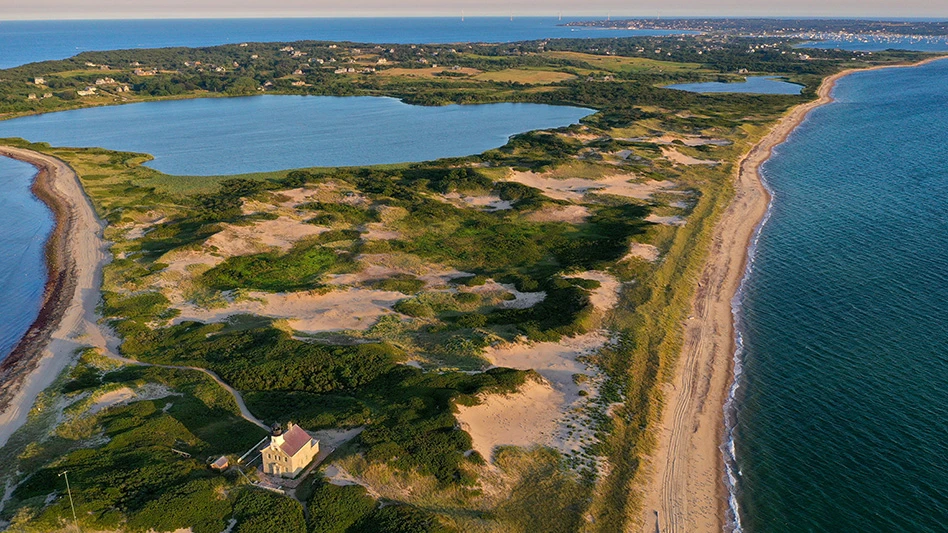
Also called Block Island, New Shoreham sits 9 miles off the southern coast of Rhode Island as part of the Outer Lands coastal archipelago in New England and is a popular tourist destination during the summer.
“My family bought the property here in 1919, so we used it as a summer house,” Sean says.
He returned—in a more permanent capacity—to the island upon graduating college in 1989. Before it even had a name, BIRM began as a waste collection solution for one of Sean’s early business ventures.
“I opened a moped shop and a restaurant as my first two ventures, and at the restaurant, we didn’t have a viable trash collection company to handle our waste,” he says. “So, I went and bought a garbage truck to store the waste until I could deliver it to what was then a landfill here on Block Island.”
To pay for the truck, Sean began offering collection services to neighboring businesses.
“I didn’t enjoy the restaurant business very much, but I’ve loved the waste industry, and I’ve stuck with it ever since,” he says.
What started as a small-scale commercial waste solution eventually transformed into the entire island’s waste and recycling collection solution.
New Shoreham’s waste landscape began to shift in the '90s, with the construction of the New Shoreham Transfer Station and the closing of the town’s landfill at the beginning of the decade.
“[The transfer station] was barely usable,” Sean says. “There was just an overwhelming accumulation of waste everywhere, and I just thought to myself, ‘I can do a much better job than this.’ So, I asked a friend of mine, who also was doing some residential collection, if he wanted to join together and bid on operating the transfer station.”
BIRM was awarded the New Shoreham Transfer Station contract in 1998 and has operated the facility ever since.
Today, BIRM is a family business and father-son operation. Ryan McGarry, Sean’s son, joined the company a few years ago and absorbed an array of responsibilities, likening his role as facility manager to a Swiss Army knife.
With the closing of Block Island’s landfill, waste and recycling are now shipped to the mainland to be transported to Rhode Island’s Central Landfill in Johnston. BIRM operates an additional facility at the Galilee, Rhode Island, port, where trucks and containers are staged before traveling north to the state’s last remaining landfill.
Seasonal changes
New Shoreham has two seasons: tourism season and offseason, which Sean also refers to as construction and demolition (C&D) season. During tourism season, the island’s population jumps from 1,000 to somewhere between 15,000 and 20,000, depending on the daily number of visitors.
BIRM has nine full-time employees and hires an additional four seasonal employees to augment the summer workload.
“[In the offseason], our employees aren’t working full 40-hour weeks, usually around 30 to 35 hours a week,” Sean says. “But in the summer, everybody’s working 50-plus hours.”
The island’s annual population fluctuations impact every business in New Shoreham, and waste and recycling are no exception.
“The trash systems, they are parallel with the tourism,” Ryan says. “If one of them is out of skew, the whole thing blows up.”
BIRM offers curbside collection for households that sign up for the service and uses 6- to 8-yard rear loaders with side dump recycling bins so that waste and recycling can be collected simultaneously.
“The roads out here are, for the most part, not paved—the residential roadways,” Sean says. “They’re very narrow, so to use a large 15- or 20-yard packer is impossible.”
In 2024, the company collected more than 4,000 tons of material, not including recycling, with tonnage spiking June through September for municipal solid waste and commercial waste.
Commercial customers make up 70 percent of BIRM’s collected summer materials. Unlike the state of Rhode Island, which Sean says concentrates primarily on residential recycling, most of the recycled material on New Shoreham is generated by commercial customers.
“There’s 32 bars and restaurants here on the island,” he says. “There’s been a big push from corporations to buy some of these older hotels and revamp them and add additional rooms. The quality of the hotel experience has increased substantially, and we see a lot more overnight visitors now through the hotel system.”
For these larger venues, like hotels and public buildings, BIRM provides self-contained compactors. Commercial customers also are given the opportunity to use commingled recycling containers to make recycling more accessible for businesses.
Inversely, the collected tonnage of C&D materials tends to drop slightly in the summer months. The offseason serves as the primary time for construction on the island, with a peak of 234.94 tons of C&D debris collected in April of last year.
As of 2024, 46.1 percent of the island’s 6,076 land acres have been preserved as open space for conservation, recreation, agriculture or aquifer recharge areas, meaning there isn’t much developable land left.
“In order for someone to move into the area and build their dream vacation home, they buy an older piece of property, they tear it down and they build something pretty spectacular,” Sean says. “Our demographic is changing pretty rapidly from what used to be a cottage community to something more like the Hamptons. … Some very wealthy people have moved into the area.”
This C&D activity spiked following the pandemic as people began moving away from densely populated areas.
In the offseason, Sean says 99 percent of BIRM’s collected materials consist of C&D debris, with the company collecting very little commercial waste due to the island’s dramatic winter population decline.
The company has 10 50-yard roll-off containers to ship C&D materials to the mainland port.
“We like to get about 12 tons in a 50-yard container, which, for construction and demolition debris, is a pretty aggressive task,” Sean says.
Logistical challenges
Transportation has proven to be one of BIRM’s biggest obstacles. Being 9 miles from land, materials are transported off the island by a conventional ferry, which hauls freight and passengers as well as waste and recycling.
BIRM works with multiple companies to haul freight to the island in its empty containers after waste and recycling are dropped off on the mainland.
“There’s a number of companies that haul sand and gravel to the island,” Sean says. “We work with them to haul back the other way when they’re empty, leaving here. … One of our largest customers is a farmer who raises cattle here, and we bring a lot of silage, which is ground up corn for the cattle industry, back in our empty containers.”
To ensure the consistent transfer of materials, BIRM receives its yearly list of ferry reservations in January.
“It’s quite the game to play as far as getting your slots,” Ryan says. “This has taken 25 years to get in as good graces with the ferry company as [Sean has] to get the accommodation of getting all of our reservations up front. … The fact that the ferry company works with us as well as they do is key to a successful trash industry out here.”
It’s not uncommon for the ferries to be cancelled, leaving materials to sit idle in BIRM’s containers at the New Shoreham Transfer Station until the boats are up and running again.
“Unlike a mainland company, they go to the landfill at the end of every route,” Sean says. “We don’t do that here. We come back to the transfer station. We compact that material, we sort that material, we take as much material out of it that can be recycled or put with a different product, and then we ship it on the ferry.”
Because ferries transport more than just waste and recycling, BIRM must abide by the ferry company’s rules. Of the three conventional ferries shipping New Shoreham’s waste and recycling, one has a fully enclosed freight deck while the other two have open freight decks, meaning passengers can look down during their voyage at the containers traveling to and from Block Island.
“The ferry company does not allow us to drip or have vectors like maggots or flies or things like that,” Sean says.
Odors, leakage and pests come with the territory, so BIRM ensures all containers are fully gasketed and doors and orifices sealed with binder chains before materials set sail. However, as waste starts to decompose, it produces methane and causes pressure to mount if containers are sealed prematurely. To avoid this, BIRM waits to seal its containers 30 minutes prior to the ferry’s departure.
BIRM ships one 50-yard container of C&D debris per day during the offseason and three containers of waste and recycling per day during its tourism season.
“We can’t really use dump trailers or live floor trailers because the length of the ferry deck doesn’t accommodate that,” Sean explains.
Once containers arrive at the port in Galilee, a driver transports the materials to the Central Landfill.
Equipment repairs have been another challenge the BIRM team has learned to tackle.
“If we have a truck that’s broken down out here in our yard, there’s nowhere to bring it to get it fixed,” Ryan says. “We have to fix it.”
BIRM has an aging front loader that cannot be transported by the ferry, so when it breaks down, the whole system breaks down, Sean says. With nowhere to send it for repairs, he had to learn the basics of diesel mechanics to keep the company’s operations up and running.
“In the 30 years I've been doing this, I’ve become a master diesel mechanic,” Sean says. “I’ve passed that knowledge onto my son and to the other employees that come here.”
Environmental stewardship
With only one active landfill in the state of Rhode Island, waste diversion efforts have become increasingly important.
To extend the life of the landfill, BIRM partnered with the town of New Shoreham and the Block Island Conservancy to launch a composting program in 2024.
Using an in-vessel drum composter designed for pig mortalities, the program collects residential and commercial food waste at the transfer station to produce a soil amendment, which is then given back to program participants. Residents can purchase a composting bin for $50 at the transfer station, and the Rhode Island Resource Recovery Corp. (RIRRC) gives the town of New Shoreham an annual diversion credit for every bin sold.
The composting program also opened the door to community education efforts, with student field trips coming to the transfer station to see the in-vessel composter and learn about the process.
“It adds a whole new dynamic to people wanting to come out and learn about this,” Ryan says. “I think if we could get two, three field trips a month even, that would be great.”
To ensure community members and island visitors know about New Shoreham’s recycling and waste management efforts, various organizations publish educational materials. RIRRC prints brochures outlining the island’s recycling capabilities, which BIRM distributes to residents. The information also is publicly available online through its website, as well as on the New Shoreham and Block Island Tourism Council websites.
“There’s a local newspaper called The Block Island Times that runs year-round, [and] every issue has a section about recycling, the dos and don’ts,” Sean says. “They run a couple of special publications in the summertime for visitors that are coming. … All of these people provide this service, so we don’t have to pay for that. They’re doing that voluntarily as their contribution to helping the island’s sustainability, beauty and to keep their businesses alive. … Everybody’s bought into this, and we are kind of like the maestros of bringing all these people together.”
Because the island relies so heavily on tourism, sustainability and conservation are top of mind for many permanent residents and business owners. If waste and recycling are not adequately maintained, New Shoreham’s popularity as a vacation destination would inevitably decline.
“We have to care,” Ryan says. “We rely heavily on our tourism dollars, and if this place weren’t looking as clean and efficient as it was, it would be hurting. Everybody would be hurt.”
Environmental stewardship is foundational to the work BIRM does, and Sean McGarry says providing quality service to the residents, visitors and businesses on the island is his primary goal.
“If [the work’s] not done, we don’t go home,” he says. “It’s just the way it is. Everybody buys into that, and it creates a very clean, environmentally friendly facility, popular with the public. That makes me personally proud, and that’s what I’m trying to accomplish. Not necessarily looking to get rich, I’m looking to put out a quality product that I’m proud of.”
“Yes, this is our company, but we don’t own any of this,” Ryan says. “We don’t own this island. We don’t own trash outright. … The reality is that we’re building something here that hopefully will outlast us, … that the idea, the philosophy, will live far beyond us and will hopefully carry this community into a better future than we’re on trajectory for right now.”