Non-governmental organizations (NGOs) and regulatory agencies in the European Union and elsewhere are proposing changes to existing regulations potentially disruptive to global trade in several scrap commodities.
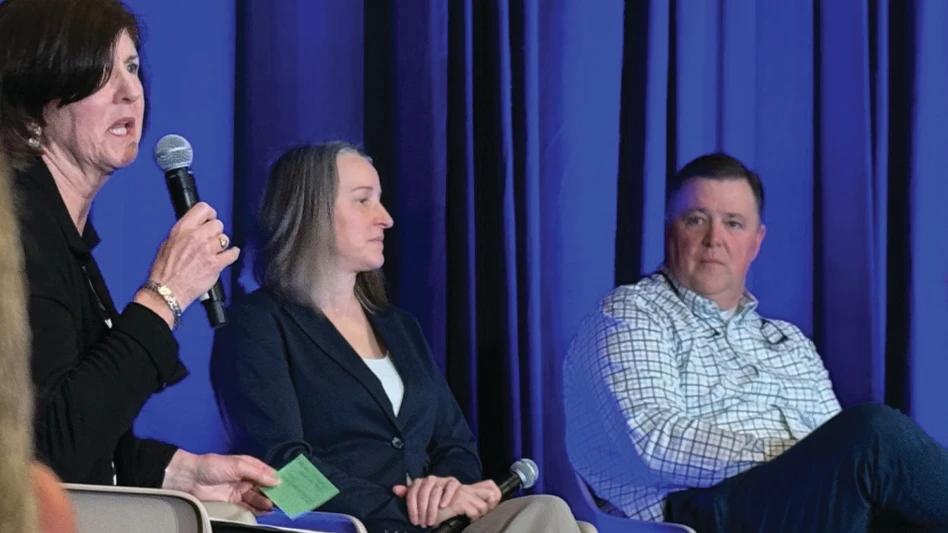
These potential changes were a topic of conversation at the meeting of the International Environment Committee (IEC) at the 2015 Bureau of International Recycling (BIR) World Recycling Convention in Dubai, United Arab Emirates, in May.
IEC panelists, led by committee chair Olivier Francois of Belgium’s Galloo Group, expressed concern that Organization for Economic Cooperation and Development (OECD) classification, labeling and packaging (CLP) regulations designed to address shipments of chemicals may be applied to scrap materials.
Submitting a chemical analysis of every scrap shipment is “nearly impossible” and would present “very big difficulties,” said Francois. “If they have this idea in their head, it is very dangerous. Is it best to [simply] landfill old materials?” asked Francois.
Panelist Surendra Borad of Belgium-based Gemini Corporation said too many regulations, in Europe in particular, are based on “mismatches” between hazardous and non-hazardous materials. “Why does scrap paper need to be monitored” as potentially hazardous, he asked.
BIR Trade & Environment Director Ross Bartley also provided a report on a United Nations Environment Programme (UNEP) meeting that had taken place in Geneva, Switzerland, earlier in May.
Delegates at that meeting discussed proposed updates and changes to the Basel Convention, designed in part to regulate trade between OECD and non-OECD nations.
Bartley said there was considerable discussion at the meeting about stemming the flow of used and repairable end-of-life electronics from OECD nations to non-OECD nations. Further discussion lies ahead, but essentially any nation “not wishing to import such items can do that,” said Bartley.
Coinciding with the meeting, UNEP released a study on end-of-life electronics disposal and recycling that has been met with considerable skepticism from the BIR, the Institute of Scrap Recycling Industries Inc. (ISRI) and other organizations.
The report’s authors determined that some 90 percent of obsolete electronics are being disposed of in ways they consider illegal. “One has to be careful about where you get your data,” Bartley said of the report. “People have made some assumptions. Just because you can’t measure it, doesn’t make it illegal,” Bartley said of many reuse and recycling methods.
He added, “To say 90 percent is being dumped illegally, that would say that everything [the NGOs and the Basel Convention] have been doing for decades has been ineffective.”
ISRI President Robin Weiner also was skeptical, saying ISRI had analyzed the UNEP report and had found in some cases the authors were using one criterion for the numerator and a different one for the denominator, by including household appliances (refrigerators, washers, dryers, etc.) in the overall end-of-life stream but only measuring the volume of computers and cell phones recycled.
“The report is not just off by a couple of percentage points,” said Weiner, but by an amount that is difficult to even measure. She also said it conflicts directly with the findings of United Nations University research that was conducted just one year earlier.
“I was somewhat shocked that the report had come through in that state,” added Bartley.
The 2015 BIR World Recycling Convention was May 17-20 at the InterContinental Festival City in Dubai.
Latest from Recycling Today
- Charter Next Generation joins US Flexible Film Initiative
- Vecoplan to present modular solutions at IFAT 2026
- Terex Ecotec appoints Bradley Equipment as Texas distributor
- Greenwave raises revenue but loses money in Q2 2025
- Recycled steel prices hold steady
- EY says India’s need for scrap imports will continue
- Coming full circle
- Amcor, DCM introduce fertilizer packaging with 35 percent recycled content