Photo by Brian Taylor
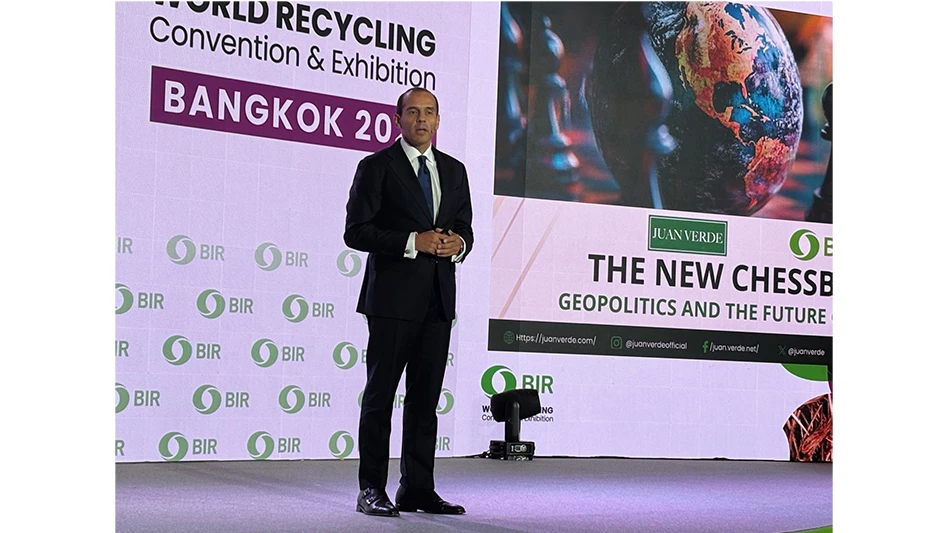
National security issues surrounding natural resources may continue to disrupt metals recycling markets, but also underpin a long-term demand driver for the materials, according to the keynote speaker at the Bureau of International Recycling (BIR) convention in Bangkok in late October.
Emphasizing the positive long-term prospects for recyclers tied to resource nationalism policies was Juan Verde, a Washington-based government and industry consultant who has served as an adviser to three different United States presidential administrations.
“This new protectionism is actually quite good for your industry because it is going to force nations to invest unthinkable amounts of money to increase their recycling capacity,” Verde told delegates assembled in Bangkok.
That benefit may be difficult to discern for those who engage in cross-border trading of such materials.
“We are at a historic crossroads,” Verde said. “Rules that applied to free trade and the global economy are no longer valid. We are at the birth of a new world order that will have a significant impact on your industry in particular.”
Verde spelled out what, to recyclers, was the familiar rise of China as a global manufacturing and metals production power.
“It happened because the United States and Europe were very successful at sending our manufacturing and industrial capacity to China, and so did the rest of the world," he said. "As a consequence, China is now a superpower able to contest and compete with the U.S."
In the mid-2020s, however, policymakers and corporations based in the U.S. and Europe are favoring seeing some of that manufacturing and metals production return home, according to Verde. A shift to greater manufacturing regionalization and more “friend-shoring” has included a tilt toward greater protectionism and a race for resource security that will has clear implications for traders and recyclers.
While current President Donald Trump demonstrates little support for sustainability, Verde said that movement is not going away.
“Sustainability is not being phased out; it is being relabeled,” he said. “I could not be more bullish about your sector, or more optimistic you are in the right industry at the right time.”
Verde says one forecast has the market for recycling critical minerals projected to grow by around 15 percent annually until 2033 and referred to it as the fastest-growing segment of the recycling industry.
The definition of critical minerals can vary from country to country. In the U.S., it includes more than 50 minerals or metals, including aluminum, copper, lead, lithium, magnesium, manganese, nickel, tin, zinc and most precious metals and rare earth elements.
Verde pointed to another study that determined the level of global investment in recycling and the circular economy from 2019-2024 exceeded $160 billion, a 40 percent increase in five years.
“Your industry is set to do well, and it is rather likely that we will see a very significant increase when it comes to governments defining your industry as being critical to our national security,” Verde said.
At the same keynote session in Bangkok, BIR President Susie Burrage of United Kingdom-based Recycled Products Ltd. said the October event had attracted more than 1,100 participants from 58 countries.
She said 2025 has been an exceptional year for BIR.
“I am delighted to share that we have achieved the largest membership in our 77-year history," she said.
Burrage also announced that the next BIR convention would be in Gothenburg, Sweden from June 1-3, 2026.
The BIR October 2025 World Recycling Convention & Exhibition was at the Centara Grand Convention Centre at Centralworld in Bangkok from Oct. 26-28.
Latest from Recycling Today
- Fleetio launches AI capability to accelerate fleet maintenance approvals
- The Metals Agency receives approval for export credit insurance
- Recycle Ann Arbor extends drop-off station operating hours
- Sybilion seeks to help manufacturers confidently address volatility
- Rio Tinto, Prysmian partner on low-carbon aluminum solutions for data centers
- Unilever criticized for plastics approach
- USTR to study additional steel, aluminum tariffs
- Electrified Materials adds processing capacity