Photo by Brian Taylor
Shortly before it convened in Bangkok in late October, the Plastics Division of the Brussels-based Bureau of International Recycling (BIR) gathered reports portraying dire conditions in that sector in Europe and other parts of the world.
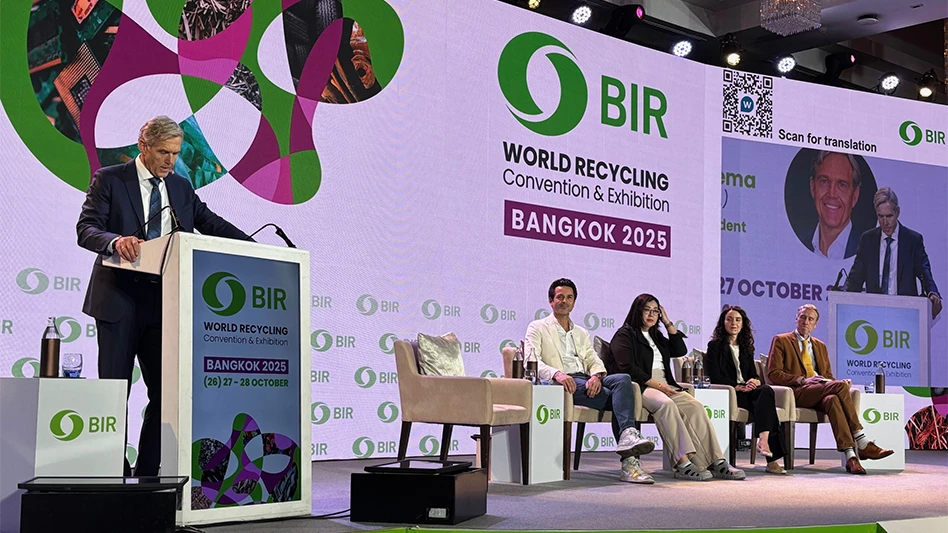
When the division convened in Bangkok, those circumstances were mentioned again, with division board members also trying to find favorable news to report.
Henk Alssema of Netherlands-based Inviplast said that by the end of this year, nearly 1 million metric tons of recycled plastics reprocessing capacity will have disappeared from the market in Europe in 2024 and 2025 combined.
One “glimmer of hope” mentioned by Alssema was France’s scheduled introduction, next January, of financial incentives for companies that use recycled content. He also said that in the Middle East, governments are funding circular economy initiatives tied to plastic.
Division member Max Craipeau of Hong Kong-based Greencore Resources Ltd. said some trade groups in Europe have been encouraging a barrier for imported baled plastic scrap or recycled-content resins. Craipeau said such a measure would not address the major issue.
The “major culprit” in the sector’s loss of capacity, he said, was cheap oil (and thus cheap virgin plastic), not imported material from Asia, North Africa or South America shipped to Europe.
By his calculations, Indonesia and Malaysia shipped an average of 60,000 metric tons each to Europe, a sliver of the 2 million metric tons of polyethylene terephthalate (PET) recycling capacity installed in Europe.
“When I talk to PET recyclers in Europe, they all tell me, ‘We don’t have enough; we need to import,’” Craipeau said. “What they import from those two countries [is] 2 percent of the capacity. So, the culprit is not imported material.”
Also at the Plastics Division meeting, Olivier François of the Brussels-based Recycling Europe organization offered additional insight into European supply and demand conditions, Bianca Mannini of BIR offered an update on the United Nations Plastic Treaty, and Patcharin Thamasirianunt of Thailand-based Union J Limited described that company’s growing plastic recycling capacity and its ambition to create food-contact grade polypropylene (PP), high-density polyethylene (HDPE), low-density polyethylene (LDPE) and linear low-density polyethylene (LLDPE).
In the synthetic rubber sector of the polymers recycling industry, attendees of another meeting heard from two companies engaged in synthetic rubber recycling in Southeast Asia.
At the Tyres and Rubber Committee meeting in Bangkok, Asmipudin Mohd Ali Jinnah, CEO of Malaysia-based Bridge Fields Resources (MYS), said his company has been recycling rubber in that nation since 2004, using what he called a patented non-toxic, low-heat technology treatment used in part to recycle nitrile work gloves.
Bridge Fields creates white and black latex reclaimed materials, a hybrid material made from latex and end-of-life tires and reclaimed synthetic rubber that includes nitrile, butyl and EPDM latexes.
The recycled rubber is used in the soles of shoes and floor mats or can be granulated for use in sports fields or playgrounds. Only when those products reach the end of their lives would they be subject to pyrolysis, according to the company.
Anansinee Thaboon, founder of Thailand-based Greenergy One, said that company has been recovering recycled carbon black (rCB) from tires and adding graphene to produce materials used in battery manufacturing applications.
The tires are dried, cleaned and shredded before undergoing pyrolysis, resulting in what Thaboon calls refined rCB. Graphene, meanwhile, is synthesized from methane and biogas, she added.
Thaboon said rCB sometimes has a lower value, but it can be doubled with sufficient purification. The value increases when rCB is coupled with the graphene to form a composite she said is sought by manufacturers in electronics insulation markets.
Both Southeast Asian recyclers pointed to certifications such as ISO as a differentiator in the market, with Asmipudin saying Malaysia was transitioning from voluntary disclosures to mandatory plans by 2030.
The BIR October 2025 World Recycling Convention & Exhibition was at the Centara Grand Convention Centre at Centralworld in Bangkok Oct. 26-28.
Latest from Recycling Today
- Fleetio launches AI capability to accelerate fleet maintenance approvals
- The Metals Agency receives approval for export credit insurance
- Recycle Ann Arbor extends drop-off station operating hours
- Sybilion seeks to help manufacturers confidently address volatility
- Rio Tinto, Prysmian partner on low-carbon aluminum solutions for data centers
- Unilever criticized for plastics approach
- USTR to study additional steel, aluminum tariffs
- Electrified Materials adds processing capacity