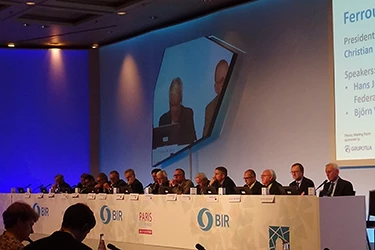
Officers of the Brussels-based Bureau of International Recycling (BIR) said market conditions continue to be challenging for European recyclers, particularly on the ferrous side, leading to likely market contractions.
The comments were made during an informal press conference held during the BIR Autumn Round-Table sessions in Paris, Oct. 27-28.
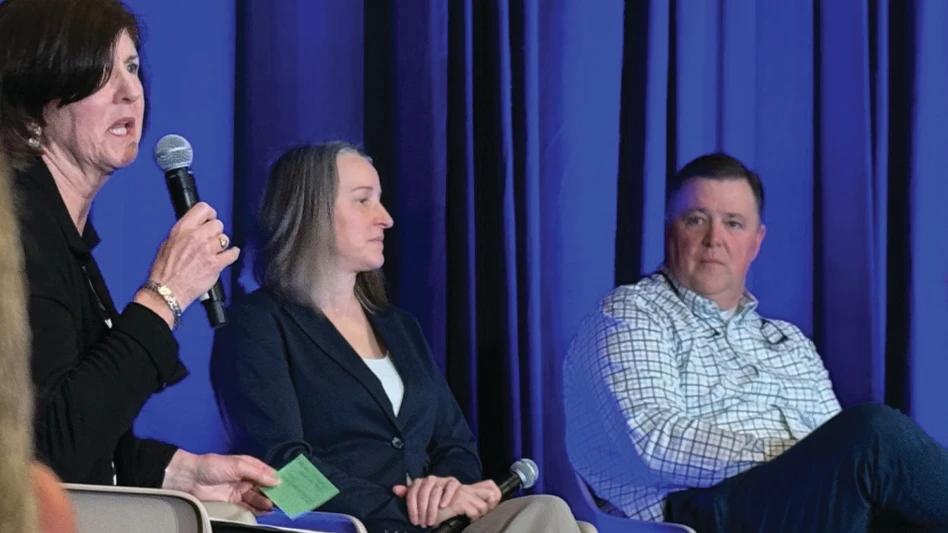
At the meeting, Elisabeth Christ, BIR communications director, said the Paris event was nonetheless a successful one for the global organization of recyclers, drawing close to 900 delegates and more than 1,000 attendees from 54 countries.
BIR President Bjorn Grufman reported on a changing of the guard for several BIR officer positions, with new division chairs taking over several of the group’s divisions during the October event.
Grufman also said he would be completing his term as president of the BIR in May 2015 at the association’s World Recycling Convention, to be held in Dubai, United Arab Emirates. Grufman has served as president of the organization since 2011. He said details on the new president will be announced in the coming weeks.
As Grufman indicated, during the following two days of divisional meetings, several new chair positions were announced:
- Ferrous Division Chairman Christian Rubach of Germany’s TSR Recycling, who has held the post for eight years, passed the reins to William Schmiedel of U.S.-based Sims Metal Management.
- Robert Stein of U.S.-based Alter Trading, who has served as president of the Nonferrous Division for more than seven years, also stepped down from the post in late October. He named David Chiao of Uni-All Group interim president, to serve the balance of his term, which runs to May of 2015.
- Stainless Steel Committee Interim Chair Mark Sellier of OneSteel Recycling, China, announced that Joost Van Kleef of KMR Stainless would take over as division chairman.
- After almost two decades as chairman of the BIR Tyres & Rubber Committee, Barend Ten Bruggencate of VACO in the Netherlands stepped down at the Paris meeting. His successor is Ruud Burlet of Rubber Resources in the Netherlands.
- Additionally, Textiles Division Immediate Past President Olaf Rintsch of Germany-based Textil Recycling K&A Wenkhaus GmbH was appointed an honorary president of that division.
On the topic of European market conditions, Grufman told attendees of the informal meeting that Western Europe’s slowing manufacturing industry continues to hamper its recyclers.
“We have the same capacity that we had in the summer of 2008, but we have only 60 or 70 percent of the material to treat,” Grufman observed. “Everyone is fighting for the little material that is around.”
Grufman also described rising scrap prices amid stagnating sales prices, leading to thinner margins. As a result, Grufman said, it was likely Western Europe’s recycling industry would see a reduction in capacity. He referred to an excess of finished steel products from Chinese steel mills overflowing in European markets as another challenge.
“The financial situation for steel scrap traders and processors in Western Europe is poor, and that goes a bit for the whole world as well,” Grufman said. He said conditions were better in the nonferrous sector, possibly because of the influence of the London Metal Exchange on pricing for most nonferrous grades.
Also during the meeting, Ross Bartley, BIR environmental and technical director, discussed recent progress in Basel Convention proceedings after a long period of stagnation. He said the BIR is continuing to work to promote its members’ interests, particularly with regard to the movement of goods for repair, refurbishment and reuse across borders.
BIR Director General Alexandre Delacoux said the association is promoting the development of a more global circular economy. “We see many instances in developed countries, notably, that look at circular economies as a way to restrict trading to a certain region or even nation,” Delacoux observed. Such a view is not appropriate, he said, “because of the fact that you need trading in these materials on an international basis and based on price, rather than on decisions to support various parts of the value chain.”
Delacoux also reported on a reorganization of the BIR Secretariat, based on the recent creation of the European Recycling Industry Confederation (EURIC), which represents European members of BIR.
Delacoux said the change underscores BIR’s wider intent to serve a global audience. “We are the only association in the world that’s not linked to a national agenda,” he said. “We’ve never been linked to a national agenda and this is now fulfilled with the launching of this organization.”
Additionally, Delacoux said the BIR would soon announce the hiring of a new conference director. The BIR’s long-time Director General Francis Veys had announced his retirement from the BIR in late 2013 but has continued to assist with conference planning since then.
Delacoux said the new conference director, to be announced in the coming weeks, is expected to usher in a series of changes to BIR conference formats. “That’s going to shape [us] completely differently in terms of looking at conventions and the way our conferences are organized,” Delacoux said.
Latest from Recycling Today
- Greenwave raises revenue but loses money in Q2 2025
- Recycled steel prices hold steady
- EY says India’s need for scrap imports will continue
- Coming full circle
- Amcor, DCM introduce fertilizer packaging with 35 percent recycled content
- Comstock Metals gets closer to commissioning commercial-scale solar panel recycling facility
- Washington selects Circular Action Alliance as PRO
- Smurfit Westrock expands in Latin America