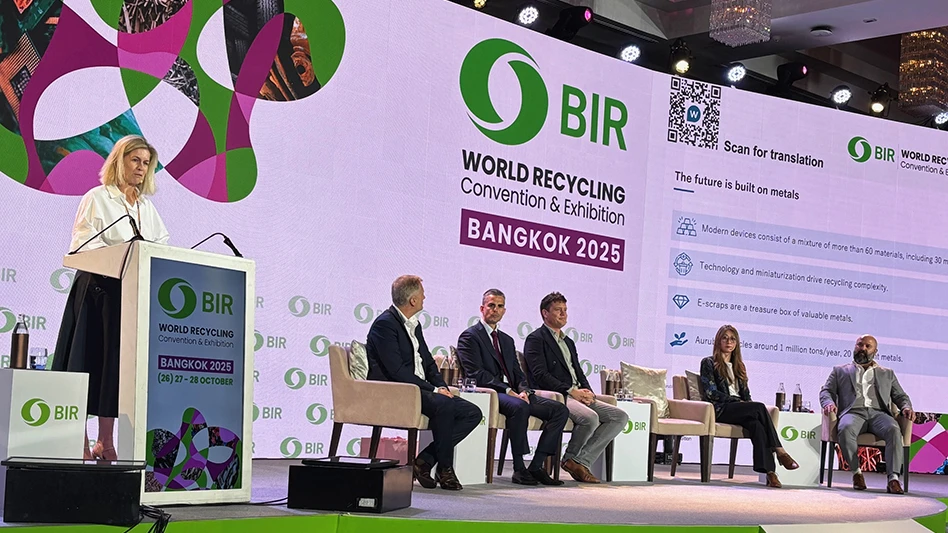
Photo by Brian Taylor
Recycled metals traders have been faced with a series of hurdles in the 2020s, but thus far, material continues to be collected and traded abundantly, according to presenters at the Bureau of International Recycling (BIR) Non-Ferrous Division meeting held in late October in Bangkok.
“Nonferrous material flows are a lot like trade winds,” division President Paul Coyte of New Zealand-based Hayes Metals said. “It's really hard to work out the future direction of wind flow if you don’t have accurate information. Similarly, in our businesses, without accurate information, it’s really hard to spot future trends.”
Information making the rounds in the last year has been tied to policy measures in several market regions, including restrictions and port inspections in Malaysia, Thailand and China.
In the United States, tariffs are affecting supply chains, while policymakers in Europe are considering restrictions on recycled aluminum and copper exports.
Jessica Fung, a consultant with London-based Project Blue, said announcements relating to potential copper tariffs in the U.S. had immediate and measurable effects on material flows and prices.
Imports of refined copper jumped sharply in the months before the measures were due to take effect in August, Fung said.
“All of a sudden the market takes note and says, ‘Well, we’d better get all our refined copper into America as quickly as possible before these trade tariffs kick in,'" she continued.
Project Blue has calculated that secondary copper imports and exports, on a volume basis, have shown a generally flat trading trend globally over the past decade. However, Project Blue has adjusted the numbers to a copper equivalent basis by considering the value of contained copper, the timing of shipments and how exporters report their numbers.
According to Fung, this “smarter” data reveals steady secondary copper trading growth during the past 10 years and indicates that more copper per ton is being exported or imported now compared with a decade earlier.
Data gathered by Project Blue indicate growth in secondary copper refining capacity is particularly strong in Asia, including beyond China, with Japan and South Korea both expanding their consumption of copper scrap this century.
"What started at below 10 percent of scrap input into their smelters and refineries [in 2000] has increased to almost 25 percent now, and we expect that to continue growing,” Fung said.
Fellow speaker Inge Hofkens, chief operations officer with Germany-based Aurubis AG, said now more than ever in the 30 years she has been in the metals industry, she is seeing changes in the world’s nonferrous scrap flows.
“If some regions keep markets open while others close their borders, and at the same time buy large volumes of metals in other jurisdictions, this puts international trade and ultimately our circular economy at risk,” she said of the current situation.
“If we as industry players are fragmented and not united, others will define our future. If we stand together, we will define our future ourselves.”
She characterized responsible primary metals production and strategic recycling as a powerful duo, not necessarily as competitors, with the two sectors having the combined ability to offer resilience.
Hofkens referred to Aurubis’ new recycled-content metals production plant in the U.S. as an example of another kind of partnership.
“We are supporting the U.S. scrap community by building a local outlet, turning complex scrap into refined metals,” she said. “It marks a new era of circularity.”
Meeting presenter Stuart Kagan offered insight into the benefits of his of New Zealand-based Buddy online recycled materials trading platform, which was one of several presentations on technology offered at the Bangkok event.
The BIR October 2025 World Recycling Convention & Exhibition was at the Centara Grand Convention Centre at Centralworld in Bangkok from Oct. 26-28.