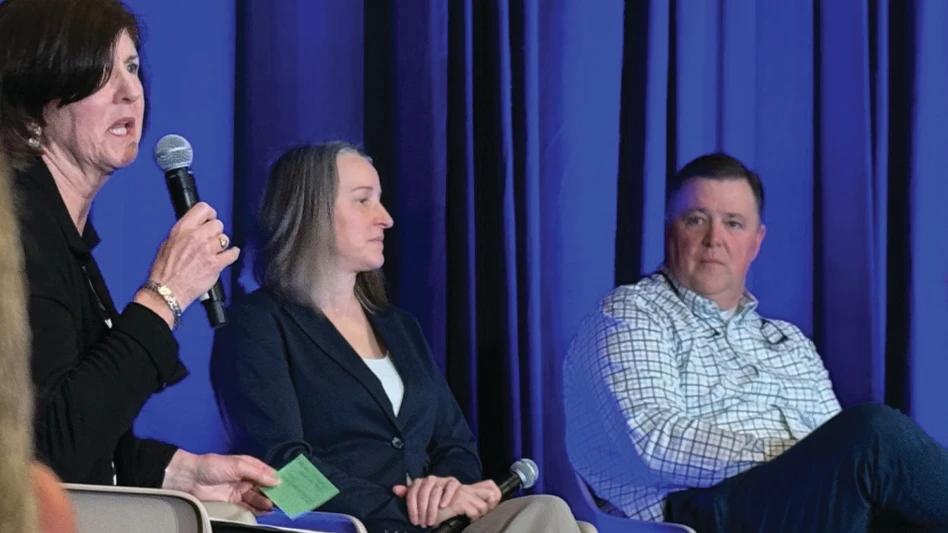
During the Bureau of International’s Spring meeting, members of the ferrous division discussed various issues that are having an impact on the ferrous market.
One issue that was noted is that the European Commission is set to clarify when waste ceases to be waste for a limited number of streams, and it will begin the determining process with steel scrap, said Christian Rubach, president of EFR, Germany. According to published reports, facts and figures, as well as assessments of the financial impact of the waste stigma on the scrap industry, are to be collated by EFR ready for presentation to the Commission and member states on June 8.
During the Ferrous Roundtable meeting it was announced that Colin Iles of UK-based European Metal Recycling Ltd had been made BIR Ferrous Division President following the resignation of Robert Philip of Hugo Neu Schnitzer Global Trade.
In the traditional review of latest world market conditions, Anton Van Genuchten of TSR GmbH & Co. KG in Germany stated that the EU’s scrap trade balance had been improved by last year’s admission to membership of countries such as Poland, the Czech Republic and Hungary. The EU imported 8.2 million metric tons of ferrous scrap last year while exporting 9.5 million metric tons. While noting that demand for scrap had reversed within recent months, Genuchten contended that the current state of panic in the scrap market was unlikely to last and that prices ‘could be bottoming out this summer’.
Reporting on the situation in the USA, John Neu of Hugo Neu Schnitzer Global Trade, said that collections were beginning to slow and that suppliers were confused how scrap prices could fall so much ‘while steel production and scrap consumption still remain relatively very strong’. But he added: ‘At some point, buyer reluctance and reduced collections will cause scrap inventories to reduce further, which will then be accompanied by a greater need to replenish.’
In many regions of Russia, the seasonal increase in scrap collections had begun as late as mid-April this year due to a persistent covering of snow; as a result, collection levels in May were expected to be 10 percent greater than the same time last year, according to BIR Ferrous Division Vice-President Denis Ilatovskiy of Mair Joint Stock Co.
Illatovskiy added that stable market conditions were likely to lead to ‘an intense competition in the scrap market’, a drop in profitability and a reduction in the number of market participants.
Scrap prices ‘haven’t yet found the resistance level’ in 2005, said Jeremy Sutcliffe of Australia-based Sims Group Ltd in his Pacific Rim and Far East report. He also noted that Chinese steel production had increased by 24 percent so far this year and yet the country’s ferrous scrap imports had dropped by 21 percent.
Developments in China were also discussed by the Ferrous Division’s guest speaker - Josep Giné, General Manager of Spanish steel producer CELSA. Due to its heavy reliance on BOF steel production, ‘iron ore is much more strategic to China’s steel industry development than scrap’, he told delegates. Increases in EAF production would be absorbed by higher domestic scrap recovery, with the result that China’s ferrous scrap imports would be around 10 million metric tons in 2010 - the same as in 2004, he argued.
Giné added that energy shortages in both China and India, together with the availability of iron ore, ‘will slow down the global trend towards EAF’.
Latest from Recycling Today
- Vecoplan to present modular solutions at IFAT 2026
- Terex Ecotec appoints Bradley Equipment as Texas distributor
- Greenwave raises revenue but loses money in Q2 2025
- Recycled steel prices hold steady
- EY says India’s need for scrap imports will continue
- Coming full circle
- Amcor, DCM introduce fertilizer packaging with 35 percent recycled content
- Comstock Metals gets closer to commissioning commercial-scale solar panel recycling facility