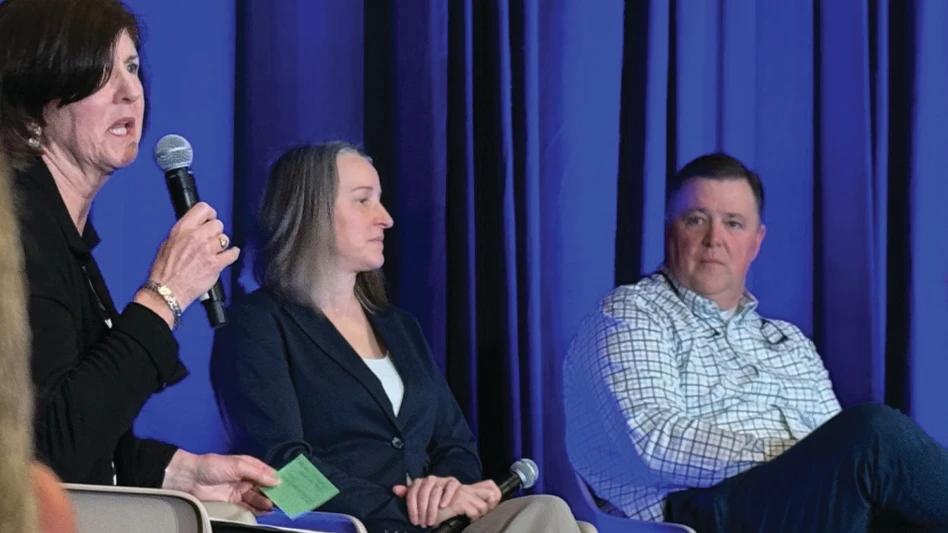
The strength and sustainability of the much-discussed economic upturn preoccupied speakers at the BIR Ferrous Round-Table in Amsterdam.
Divisional President Christian Rubach of Germany-based Interseroh Hansa Recycling GmbH, president of the Ferrous Division, noted that “So far, this seems to be based on restocking of inventories and/or the result of stimulus packages and other governmental programs.” And over the coming years, he added, the Western economies appear likely to suffer significantly slower growth rates than leading developing nations.
Idled excess capacity remains an “overriding issue” in the steel industry and so, despite consolidation, the sector’s product prices “are unlikely to increase to sustainable levels any time soon”, said Blake Kelley of Sims Metal Management. “But in the meantime, lower volume makes it very difficult for scrap processors and steel producers to effectively amortize their costs.”
He added that scrap prices are likely to continue easing downwards until demand and supply return to balance - possibly by late December buying but more probably not until January.
The EU report from Markus Barg of TSR Recycling in Germany confirmed that “one year of crisis with production cuts of more than 40 percent has certainly left its mark on the financial situation of our customers; their margins seem to be healthy, but the volumes are missing”. EU steel scrap consumption fell around 40 percent in the January-August period to approximately 45 million metric tons, while exports dropped some 20 percent in the first half of 2009 to 6.5 million metric tons, with leading buyer Turkey slashing its orders for EU material by 39 percent to just short of 3 million metric tons.
According to Andrey Moiseenko of MAIR in Russia, domestic scrap collection volumes amounted to around 2 million metric tons in September this year - a decline of around 30 percent compared to 2008. However, October is likely to see the highest collection total of the year to date, he added.
The Ferrous Division’s guest speaker Dr Thomas Ludwig, CEO of German steel distributor Klöckner & Co SE, also warned that real demand for steel has shown no signs of a major recovery and could remain at low levels for some time. Without a rapid improvement in real demand, steel prices are likely to remain highly volatile in the coming years, he said.
Highlighting China as “the wildcard” in his industry outlook, he argued that fears of the country becoming a major steel exporter are unfounded. He also suggested that the worst of the global crisis “is behind us” and that the long destocking phase in the steel sector is at an end.
Ikbal Nathani of India’s Nathani Group of Companies emphasized the concerted efforts of BIR, ISRI and the newly-formed Metal Recycling Association of India to convince the Indian government that ferrous and non-ferrous scrap should not be classified as “hazardous waste”. Current proposals threaten scrap exports to the country, he warned.
Latest from Recycling Today
- Charter Next Generation joins US Flexible Film Initiative
- Vecoplan to present modular solutions at IFAT 2026
- Terex Ecotec appoints Bradley Equipment as Texas distributor
- Greenwave raises revenue but loses money in Q2 2025
- Recycled steel prices hold steady
- EY says India’s need for scrap imports will continue
- Coming full circle
- Amcor, DCM introduce fertilizer packaging with 35 percent recycled content