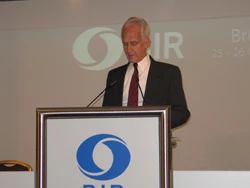
The Bureau of International Recycling (BIR) Nonferrous Division reported during the organization’s autumn convention in Brussels that demand for nonferrous scrap has been resurgent in 2010 following the lows of late 2008 and the first half of 2009. “We again found ourselves as the fuel for the demand of the emerging economies of the world - as providers of ecologically viable alternatives to primary metals to growing but mineral-deficient nations,” the division’s president, Robert Stein of U.S.-based Alter Trading, told those in attendance at the Oct. 25 session.
But while “scrap has come into the system and has met the needs of consumers,” the nonferrous scrap world “still suffers far too many limitations and obstacles from governments,” Stein added. He also stated firmly, “Our scrap metal should be treated on an equal footing with its primary counterparts.”
Robert Voss of U.K.-based Voss International, chairman of BIR’s International Trade Council, reported trade barrier developments in a number of countries, including Sri Lanka and the East African community. Voss urged BIR members to keep the world organization informed of any moves likely to impair import/export flows of recyclables such as nonferrous scrap.
In reviewing market reports from around the globe, BIR nonferrous division board member Alejandro Jaramillo of Recicladora Cachanilla in Mexico noted a number of common themes, such as: the weakening of the U.S. dollar, making exports more challenging; concerns throughout the supply chain about price volatility; widening discounts between scrap and primary metal prices, in some cases to “historical highs;” cash-flow issues for many traders and processors; and the impact of China’s relative inactivity in the market.
Jaramillo also highlighted the fact that Russia has begun importing nonferrous scrap this year from Romania, Poland, Kazakhstan, the Ukraine and Spain, among others. “The trend is likely to continue,” he said.
Guest speaker Bob Garino, director of commodities at the Institute of Scrap Recycling Industries Inc. (ISRI), said the recycling industry appears to be “on a reasonably solid footing” whereas the overall U.S. and global economic recovery “is still fragile” and “subject to external shocks.” These could be triggered, he suggested, by fresh sovereign debt issues in the European Union, global currency devaluations and subsequent protectionist trade policies and/or major political or economic upheavals.
William Adams, head of research at U.K.-based FastMarkets Ltd., told attendees that prices of all of the major nonferrous metals will push higher in time as part of a “super-cycle” driven by secular growth in rapidly-developing economies and supported by “slow but volume growth” in mature economies.
While Adams anticipated “considerably stronger” metals prices in the years ahead, he also argued that current levels “are not justified” and so there exists “considerable risk of downside corrections.”
Latest from Recycling Today
- Equipment from the former Alton Steel to be auctioned
- Novelis resumes operations in Greensboro, Georgia
- Interchange 360 to operate alternative collection program under Washington’s RRA
- Waste Pro files brief supporting pause of FMCSA CDL eligibility rule
- Kuraray America receives APR design recognition for EVOH barrier resin
- Tire Industry Project publishes end-of-life tire management guide
- Des Moines project utilizes recycled wind turbine blades
- Charter Next Generation joins US Flexible Film Initiative