Photo by Brian Taylor
The Electrics, Electronics & EV Batteries (EEEVB) Committee of the Brussels-based Bureau of International Recycling (BIR) is joining forces with the United Nations Institute for Training and Research (UNITAR) to develop an updated edition of the Global E-Waste Monitor.
That publication referred to the Monitor as “the textbook for end-of-life electronics policy.” According to BIR, the partnership can help bring global visibility to the true impact of electronics recycling.
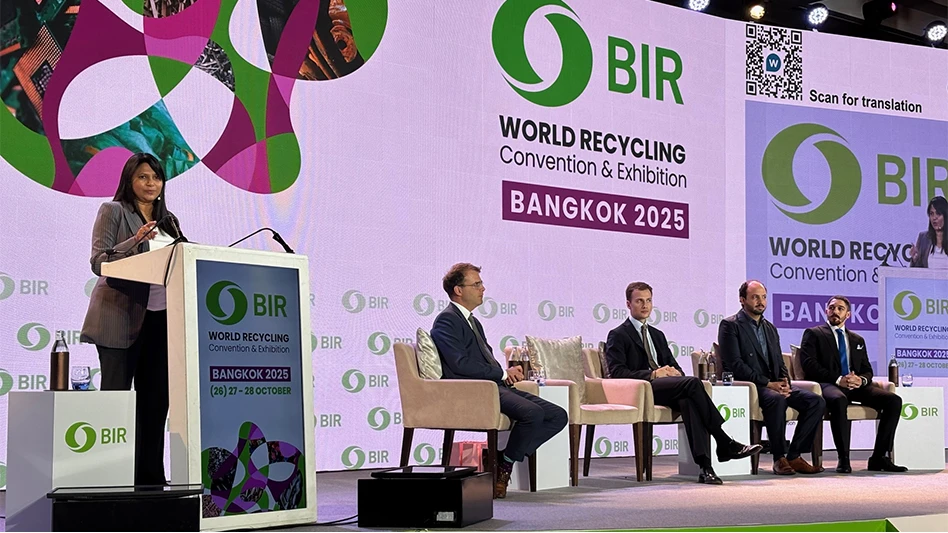
Dr. Kees Baldé, a senior scientific specialist with UNITAR, told delegates at an EEEVB Committee meeting in late October in Bangkok, that BIR would help broaden and deepen UNITAR’s data and understanding of how secondary raw materials can be recovered from electrical and electronic products.
“We know what recycling delivers: recycled materials, critical raw materials, economic value, job creation, environmental protection and innovation in motion,” said Josephita Harry of the EEEVB Committee and United States-based Pan-American Zinc LLC. “It’s time the world knows [that] our work matters, our data matters [and] our impact matters. When our impact is counted, our industry is impossible to overlook. Electronics recycling is not the end of life; it is the beginning of value.”
Baldé said the partnership would cooperate on data gathering, mapping recycling capacities—including a questionnaire sent to BIR members on a global level, says the organization.
The announcement came in the middle of Baldé’s presentation on the Monitor in which he emphasized the importance of good data.
“It's always crucial because with bad data we can only have bad information," he said. "And with bad information we will have no policies or bad policies.”
UNITAR’s current figures indicate about 22.3 percent of e-scrap has been collected and recycled in what the agency considers an environmentally sound manner.
As did attendees at the BIR International Environment Council meeting in Bangkok, delegates heard how confusion and uncertainty had followed amendments enacted in January to the Basel Convention on E-Waste.
Trade and Environment Policy Officer Federico Zanotti said the amendments were affecting the transboundary flow of recycled nonferrous metals, such as zorba and other shredded metal grades, and BIR was striving for resolution of the problem.
“This is creating a lot of confusion, both for customs authorities and recyclers, with significant impact,” Zanotti said, indicating hundreds of containers belonging to BIR members had been stopped by customs authorities at many ports claiming the material has been misdeclared.
“We have raised the issue at the UN Basel Convention level, and what has clearly emerged is that the amendments are going well beyond their intended scope, which certainly was not to control the trade in nonferrous recycled metals,” he continued.
Zanotti said the UN has established a working group to develop a guidance document and said BIR was actively participating in the process and had created a dedicated internal working group devoted to it.
Dylan Roman of Mexico-based Niu Niu Resources said the new prior informed consent (PIC) regulation could offer a competitive advantage to some recyclers because it represented legal, traceable and responsible material flows.
According to Roman, PIC should be embraced because of the standards it sets, although he acknowledged the challenge was to make the process visible, digital and verifiable but without more paperwork.
EEEVB Committee member Yousef Al Sharif of the United Arab Emirates-based Sharif Metals Group said the closure of Red Sea routes, container shortages and insurance charges were adding up to $110 per ton to the cost of exporting secondary metals from the region. Government-imposed duty fees ranging from $82 to $109 per metric ton for recycled steel, copper and e-scrap also have been imposed.
“Policy now moves markets faster than price,” Sharif said. “The recyclers who master compliance, transparency and quality will lead the next decade of global metal trade.”
The BIR October 2025 World Recycling Convention & Exhibition was at the Centara Grand Convention Centre at Centralworld in Bangkok from Oct. 26-28.
Latest from Recycling Today
- England's Environment Agency extension provides stability for metal shredding operators
- Schupan names new chief financial officer
- NAW looks ahead to July hearing in Oregon
- Recycle Coach partners with Bartec Municipal Technologies
- EPA proposes abandoned tire cleanup plan with focus on energy recovery
- BIR welcomes new policy officer for trade & environment
- Global Recycling Foundation recognizes Recycling Heroes
- Recycling Today Media Group launches Paper and Plastics Recycling Conference webinar series