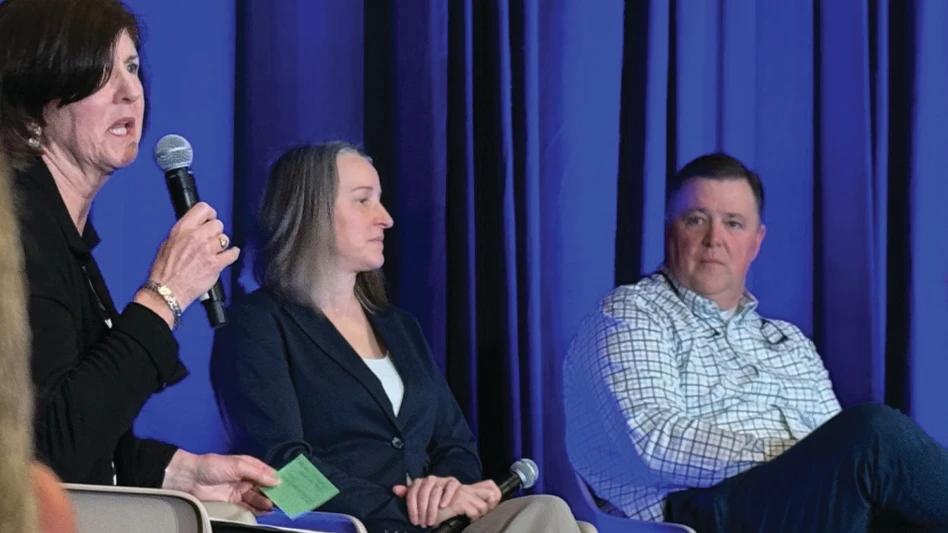
2015 has been “a very tough year” in which the “bad economic climate” has led to adverse effects on companies’ budgets and employment plans. So said Bureau of International Recycling (BIR) Nonferrous Metals Division President David Chiao of the Uni-All Group in the United States, at the BIR’s annual Autumn Round-Tables conference held 25-27 October in Prague.
These sentiments were echoed in the world market summary provided by divisional board member Nick Rose of U.K.-based Tandom Metallurgical Group.
“It was never going to be the year of plenty but the most pessimistic of bears couldn’t have foreseen the constant downward spiral of 2015,” he lamented. “Today’s nonferrous industry faces diminishing margins, rising costs and low confidence—and it will not be long until the banks become nervous.”
Since January, he noted, London Metal Exchange (LME) prices had fallen by 14 to 15 percent for copper, 12 percent for aluminium and 9 percent for lead, but even these declines had been eclipsed by the 23 percent and 35 percent slumps seen in zinc and nickel respectively.
Among the contributing factors, Rose listed slowing economic growth in China and the devaluing of the Chinese currency, which he said had undermined traders’ confidence. And even though India had fared better than most this year, the nonferrous industry had been adversely affected by “teething problems” surrounding the country’s new preshipment inspection procedures. Market conditions in Europe, meanwhile, were described as bleak, with traders complaining of low volumes and difficult sales.
The meeting in Prague also brought a standing ovation for two of BIR’s nonferrous mainstays on the occasion of their retirement from BIR activities, namely Immediate Past President of the division Robert Stein of U.S.-based Alter Trading and Robert Voss CBE of the U.K., formerly Nonferrous Metals Division board member and International Trade Council chairman.
Stein acknowledged that business conditions were “painful and ugly” at present, partly because of the excessive capacity expansion of past years that had been based on strong demand from China. While many businesses would “vanish,” those with foresight “will lead our industry into a period of acceptable growth.”
Voss—a veteran of more than 70 BIR World Conventions—identified the communications revolution as the biggest change to affect the nonferrous industry that he had joined more than 40 years earlier.
Guest presentations in Prague focused on Eastern European recycling markets, specifically as they relate to zinc and lead. Marek Orlicz, commercial director of Polish secondary zinc and zinc die casting alloys producer MetalCo, spoke of a trend toward increasing volumes of zinc scrap being brought into Poland so as to service domestic operators’ burgeoning order files for secondary zinc and zinc alloys. In addition to Europe and most notably Germany, material was being sourced from the Americas, the Middle East and North Africa.
Marek Zelazny, commercial director of Baterpol S.A., which is one of the biggest lead producers in Poland with a core business of recycling lead-acid batteries, agreed with his fellow guest speaker that sourcing raw material was his pre-eminent concern. “Twenty-five percent of my activity is in sales and 75 percent is in looking for raw material,” he said. “It is crucial for our business.”
According to Orlicz, sharp fluctuations in LME zinc had created a “frozen” market as those holding stocks awaited more attractive prices.
Latest from Recycling Today
- Charter Next Generation joins US Flexible Film Initiative
- Vecoplan to present modular solutions at IFAT 2026
- Terex Ecotec appoints Bradley Equipment as Texas distributor
- Greenwave raises revenue but loses money in Q2 2025
- Recycled steel prices hold steady
- EY says India’s need for scrap imports will continue
- Coming full circle
- Amcor, DCM introduce fertilizer packaging with 35 percent recycled content