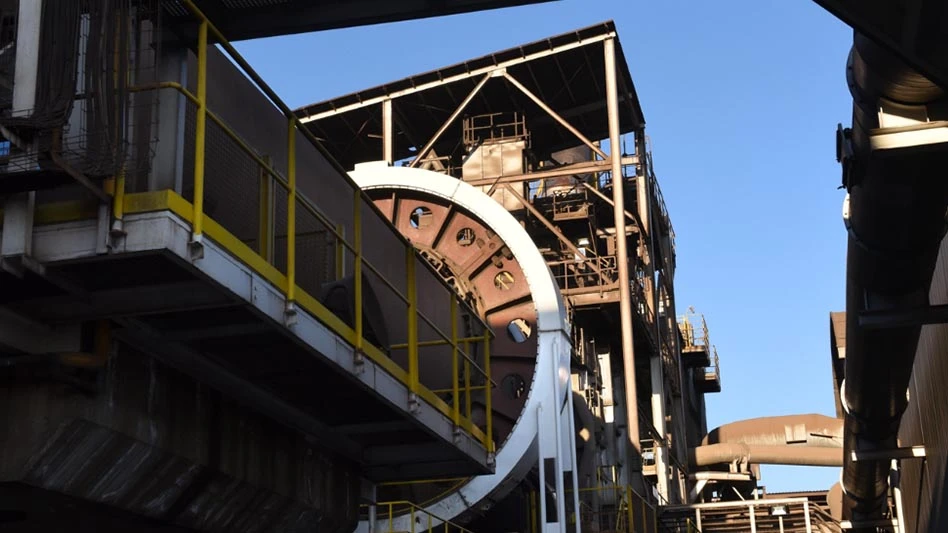
Photo courtesy of Befesa
Befesa S.A., headquartered in Luxembourg, has reported its preliminary financial results for 2025, noting record performance in adjusted earnings before interest, taxes, depreciation and amortization (EBITDA) and operating cash flow.
The provider of hazardous waste recycling services to the steel and aluminum industries says its strong operational and financial performance was despite a challenging market environment.
While Befesa’s total revenue decreased by 5 percent to 1,182.6 million euros (1,396 million) in fiscal year 2025 from 1,239 million euros ($1,463 million) in 2024, primarily reflecting lower secondary aluminum volumes, its adjusted EBITDA increased by 14 percent to 242.8 million euros (286.6 million) from 213.4 million euros (251.9 million) in 2024. The company says the increase in EBITDA was driven by favorable zinc treatment charges, improved zinc hedging prices and lower operating costs. The company says its adjusted EBITDA margin improved significantly to 20.5 percent from 17.2 percent in 2024, reflecting the quality of earnings growth achieved during the year.
“2025 was a year of robust delivery for Befesa,” Befesa CEO Asier Zarraonandia says. “We achieved 14 percent EBITDA growth, record operating cash flow and reduced leverage well below our target whilst completing the Palmerton [Pennsylvania] expansion and extending our zinc hedges to mid-2028 at record levels. We are now entering a new cycle characterized by low capital intensity and high earnings. Looking ahead, 2026 is expected to be another year of growth, driven primarily by increasing U.S. volumes and an expected recovery in secondary aluminum operations.”
Operational highlights
The company’s Steel Dust segment reported adjusted EBITDA that grew by 25 percent to 212.1 million euros ($250.4 million) from 2024’s 170.4 million euros ($201.1 million), while its adjusted EBITDA margin was 26.5 percent compared with 20.6 percent in 2024. Steel dust throughput remained resilient at 1.21 million metric tons, with an average capacity utilization of 70 percent. In Europe, capacity utilization reached 94 percent in the fourth quarter, and China remained at low utilization levels. Befesa says capacity utilization improved to 71 percent in the U.S. in the fourth quarter, while Asia, Turkey and Korea delivered solid growth.
Zinc London Metal Exchange prices averaged $2,867 per metric ton in 2025 (an increase of 3 percet year over year), though unfavorable foreign exchange rates resulted in a flat euro-denominated zinc price of 2,542 euros per metric ton compared with 2,569 euros per metric ton in 2024. Befesa’s zinc blended price averaged 2,571 ($3,035) euros per metric ton, up slightly from 2,549 euros ($3,009) per metric ton in 2024.
Befesa says it extended its hedging program to the first half of 2028 at an all-time-high level of $3,100 per metric ton, with similar hedged volumes. For fiscal 2027, the hedge is set at $3,000 per metric ton.
The Aluminium Salt Slags segment saw salt slags and spent pot lining (SPL) recycled volumes remain broadly stable at 422,000 metric tons compared with 426,000 metric tons in 2024, with plants maintaining high utilization levels of approximately 90 percent. Salt slags revenue increased by 8 percent to 114 million euros ($134.6 million), up from 105.9 million euros ($125 million) in 2024.
The Secondary Aluminum business remained under pressure, however, with tight metal margins and lower production driven by the weak European automotive sector, Befesa says. Volumes decreased 10 percent to 154,000 metric tons at a 75 percent utilization rate, but a strong fourth quarter reinforces the view that a recovery is underway, according to the company.
Cash generation and deleveraging
Operating cash flow reached a record 211.9 million euros ($250.1 million) for the year, up 10 percent from 2024’s 191.8 million euros ($226.40 million), reflecting strong cash conversion and the benefit of higher underlying earnings, the company says.
Total capex was 76 million euros ($89.7 million), below the guided range of 80-90 million euros ($94.4-106.2 million). Befesa says this change reflects continued capital allocation discipline and delivering on planned investment programs, including 26 million euros ($34.2 million) in growth capex related to the Palmerton and Bernburg, Germany, projects, the latter of which is underway as of August of last year and will expand aluminum alloy production capacity from current 75,000 metric tons to 135,000 metric tons.
Earnings per share increased by 58 percent to 2.01 euros ($2.37).
Outlook and strategy
Befesa says it expects 2026 to be another year of earnings growth, primarily driven by higher U.S. electric arc furnace (EAF) steel dust volumes supported by new steelmaker contracts.
In Europe, Befesa expects solid steel dust volumes as EAF deliveries remain at healthy levels. In Asia, volumes are expected to remain stable versus 2025.
The zinc treatment charge for 2026 is expected to increase to around $100 to $130 per metric ton, which will have a negative impact compared with the all-time-low benchmark of $80 per metric ton in 2025, Befesa says.
In the aluminum segment, salt slags volumes are expected to remain stable to positive, while the metal margin in secondary aluminum is expected to improve gradually throughout 2026 after bottoming out in the third quarter of 2025.
Once the benchmark zinc treatment charge is settled for 2026 (expected around March/April), Befesa says it will provide its earnings guidance for the full year, to be released alongside the first-quarter 2026 results scheduled for April 30.
Latest from Recycling Today
- Remade Institute hosts Circular Economy Tech Summit & Conference in March
- North Carolina county receives FRC foam recycling grant
- Cascades tissue business falls short in Q4
- GFL renews share repurchase programs
- MP Materials selects suburban Dallas site for factory
- Press Metal affected by currency, hedging issues
- Steel output rises in top economies in January
- Thommen Group announces personnel changes