During the years following the financial crisis of 2008, an ongoing story line in the recycling industry was the idling of auto shredding plants in Europe, North America and other nations with developed economies. The boom years from 2002 to mid-2008 had clearly resulted in more metals shredding capacity than was sustainable.
In the subsequent slow-growth rebound, some of these plants have been restarted and a few new installations have taken place.
On the restart side, one recent example in the United States involves Kentucky-based Industrial Services of America Inc. (ISA), which for the first quarter of 2018 reported a 13 percent revenue increase and a $300,000 improvement in net income.
In the publicly-traded firm’s government-required quarterly financial filing, it says the improvement in operating performance “was due in part to the successful restart of the company’s shredder, as well as improvements in the company’s ferrous operations margins from 2017 to 2018.” The company says the restarts of its shredder in Louisville, Kentucky, “led to [a] favorable sales mix and improved margins.”
The news points to the ongoing role of the shredder as critical to scrap recyclers who wish to achieve scale and compete in the full spectrum of ferrous and nonferrous markets.
As the shredder has retained that role, the technology involved in shredding continues to evolve, as does the geography of where shredders are located around the world.
Changing pre-conceived notions
Shredder operators take great lengths to avoid them, but small explosions inside shredding plants can occur, presenting both a danger and, in many cases, a source of nuisance complaints from neighboring property owners.
The explosions can stem from fast-moving hammer mills encountering “sealed units” (such as propane tanks) or volatile substances that have slipped through undetected inside an auto hulk or larger piece of obsolete scrap.
In some parts of the world, low-speed, high-torque pre-shredders have become a necessary investment by scrap recyclers to avoid explosions. The “pierce-and-tear” shredders can size-reduce sealed units without causing an accompanying explosion.
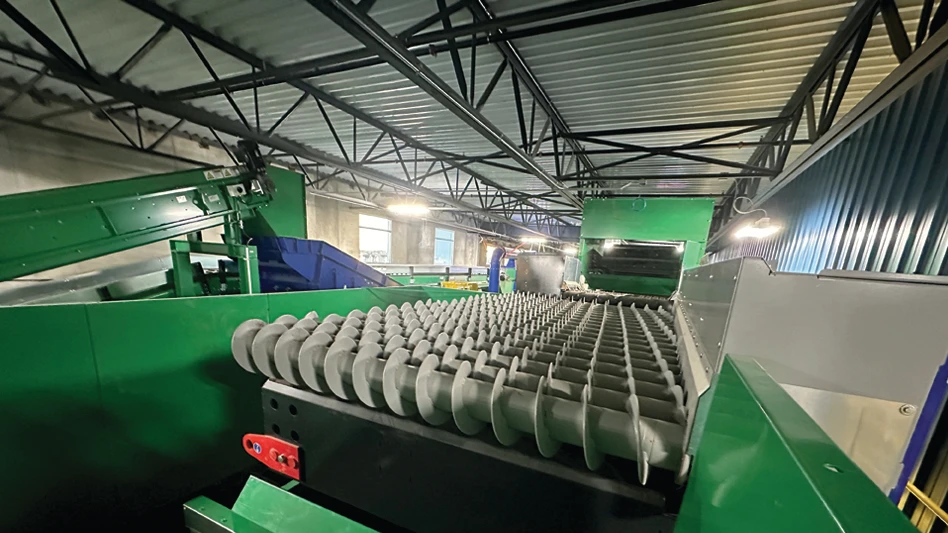
Finland-based equipment manufacturer Metso says its model, the Metso Lindemann EtaRip pre-shredder, has been designed to pre-process bundles of scrap metal or end-of-life vehicles (ELVs) before feeding them to an auto shredder.
In addition to its role in preventing explosions, Metso says the use of its pre-shredder can result in more homogeneous, easily processed infeed material, which in turn enables the next-in-line hammermill shredder to operate at optimal efficiency.
In mid-April 2018, Metso announced receiving an order to supply its first EtaRip pre-shredder in North America to an auto shredding plant operator in Ohio in the U.S.
“We are excited to have secured our first EtaRip order in North America,” said Keith Carroll, vice president, Metso Metal Recycling Americas, when the sale was announced. “We also look forward to being able to demonstrate the benefits of this product to a new audience.”
The use of such pre-shredders in North America was a topic of conversation among some scrap processors at the ISRI2018 convention in Las Vegas in mid-April. That event, hosted by the Washington-based Institute of Scrap Recycling Industries (ISRI), included an exhibit hall where several manufacturers of pre-shredding machines were able to interact with recyclers.
Metso touts the benefits of such devices for next-in-line hammermill plants as including:
- reducing the risk of unexpected explosions inside the shredding chamber;
- creating homogeneous, easy-to-process infeed material for the shredder to operate efficiently;
- reducing peak electrical loads on the main shredder drive;
- providing protection against unshreddable materials that may be inside bales or bulky materials; and
- increasing the auto shredder castings’ wear life.
If the ferrous scrap market remains strong in 2018, it could provide processors in North America with the confidence to make investments in pre-shredders to bring such potential benefits to their operations.
Addressing Asia’s ELVs
Many of the fastest-growing economies in the world are in Asia, where the auto shredding plant installation base has historically lagged that of Europe or North America. (Not including the OECD [Organization of Economic Cooperation and Development] nations of Japan and South Korea.)
With China having this decade surpassed the U.S. as the nation where the most passenger vehicles are sold annually, it is becoming increasingly clear the nation’s auto shredding installation base is poised to grow.
At the ISRI2018 convention, Scott Newell Jr., chairman and CEO of El Paso, Texas-based Newell Recycling Equipment LLC, reported his company has installed or sold 19 auto shredding plants to scrap recyclers in the People’s Republic of China.
Newell, who also is vice-chair of Nantong City, China-based China Recycling Newell Equipment (Jiangsu) Co. Ltd., said one recently installed shredder can process up to 600 tons per hour.
Among the recent installations is one in the city of Anyang in Henan Province, China, that features three infeed conveyors used to supply feedstock in steady amounts to an 11,000-horsepower (hp) shredder. “When shredding, there are plenty of times when the plant is operating at 500 or even 600 tons per hour,” states Newell.
Newell says his company has orders for three more such 11,000 hp shredders in China and has orders for “11 of our 6,000 hp machines, three of our 4,000 hp models and one of our 3,000 hp plants.”
Newell, whose father was an auto shredding pioneer and who now has several decades of shredding equipment sales and installation experience himself, says regarding the 11,000 hp super-sized plants, “It is difficult to imagine the necessity of feeding the equivalent of 10 automobiles into the infeed chute every minute (or one every six seconds). That is the beauty of having three infeed conveyors. It provides space for three to six cranes to be feeding the shredder at any given moment.”
Referring to the 11,000 hp installation in Anyang, Newell comments, “I am very proud of this installation. Having done this now for more than 50 years, I remember when, with a previous shredder powered with 500 hp, we could process 10 tons every hour if we did everything exactly right. Therefore, my pride in having a machine that does the 10 tons in one minute is, I hope, understandable.”
Fast-growing India is likewise putting a growing number of cars, trucks and scooters on the road each year, leading to an inevitable increase in ELVs.
At the SteelMint 2017 Steel Scrap & Raw Materials Conference Asia, held last September in Bangkok, Jayesh Jain of India’s MTC Group said that company is making investments, including the installation of an auto shredder, to help address India’s increased generation of ferrous scrap.
At the same conference, Yogesh Bedi of India’s Tata Steel said that company is launching a recycling division—Tata Recycling—based in part to help execute a national recycling policy being formulated by India’s Ministry of Steel.
Bedi said India’s scrap industry currently is “very fragmented.” ELVs, said Bedi, are most often handled by an informal sector that uses environmentally unsound methods that also create health risks for workers and nearby residents. He said the anticipated new policy should include “norms” that must be followed by dismantlers and incentives for ELV owners to take vehicles to recyclers who follow these norms, which eventually would lead to shredding.
Developments in the global auto and metals shredding sector will be part of the discussion at the upcoming Bureau of International Recycling (BIR) World Recycling Convention in late May in Barcelona.
The BIR’s Shredder Committee will meet, as part of that event, on Tuesday, May 29, at 10:30 a.m., immediately following the BIR’s Ferrous Division meeting.
Latest from Recycling Today
- Organics Recycling Conference 2026: Q&A with keynote speaker Andy McNeill
- CMRA selects Vietnam for 2026 event
- Steel Dynamics foresees profitable Q1
- AF&PA joins NAW lawsuit in Oregon
- California’s ‘Truth in Labeling’ law faces federal suit
- Fayetteville, Arkansas, adopts new cart-based recycling program
- Google purchases carbon removal credits generated by Amp’s organic waste processing
- FTR forecasts toughening conditions for shippers