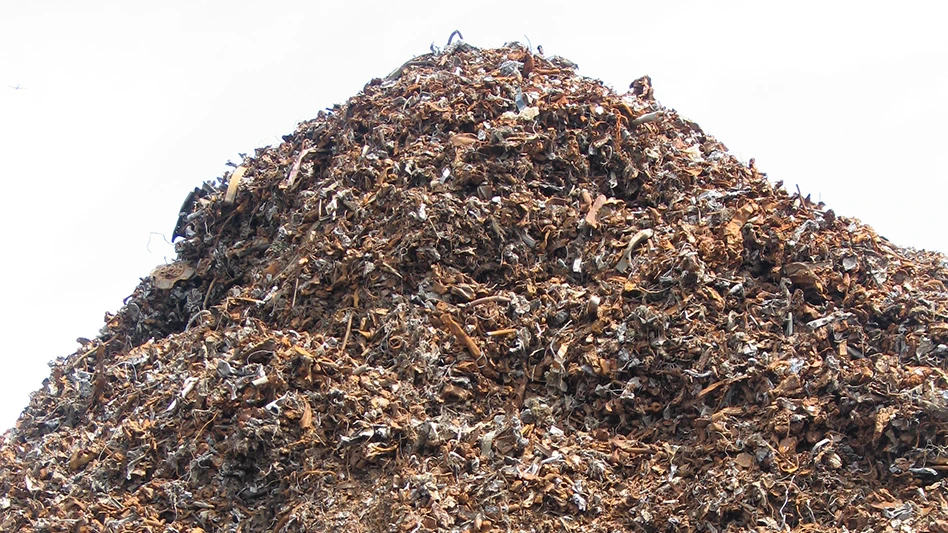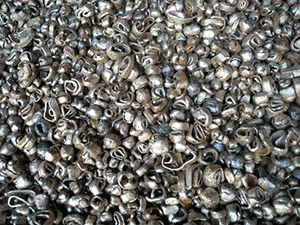
Operators of scrap metal shredding plants now have access to a brochure that spells out eight benefits to mills and foundries melting shredded ferrous scrap. The brochure was produced by the Bureau of International Recycling (BIR), whose Shredder Committee convened at the 2015 BIR World Recycling Convention in Dubai, United Arab Emirates, in May.
Among the benefits provided by shredded ferrous scrap spelled out in the brochure are:
- cost savings in the melting stage brought about by the size, shape and density of shredded scrap;
- time savings in charging shredded scrap into electric arc furnaces (EAFs);
- improved quality control in terms of measuring residual copper content and preventing radioactive materials from being introduced;
- material handling efficiency compared to baled scrap, including the use of conveyor belts.
BIR Trade & Environment Director Ross Bartley and Shredder Committee board member Salam Sharif also presented the BIR’s updated figures on how many auto shredders there are globally. Sharif, chairman of United Arab Emirates-based Sharif Metals, said the BIR and BMR (Bureau of Middle East Recyclers) know of 30 shredders in the host MENA (Middle East – North Africa) region, with 18 of these being 3,000 hp or larger.
Bartley said the NAFTA region (Canada, United States and Mexico) includes 288 shredders in the United States, 18 in Canada and 11 in Mexico that the BIR is aware of. Japan has 110 shredders serving its population of 126 million people.
In Europe, Italy is listed by BIR as having the most shredders at 63 plants, followed by France with 51, the United Kingdom with 47 and Germany with 43, according to Bartley.
Although the BIR knows of 23 shredding plants in China, Shredder Committee board member Scott Newell of The Shredder Company LLC said that figure may only include plants installed by American and European manufacturers. He estimated an additional 50 shredding plants designed and made by Chinese equipment companies may now operate within China.
Shredder Committee member George Adams Jr. of U.S.-based SA Recycling urged plant operators to keep a close eye on shredder feedstock stockpiles, saying the presence of batteries containing lithium is leading to more stockpile fires.
Adams urged members to maintain a low inventory of feedstock, or to keep their inventory in piles of 250 tons or less so that any fire can be contained or extinguished easily.
Guest presenter Heiner Guschall of Germany’s Sicon GmBh said shredding operations have changed from the running of a single machine (the shredder) 20 years ago to “a process of different steps that need to be designed and adjusted precisely.”
Guschall said plant operators are not only prioritizing the intense recovery of all nonferrous metals, but that they also are seeking “better-performing ferrous separation.”
He noted that cars increasingly contain more electronic components, which represent potential opportunities in the form of more copper, but also challenges in the form of small batteries and printed circuit boards, both of which are unwanted at melting facilities.
The 2015 BIR World Recycling Convention was May 17-20 at the InterContinental Festival City in Dubai.
Latest from Recycling Today
- Equipment from the former Alton Steel to be auctioned
- Novelis resumes operations in Greensboro, Georgia
- Interchange 360 to operate alternative collection program under Washington’s RRA
- Waste Pro files brief supporting pause of FMCSA CDL eligibility rule
- Kuraray America receives APR design recognition for EVOH barrier resin
- Tire Industry Project publishes end-of-life tire management guide
- Des Moines project utilizes recycled wind turbine blades
- Charter Next Generation joins US Flexible Film Initiative