Photo courtesy of Ascend Elements
Ascend Elements, a Westborough, Massachusetts-based lithium-ion battery (LIB) recycler, says it has achieved a significant milestone in domestic critical minerals recovery, producing greater than 99 percent pure, recycled lithium carbonate from black mass—a development the company claims is the first in U.S. history.
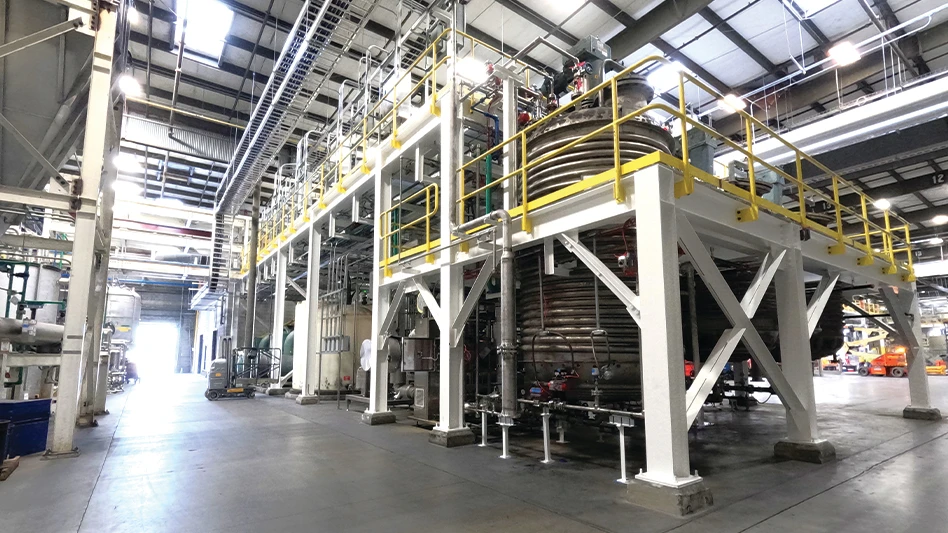
Ascend operated a commercial-scale lithium recovery line at its battery recycling facility in Covington, Georgia, in August to demonstrate the commercial viability of lithium recovery and recycling and plans to produce more than 15,000 metric tons of recycled lithium carbonate per year in the U.S. and Europe by 2027.
RELATED: Poland offers up to $320M to Ascend Elements for LIB recycling facility
In addition to the Covington facility, Ascend plans to operate a battery materials facility at a new location in Europe.
“Ascend Elements is at the center of three macro trends: Electrification, localization and critical minerals,” President and CEO Linh Austin says. “Our production of recycled lithium carbonate is an important milestone across all three of these trends. By producing recycled lithium carbonate at commercial scale in the United States and Europe, our team will advance energy independence, critical minerals security and electrification for the western world.”
Ascend notes that lithium carbonate is listed on the official U.S. federal government list of critical minerals published in August. The material is used to manufacture LIBs, glass and ceramics. The company cites research from Benchmark Mineral Intelligence claiming that 98 percent of U.S. lithium carbonate imports come from South America, while most of Europe’s imported lithium carbonate comes from South America and China. Both the U.S. and Europe currently have limited capacity to mine and process lithium carbonate.
“I’d like to thank our team in Georgia, who worked tirelessly on this project,” Austin says. “Recovering lithium from black mass is the most efficient way to source this critical mineral. In fact, the concentration of lithium in black mass is 10 times higher than in Chilean brine pools.”
The company says a recent life cycle assessment found its lithium recovery process is “significantly cleaner than traditional mining processes,” producing 86 percent lower carbon dioxide equivalent (CO2e) emissions and 97 percent lower particulate matter 2.5 (PM 2.5) emissions than spodumene mining and 37 percent lower CO2e emissions and 81 percent lower PM 2.5 emissions than Chilean brine extraction. By 2030, the company says it aims to achieve 99 percent lower CO2e emissions and up to 99.7 percent lower PM 2.5 emissions through additional decarbonization efforts.
Latest from Recycling Today
- Fleetio launches AI capability to accelerate fleet maintenance approvals
- The Metals Agency receives approval for export credit insurance
- Recycle Ann Arbor extends drop-off station operating hours
- Sybilion seeks to help manufacturers confidently address volatility
- Rio Tinto, Prysmian partner on low-carbon aluminum solutions for data centers
- Unilever criticized for plastics approach
- USTR to study additional steel, aluminum tariffs
- Electrified Materials adds processing capacity