Photo courtesy of the International Aluminium Institute
A new report from the International Aluminium Institute (IAI), London, outlines the circular potential of aluminum beverage cans with an emphasis on closed-loop recycling.
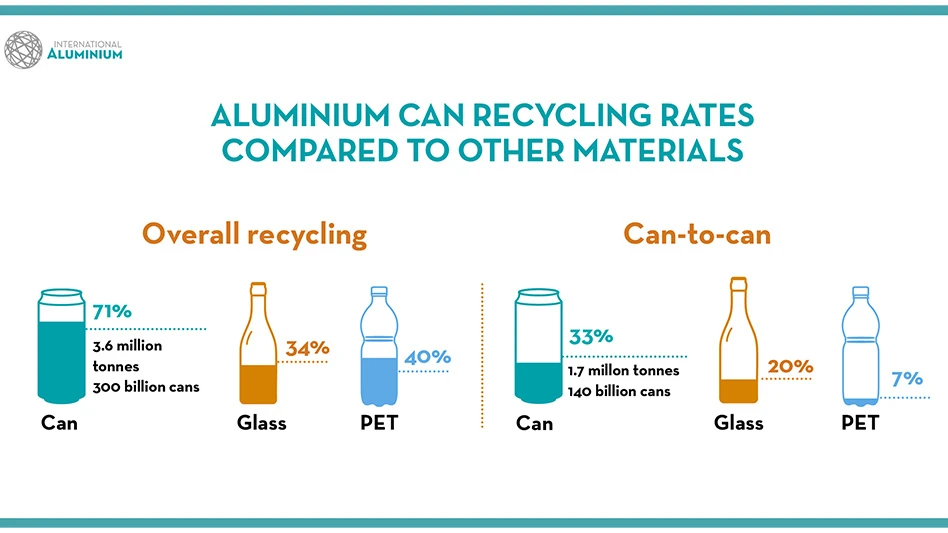
The report compares recycling rates, can-to-can recycling performance and the fate of cans not returned to the cycle. It finds that while 71 percent of aluminum cans placed on the market are recycled, only 33 percent are made back into new cans.
Among other key findings of the report:
Thirty-three percent of recycled aluminum cans (140 billion cans) are recycled back into cans compared with 7 percent for polyethylene terephthalate (PET) and 20 percent for glass.
Eighty-seven percent of all recycled cans could be turned back into cans without changing alloys or remelt operations, yet only 47 percent currently make that journey.
More than 20 percent of cans are used in products like engine blocks, where incompatible alloys prevent their return to the can cycle.
Pathways to 2050
The report models three possible scenarios regarding can-to-can recycling:
Recycling 420 billion cans would yield 207 billion new cans by 2050.
Raising closed-loop recycling from 47 percent to 87 percent could generate 685 billion cans.
With close to 100 percent collection, compatible alloys and high-quality scrap, nearly 6 trillion new cans could be produced from the same input.
Achieving this transformation would require high collection rates, clean used beverage can (UBC) scrap, recycling-friendly alloy designs and global policies to minimize contamination and scrap leakage.
“This analysis shows that aluminum cans aren’t just recyclable— they’re a blueprint for circularity,” Marlen Bertram, IAI director of scenario forecasts, says. “But true circularity demands more than collection. It eventually requires smart alloy design, clean recycling streams and infrastructure that keeps valuable materials in play.”
Regional insights
The report also provides regional UBC recycling insights:
The United States leads the world with a 97 percent closed-loop recycling rate, but the overall UBC recycling rate is 43 percent.
Thailand performs well, with 72 percent of cans returning to cans.
Vietnam has the lowest can-to-can recycling rate, hindered by export duties and missing infrastructure.
IAI's call to action aims for 87 percent of recycled aluminum cans to be returned to can production, maximizing material and economic value worldwide.
Latest from Recycling Today
- Fleetio launches AI capability to accelerate fleet maintenance approvals
- The Metals Agency receives approval for export credit insurance
- Recycle Ann Arbor extends drop-off station operating hours
- Sybilion seeks to help manufacturers confidently address volatility
- Rio Tinto, Prysmian partner on low-carbon aluminum solutions for data centers
- Unilever criticized for plastics approach
- USTR to study additional steel, aluminum tariffs
- Electrified Materials adds processing capacity