Photo courtesy of Aimplas
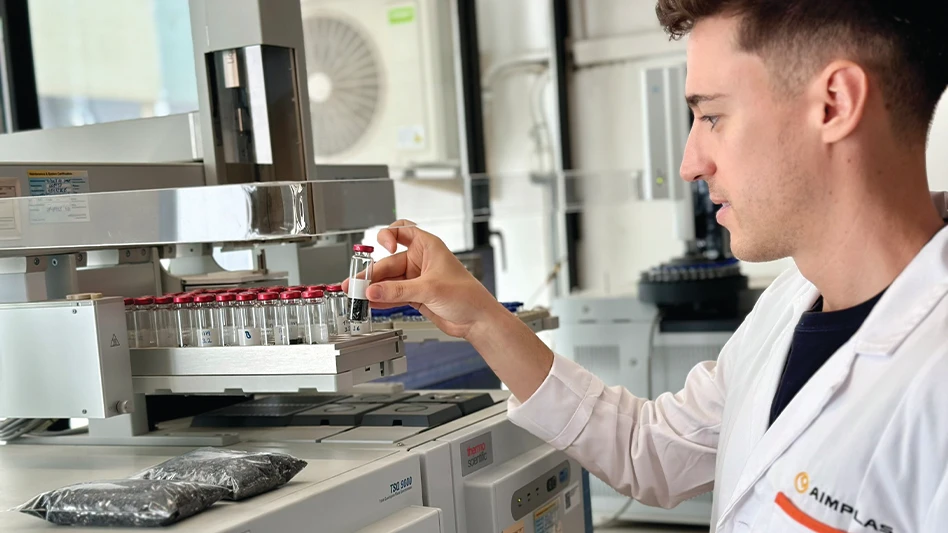
An initiative led by Aimplas, a Spain-based technological center that provides solutions to the plastics industry, aims to reduce odors and promote the use of recycled materials in the automotive sector.
The organization, which describes the aroma of vehicle interiors as “new car smell,” says the odor comes from the release of volatile organic compounds (VOCs), a mixture of chemicals that can have harmful effects on both health and the environment. Through its H2Odor project, Aimplas is focusing on the creation of new thermoplastic materials based on postconsumer recycled polyolefins, free of contaminants and odors, specially designed for use in vehicle interiors.
Aimplas says the new materials must not only meet the sector’s strict technical requirements, such as thermal resistance and UV radiation behavior, but also must be sustainable, cost-effective and “pleasant” for the end user. To this end, the organization says the project will seek to optimize the pretreatment of recycled plastic by incorporating advanced water-based decontamination and deodorization technologies in the effort to significantly minimize the present of VOCs inside the vehicle.
“Our goal is to demonstrate that it is possible to manufacture high-quality recycled materials with low environmental impact and reduced odor that are competitive for use in vehicle interiors,” says Juan Alfonso Naranjo, researcher in sustainable and future mobility at Aimplas. “It is a clear commitment to the circular economy without compromising safety and comfort.”
H2Odor involves the participation of a pair of Spain-based companies, including plastics recycler Fych Technologies, which will employ its own water vapor-based odor elimination technology and Faperin SL, which offers extensive experience in the manufacture of parts using plastic injection molding.
Promoting an automotive circular economy
Beyond the technical aspect, Aimplas says the H2Odor project is aligned with the European Commission’s new legislative proposal that seeks to increase the incorporation of recycled plastics in the automotive industry.
The organization notes that the automotive sector is the third-largest consumer of plastic worldwide, behind the packaging and construction industries. It adds that the increase in the use of plastics in vehicles is closely linked to the reduction of CO2 emissions, as many interior and exterior components are being replaced by lighter plastic materials.
In this context, Aimplas says it is worth noting that the incorporation of 50 percent recycled plastics in the interior parts of vehicles manufactured in Spain will reduce CO2 emissions by an amount equivalent to that generated by 158,475 vehicles in one year.
“The automotive industry is one of the most demanding sectors, but also one of the most strategic for applying advanced recycling solutions,” Naranjo says. “With this project, we want to offer a sustainable and viable alternative that contributes to the fulfillment of the new European objectives.”
Adhering to SDGs
In addition to its technological component, Aimplas says the project has a strong social and environmental impact, adding that it is aligned with several of the United Nations’ Sustainable Development Goals (SDGs), such as decent work and economic growth (SDG 8); innovation and sustainable infrastructure (SDG 9); improving sustainability in cities (SDG 11); and promoting responsible production and consumption patterns (SDG 12).
“H2Odor is another step towards cleaner, safer and more responsible mobility,” Naranjo says. “It demonstrates that innovation in materials can have a direct impact on people’s health and the sustainability of the environment.”
The project is being funded by the Valencian Institute of Competitiveness and Innovation (IVACE+i), through the Strategic Cooperation Projects program in its 2024 call for proposals, as well as ERDF funds.
Latest from Recycling Today
- Fleetio launches AI capability to accelerate fleet maintenance approvals
- The Metals Agency receives approval for export credit insurance
- Recycle Ann Arbor extends drop-off station operating hours
- Sybilion seeks to help manufacturers confidently address volatility
- Rio Tinto, Prysmian partner on low-carbon aluminum solutions for data centers
- Unilever criticized for plastics approach
- USTR to study additional steel, aluminum tariffs
- Electrified Materials adds processing capacity