Image courtesy of Aduro Clean Technologies Inc.
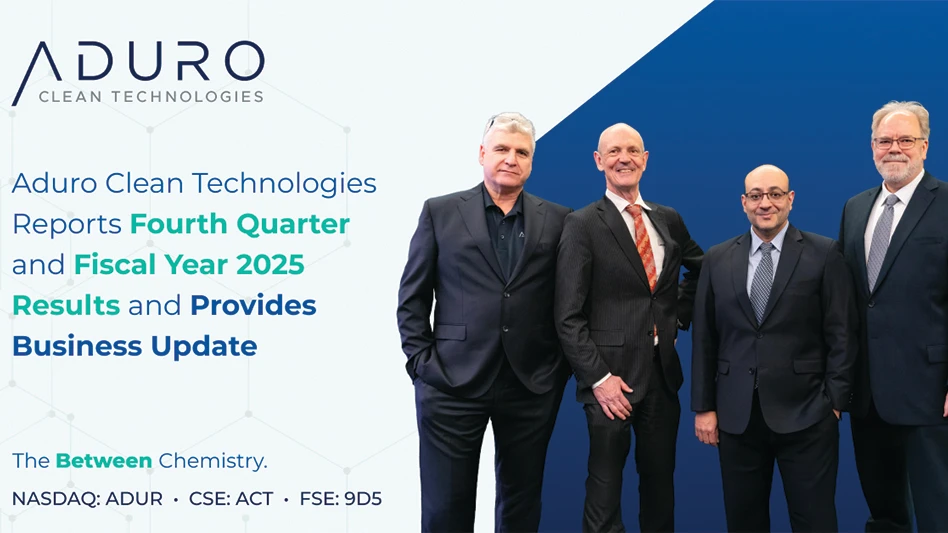
Chemical recycler Aduro Clean Technologies Inc., London, Ontario, has filed its financial results for the fourth quarter and the entirety of the 2025 fiscal year, noting that all financials are reported in Canadian dollars unless otherwise stated.
In the fourth quarter, the company produced a revenue of CA$74,670, a 27 percent decrease from the $102,250 generated in the fourth quarter of 2024. Loss from operations was about $3.7 million during the quarter, compared to about $1.7 million the year prior.
Aduro's revenue for the 2025 fiscal year was $231,212, a 31 percent net decrease from $337,516 in 2024. The company notes that its current revenue is earned through the completion of services under customer engagement programs (CEPs) for evaluation of its technology and collaboration work.
“This revenue is nonrecurring and varies with the timing and scope of evaluation projects,” Aduro says, adding that “year-over-year differences reflect the balance of company resources allocated between scale-up activities, ongoing technical analysis and customer evaluation programs.”
The company reports an operational loss of about $12.1 million for the fiscal year compared to about $7.4 million in 2024, primarily driven by increased research and development and technology scale-up activities, the hiring of new employees, an increase in noncash share-based compensation and corporate expenses associated with the company’s Nasdaq listing in November 2024.
Aduro ended the 2025 fiscal year with the carrying cost of its property, plant and equipment totaling $5.1 million compared to $3.6 million in 2024, driven primarily by increased investment in research equipment and laboratory facilities to support its current growth rate and capital work in progress related to the construction of its pilot plant in Ontario.
The company says it maintained a “strong cash position” with $6.96 million as of May 31, compared to $2.8 million the year before. Subsequent to May 31, the company reports gross proceeds of approximately $9.2 million U.S. from the closing of an underwritten U.S. public offering and approximately $800,000 from the exercise of options and warrants.
“We maintained financial discipline throughout the fiscal year, while supporting significant investment in our pilot plant,” Aduro Chief Financial Officer Mena Beshay says. “The equity financing we completed in June was executed efficiently and provides meaningful additional resources to advance our scale-up program. Aduro remains in a healthy financial position, supported by a strong balance sheet and continued backing from partners. We look forward to building on this foundation as we enter fiscal year 2026.”
A growing presence
Aduro reports a number of “corporate highlights” from the fourth quarter, starting with the memorandum of understanding (MOU) it signed with Canadian polymer processor and materials management company NexGen Polymers detailing a framework for a proposed collaboration to explore the development of a demonstration-scale plant that would use Aduro’s Hydrochemolytic Technology (HCT). The agreement outlines potential areas of cooperation, including securing feedstock, evaluating potential site options and defining plant operations with a goal of optimizing data generation to support future development of commercial solutions.
Additionally, Aduro signed a MOU with Canadian producer responsibility organization (PRO) Cleanfarms Inc. focused on evaluating Aduro’s ability to process agricultural plastics. Cleanfarms operations national recovery programs supported by more than 200 member companies and a network of more than 2,000 collection sites.
The collaboration sets out a multiphase program to examine both the technical and economic feasibility of applying HCT to plastics such as stage film, bale wrap, grain bags and twine.
In May, the company engaged Canadian sustainability consultancy Delphi to conduct a life cycle assessment of its HCT for plastic processing and measure its environmental impacts.
“By commissioning an independent assessment, Aduro is taking steps to ensure that future discussions about HCT are grounded in transparent, third-party analysis,” the company says.
During the quarter, the company advanced construction of its next generation process (NGP) pilot plant, which included “site readiness activities” such as HVAC and electrical upgrades, laboratory modifications and office expansions. Factory acceptance testing of extruders was completed, confirming performance ahead of delivery. The company says commissioning is scheduled to begin in September, starting with the feed preparation and reactor systems, followed by the product recovery system in October.
The company is collaborating with Siemens Canada to supply advanced control systems, automation solutions and engineering services for the pilot plant in a move to ensure that the facility incorporates “robust automation, data collection and process safety capabilities from the outset.”
In July, Aduro appointed industry veteran David Weizenbach as its chief operating officer to help oversee the company’s transition from research and development to pilot-scale execution. Also in July, the company became a member of the Plastics Industry Association (PLASTICS) and the Polystyrene Recycling Alliance (PSRA)—a PLASTICS initiative focused on advancing polystyrene recovery.
“Fiscal year 2025 marked a period of significant execution against our strategic priorities,” Aduro CEO Ofer Vicus says. “Notably, we advanced construction of our pilot plant in collaboration with Zeton, with commissioning activities expected to begin in September 2025. We also broadened our feedstock testing, including initial work on synthetic turf, which has drawn attention from several parties expressing interest in the results and reflects the growing attention to chemical recycling solutions in this segment.
“In addition, we deepened our customer engagement program, strengthened relationships with leading companies across the plastics and energy value chain and expanded our industry presence by joining collaborative associations. These initiatives position Aduro to demonstrate the scalability of Hydrochemolytic Technology and generate valuable data needed to assess its performance on diverse feedstocks.”
Exploring feedstock
In July, the company completed testing of synthetic turf scrap—commonly used in sports stadiums and landscaping—using its HCT, and reports “encouraging results.”
Noting that synthetic turf represents a complex material stream with multiple components considered difficult to recycle, the company says its tests focused on the polyolefin components, and HCT demonstrated the ability to convert those fractions into shorter-chain hydrocarbons under controlled conditions.
This was achieved without extensive preprocessing, the company says, and the process demonstrated tolerance for the mixed materials and contaminants typically present in aged turf systems. As part of the initiative, Aduro says it received synthetic turf samples from a global industry stakeholder for evaluation and claims several other parties have expressed interest in the results.
Latest from Recycling Today
- Nexans acts on commitment to circularity
- Hamburger Recycling announces promotions
- Nth Cycle signs offtake agreement with Trafigura
- WeSort.AI recovers critical raw materials from recycling plants
- ReMA provides economic impact report, industry update
- Collective Waste Solutions acquires Alcop Resource Recycling transfer station
- Volatility continues in nonferrous metals
- Neste chemical recycling plant is ready to scale up