A: We see it as a natural progression. We set up centralized marketing and set a goal of 75% of our material trading [with] floor price contracts, and we’ve reached that. The natural extension is to move toward hedging and to reduce the volatility. Basically, try to lock in a minimum return on investment on the processing and collection side. The generating customers on both the municipal and commercial side are both interested in a more stable rebate over one, two or three years. To be able to budget like that, we see that as a method to provide those generators with a value added service.
We’ll offer a full range of financial swaps, for recovered fiber and for finished paper, pulp, 42-pound media, finished news and then the recovered grades. We’re focusing in on hedging out Recycle America’s internal tons. We’ll also provide the service to third parties. Recycle America handles four million tons of baled fiber sold every year. The long-term goal is to hedge 50% or more of our total tons.
We think to lock in a return on investment give us a tool to grow the business. The customer sees it as a value-added service.
Q: How active is Waste Management in the export market?
A: We export every year over 500,000 tons. We certainly sell into Canada and Mexico, but also into Asia. We’re working diligently to work with the larger domestic exporters; people who buy in U.S. dollars. We’ve actually signed long-term contacts with a number of those U.S. brokers.
Q: How are end markets for plastic containers currently? Are there dramatic regional differences?
A: Plastic containers have been very volatile in pricing over the last couple of years: 30-40% volatility in a 12-month period. We think the emerging market is to produce a mixed bale, rather than a polymer specific bale. I think soon a majority of containers will be coming out of MRFs in a mixed bale form. This eliminates a choke point. You’ll see an increase in the export side. We’re receiving a lot of very serious offers for long-term arrangements form offshore. Ten years ago these markets were very nascent. They’ve matured somewhat and now we’ve got potential for contracts and for export opportunities. I think single stream collection then becomes the best collection method.
Ground dirty polymer specific flake is another commodity. It can be sold to a consumer who will wash it. There are domestic markets for the mixed polymer bale, but we would then take those to regional processing centers and do the sorting. The ground dirty flake would be one of the follow-on concepts from the regional sorting centers.
On a regional basis, on the next two years that will be very evident.
We’re finding another of the plastics end use consumers willing to partner on future processing capacity. There is a range of companies who might do that.
Q: Does Recycle America have a corporate-wide preference in terms of collection and processing methods? (Single-stream, commingled, etc.)
A: Every community has a special aspect that will drive the correct method. I think single-stream will become the majority collection method. But we’re taking a renewed interest in drop-off systems for materials such as electronic scrap.
In rural areas, it might be a drop off center for single stream material. In the past, drop-off centers have suffered by some bins filling up sooner than others. [Single stream] is easier. We think that will open up additional access to different material.
Q: Are there profitable ways for Waste Management to become more involved in other segments of the recycling industry? (C&D materials, tires, scrap metal)
We have a research and development fund internally. One of the projects we funded over the last two years was studying tires to crumb rubber, and working with a shredding approach that reduces that cost. We’re trying that at our Davis St. facility [in San Leandro, Calif.] in partnership with an equipment vendor.
We think that may provide a way to shred tires down in a cheaper fashion.
C&D clearly is an opportunity for us. Certain parts of the country, C&D recycling works very well.
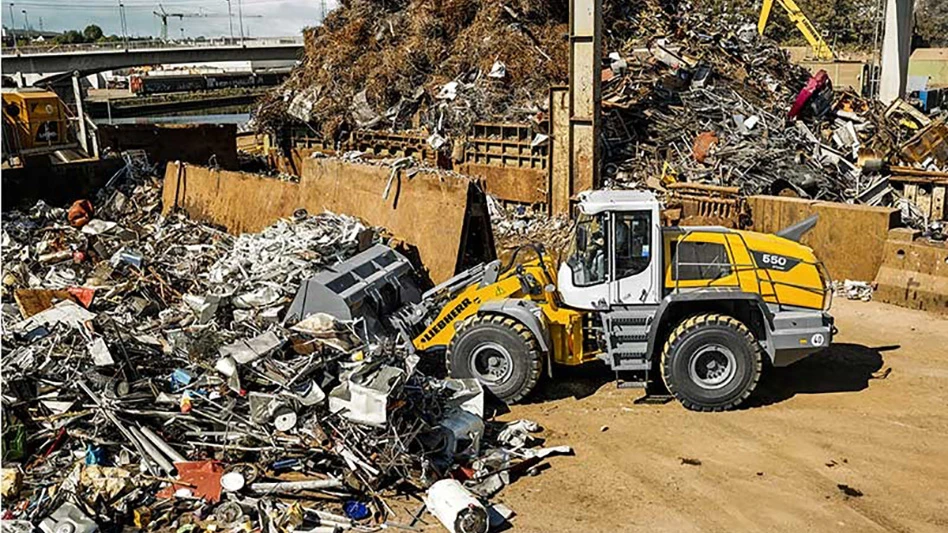
Scrap metal is a huge opportunity. Many of our industrial and commercial clients have significant amounts of scarp material and we’re looking at ways to increase our service for that.
Q: Is Waste Management ready to seek growth again, or is the company still in the process of organizing the facilities and assets it has?
I think the company is always looking for profitable growth. Clearly there are opportunities for profitable growth in recycling. We’re aggressively pursuing those. I think the hedging desk will allow us to pursue more of those with confidence in receiving a return on investment. Tuck-in acquisitions for both solid waste and recycling are possible.
Q: Is Waste Management seeking alliances with other recyclers, such as sub-contracting out materials processing? Or is the goal to be self-sufficient?
We currently run 190 recycling facilities, in North America. Over the last three years we have closed over 40 and subcontracted out to other facilities. Where we see enough volume, we’ll have a facility there. Where we don’t, we’ll subcontract out on a tolling basis or broker the material in the back-end. Clearly, we don’t need to have a facility in every market, only when we can have a return that is acceptable to our shareholders.
We have over 20 markets in the U.S. where we have successful long-term sub-contracting arrangements. Some deals are for three or five years, some longer.
Following up on our year commitment announced a year ago at the first Paper Recycling Conference, I think we’ve made a commitment by adding to our team of respected recyclers. We’ve taken over direct profit and loss responsibility at our MRFs. It’s part of a clear trend toward recycling being a core part of the company. We’re taking the necessary steps to make this a successful, predictable part of waste Management’s business.
We’ve seen the majority of our customers welcome that statement. It’s a service they ask for and they really demand. Clearly it is part of our core offering.
Latest from Recycling Today
- ReMA provides economic impact report, industry update
- Collective Waste Solutions acquires Alcop Resource Recycling transfer station
- Volatility continues in nonferrous metals
- Neste chemical recycling plant is ready to scale up
- Indonesia’s nickel pig iron spigot reopens
- Ecore says study backs crumb rubber use on sports surfaces
- Fleetio launches AI capability to accelerate fleet maintenance approvals
- The Metals Agency receives approval for export credit insurance