Image courtesy of WM
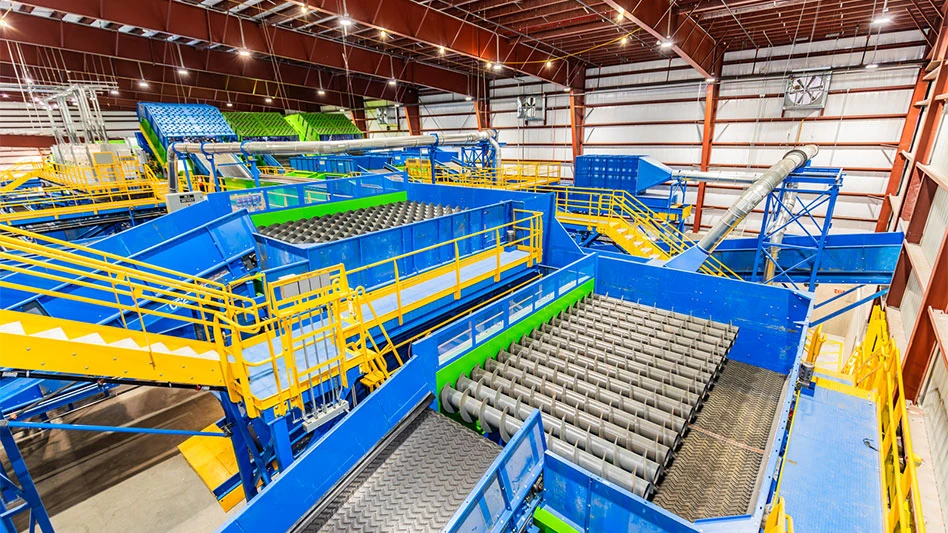
WM, Houston, celebrated the opening of its newest material recovery facility (MRF) in Pembroke Pines, Florida, last week. The $90 million facility, WM Recycling South Florida, is expected to process approximately 275,000 tons of material annually.
This facility is one of the most technologically advanced North American MRFs in WM’s network, according to the company.
“WM is proud to celebrate our new recycling facility in South Florida,” says David Myhan, WM Florida-area vice president. “WM Recycling South Florida is one of the largest and highest volume recycling facilities companywide. It utilizes state-of-the-art equipment that leverages artificial intelligence and optical sorting technologies, which we expect to increase the amount of materials we can process for recycling. Together with our customers and communities, we are helping drive circularity in South Florida.”
Situated at the edge of the Florida Everglades, the facility will service households in Miami-Dade, Broward, Monroe and Collier Counties.
“We’re excited about continuing to grow recycling volumes, continuing to bring contamination down and to work with our municipal partners,” says Dawn McCormick, WM Florida-area director of communications and government affairs. “We have very robust recycling in Florida, but we’ve had some cities and counties pull back their programs over the last four to five years for economic reasons, and a lot of them are looking to come back. We’re excited about bringing them back in.”
The facility primarily accepts old corrugated containers (OCC), paper, used beverage cans (UBCs), polyethylene terephthalate (PET), natural and pigmented high-density polyethylene (HDPE), polypropylene (PP), mixed rigid plastics and glass and is capable of processing 60 tons of material per hour.


Facility footprint
The 127,000-square-foot facility boasts 18 MSS Inc. optical sorters, one of which is equipped with artificial intelligence (AI) technology for the recovery of UBCs. Michael DeClerck, WM Florida-area director of recycling operations, says the optical sorters are part of the system’s postsort, separating material after the MRF’s mechanical and manual sorting processes.
“[The AI-equipped optical sorter] is able to distinguish between used beverage cans and other types of aluminum, such as a pie tin, for example,” he says. “The optical sorters have a specific job. They’re programmed to look for certain types of plastic, but the difference between that and the AI unit is the AI unit will learn as it goes and get better and better at its job.”
Although not accepted in the four-county recycling program due to safety concerns and limited end markets, postconsumer plastic film will be sorted and baled separately at the plant. DeClerck says the material will be sent to a cement kiln where it will be used as a feedstock.
Other hard-to-recycle plastics targeted by the MRF’s optical sorters include polyethylene terephthalate (PET) thermoforms, commonly used in food-grade packaging.
“That is an evolving market,” DeClerck says. “Virtually every bale of PET has some thermoforms in it today, but we have the capability of separating those out as those thermoform markets develop.”
The facility has multiple volumetric scanners, which can alert MRF employees when volumes get too high, preventing jams.
Baler redundancy is becoming increasingly common in new and upgraded MRFs. WM Recycling South Florida has four balers in its footprint: one two-ram baler from Sierra International Machinery, two single-ram balers from Bollegraaf and an additional baler from Balemaster dedicated solely to plastic film.
“If you can fit it in and it’s within the budget, [redundancy] is always a good idea, because if one goes down, you’re not dead in the water,” DeClerck says. “It gives you the ability … to be more efficient, so that one baler is not being overworked. You have the ability to go to a second baler if the other one is in the middle of baling mixed paper, but your cardboard bunker is getting full. You can do both at the same time. I think the reason you’re seeing more redundancy is because of the flexibility it gives you.”
The MRF employs a CP Group LightsOut glass cleaning system, which uses air separation to remove lightweight material from the glass stream.
Contamination residue is handled by SP Industries Inc. compactors attached to Mac Trailer Enterprises Inc. trailers.
“It’s a walking floor trailer with a lid on it, and these compactors push the contamination residue into the trailer,” DeClerck says. “We purchased all new equipment for that. We have two trailers hooked up to the building at all times to those compactors.”
Two Columbia Industries trailer tippers—one above grade and the other at grade—allow the MRF to dump either a walking floor trailer or a tipper trailer onto the tipping floor.
The facility’s 28,000-square-foot tipping floor also is continuously monitored by a Fire Rover unit, which uses thermal cameras to detect hot spots in the pile and extinguish fires if they occur.
A total of 80 employees work at the MRF in two shifts, including approximately 14 dedicated to manual sorting.
Sustainability education station
WM Recycling South Florida’s sustainability education station has been designed to inform community groups and stakeholders alike.
“We take everyone through the journey of recycling, from curbside to finished bales to market,” McCormick says.
Educational displays feature WM’s sustainability ambitions, including the company’s recycling volumes, sustainability investments and renewable energy goals.
The area highlights different end markets for recycled materials, showcasing the recycling process.
“We really want to show our visitors the fact that if you do recycle a plastic water bottle, there are markets to turn it into carpet,” she says. “We’re telling the circularity story. We have a whole center display that shows how cardboard is recycled, the different stages of aluminum [recycling] and plastic in the pellets. When it leaves our facility in a bale and it goes to the manufacturing site, [we’re showing] what the different steps are.”
A catwalk allows guests to walk almost the entire length of the plant to see operations firsthand.
McCormick says the facility nearly is completely booked with tours for the month of March and hosted 250 guests at its opening last week, including elected officials and commercial customers. She says the MRF will host key stakeholders in March and April, while community groups will begin touring the plant in the summer and fall.
Additionally, WM partnered with Washington-based Tandem Global in November 2025 to plant a microhabitat in front of the facility.
“We did it concert with high school students, … with Pembroke Pines Charter High School,” McCormick says. “It’s right across from the lobby entrance. … When people come to see the site, we can talk to them about microhabitats and what that means, using all natural plants. We put over 700 plants in an area basically the size of a long tennis court.”
This facility is part of WM’s enterprise-wide plan to invest more than $1.4 billion in 39 new and upgraded recycling facilities across North America from 2022 to 2026.
The company will break ground on its 109,000-square-foot Tampa MRF in April, which is slated to open by Nov. 1, 2027. WM Recycling Tampa Bay will replace an existing facility and is expected to process up to 50 tons per hour with a 228,000-ton annual processing capacity.
“We’ll be doing an education center there too,” McCormick says. “As quickly as we get this up and maximize our tours through this, we’re going to be turning our attention there.”
Latest from Recycling Today
- International Paper to close South Carolina container plant
- Waste to Resource Ontario announces new co-chairs
- WIH Resource Group adds senior associate
- BlueScope rejects recent SGH, SDI bid and notes terms for additional engagement
- Picvisa, Girbau to launch textile sorting plant in Europe
- Kaiser lifts net income figure in 2025
- Sims’ Houston contract confirmed by Enstructure
- Benlee calls 2025 record year