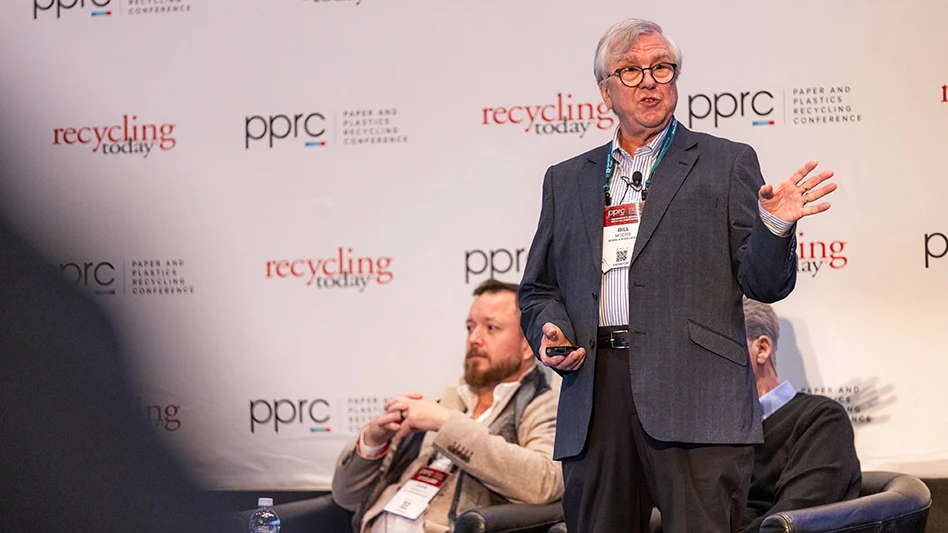
The recovered paper market has experienced changes in recent years, primarily driven by increased demand for sustainable packaging as well as global economics. These shifts in supply and demand will be a key topic of conversation at the upcoming Paper and Plastics Recycling Conference, Oct. 15-16 in Chicago.
During the session OCC and Mixed Paper Markets, Oct. 16 from 2:30-3:45 p.m. CT, Bill Moore, president of Moore & Associates; Matt Elhardt, chief revenue officer of ResourceWise; Melanie Harman, director of mill fiber procurement at PaperWorks; Matt New, vice president of sales at Ekman Recycling; and Todd Shumaker, president of commodities and brokerage at Circular Services, dive into the dynamics of recovered paper markets. From old corrugated containers (OCC) to high-grade recovered paper to the shifting landscape of exports, they’ll highlight current market drivers, trends and demand.
Ahead of the event, Recycling Today sat down with Moore to discuss the challenges and opportunities facing the mixed paper market and what attendees can expect to learn from the panelists.
Recycling Today (RT): What are the biggest challenges and opportunities currently facing the mixed paper market?
Bill Moore (BM): There are three key factors impacting the mixed paper market today.
First, the supply of paper available for recovery has been on a long-term decline as the use of newsprint and printing and writing papers continues to decrease. This means that recovery rates can still rise even if the overall volume of recovered paper stays the same.
However, this trend may be slowing as the U.S. production of paper and paperboard increased in 2024 over 2023, marking the first increase in the past 15 years.
Second, several new domestic mills built over the last five years were designed to handle large volumes of mixed paper but haven’t been able to do so, citing quality concerns as an impediment.
Third, Asian markets, which have historically been major importers of U.S. mixed paper, continue to crack down on quality requirements.
RT: How has the export landscape for recovered paper changed in recent years, and what does it mean for the U.S. market?
BM: In recent years, we’ve seen a decline in exports of both OCC and mixed paper as more domestic capacity has come online and Asian markets continue to impose stricter quality requirements. As a result, the U.S. market has started to become more self-reliant.
RT: Has the decrease in containerboard and corrugated box production contributed to the downturn in OCC and mixed paper markets?
BM: Yes, a decrease in containerboard and corrugated box production has contributed to less demand for OCC and mixed paper. During the session, we’ll explore the state of the industry, the potential for further production slowdowns and mills that may be in jeopardy of shutting down.
RT: What are the key quality issues with mixed paper?
BM: The two main quality issues are contamination, particularly plastic films and packaging, and moisture content. Both issues make material more difficult and expensive to process, and they can make it harder to pass onto domestic mills and export buyers due to strict quality requirements.
RT: What should recyclers and processors watch for in the coming months in terms of market outlook?
BM: We should be at or near the bottom of the current pricing cycle in terms of retained cash flow across the recovered fiber market. However, it depends on both U.S. and global economic conditions as well as the state of the corrugated box industry.
RT: What do you hope attendees take away from this session?
BM: I hope attendees gain a better understanding of the effect containerboard and corrugated box production can have on the OCC and mixed paper markets. Additionally, I hope the panel can provide attendees with detailed information on other key factors affecting the OCC and mixed paper markets.
Latest from Recycling Today
- SHFE trading expansion focuses on nickel
- Maverick Environmental Equipment opens Detroit area location
- International Paper completes sale of global cellulose fibers business
- Building a bridge to circularity
- Alton Steel to cease operations
- Nucor finishes 2025 with 14 percent earnings decline
- Algoma to supply Korean shipbuilder
- Improving fleet maintenance management across multiple locations