Photo by Chris Voloschuk
On the whole, the United States does a good job recycling plastic, according to Association of Plastic Recyclers (APR) Program Director Kate Eagles.
Still, she said, there are real challenges out there, especially for reclaimers who have spent more than a year competing with inexpensive virgin and imported resins and facility closures, particularly in the recycled polyethylene terephthalate (rPET) space.
RELATED: 2026 Plastics Recycling Conference: A look at PCR contracts
Help could be on the horizon, though, in the form of extended producer responsibility (EPR) legislation in seven states that promises to increase the supply and, eventually, the quality of recyclable materials in the stream. Additionally, legislation has been proposed that would provide tax credits to recyclers for equipment upgrades or for packaging producers who source postconsumer resin (PCR) from domestic suppliers.
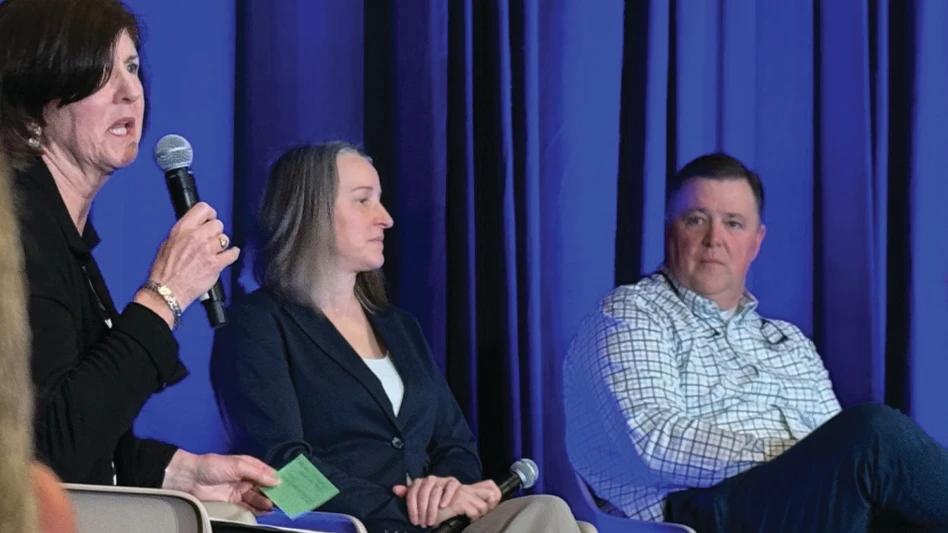
Eagles moderated a session at the 2026 Plastics Recycling Conference in San Diego, Reclaimers: Challenges, Opportunities and What’s Next, and guided the discussion among industry participants with sizable reclaiming operations, noting that around 5 billion pounds of plastic of all types are recycled in the U.S. and Canada each year.
“We’re all invested in EPR [extended producer responsibility] and we want to see that work,” Eagles said during the Feb. 24 session. “Virgin resin is going to be pretty inexpensive for a while. We have challenges we can’t shirk from, but we can’t fail.”
Challenging landscape
Despite the rPET industry’s struggles across the U.S., including the closure of seven reclaiming facilities in the past year, Paul Bahou, president of Perris, California-based Global Plastics Recycling, aimed to strike an optimistic tone.
“Last year, if you asked me about challenges, I’d say everything’s on fire and we’re all going to die,” Bahou said. “I want to come with some better energy this year. I’m eager to see some of this EPR stuff rolled out. I’m very excited for that. It’s a change in the paradigm of what we’re talking about with PET.”
Bahou, whose company specializes in processing PET, did point out, however, that in California, “Lots of cheap material is coming in from Asia. Maybe it’s recycled and maybe it isn’t. I remain optimistic, but it hasn’t been great.”
Kristen Rinehart, vice president and general manager of recycling at Hilliard, Ohio-based Advanced Drainage Systems Inc. (ADS), one of the nation’s largest high-density polyethylene (HDPE) and polypropylene (PP) recyclers, said she didn’t think industry challenges have changed much.
“It’s the challenge of getting good, reliable feedstock that’s high-quality,” she said. “We’re a reclaimer but also an end user, so quality affects us in two areas of our business. Another challenge is definitely packaging that’s not designed to be recyclable. Also, wish-cycling and residual quality where we have to do a secondary sort [are challenges].”
Much like ADS, Troy, Alabama-based KW Plastics is one of the largest HDPE and PP recyclers in the U.S. Billy Jefcoat, the company’s director of raw material procurement, said a persistent challenge has been finding more raw materials to process.
“When we break that down, we could probably run 2-3 million pounds more of natural [HDPE], colored [HDPE] or PP in our plant continuously,” he said. “That would allow us to grow again. When I came to KW, we had three [processing] lines, and now we have six. We want to grow, but we have to have raw materials to do that.”
Anna Rajkovic, market and innovation manager of Mechanical Recycling at Calgary, Alberta-based polyethylene (PE) producer and recycler Nova Chemicals, highlighted the company’s startup of a linear low-density polyethylene (LLDPE) film recycling plant in Connersville, Indiana, as a promising industry development that also entered a challenging market.
The Connersville facility, called Syndigo1 to reflect Nova’s brand of recycled-content PE, was commissioned in 2025 and recently commercialized two PCR grades produced on-site. As far as challenges, Rajkovic said timing may be the biggest one.
“It’s not a great time for demand,” she said, noting that another large-scale film recycler, WM-owned Natura PCR in Texas, was closed last fall. “That [closure] was a strong indicator out there for demand of that kind of product. Timing is challenging for us. Bringing on a new facility, we need that demand to be there for the product we now have available.”
Legislating demand
With the exception of recycled natural HDPE, which has maintained relatively high pricing due to tighter supply and consistent demand, per-pound costs of most resins have flattened or declined in the last year. Eagles said some markets have experienced demand issues, with PET serving as an example.
With demand issues in mind, the panel considered legislative measures that could aid the industry.
Bahou said he believed there were different approaches that could work, such as working PCR mandates into EPR legislation. Another measure he said could benefit reclaimers in California, specifically, was the reinstatement of the Plastic Market Development Payment (PMDP) program, which pays incentives to reclaimers and product manufacturers that use postconsumer beverage bottles sourced in-state as feedstock for new products.
The program, which previously paid reclaimers $150 per ton for use of PET and HDPE bottles, was administered by the California Department of Resources Recycling and Recovery (CalRecycle).
“The idea is to incentivize circularity of PET in the state of California by giving the wash line companies a certain subsidy to keep us competitive, because right now, even when tariffs came in, this material was still coming in cheaper than my cost of production,” Bahou said. “In California, our collection regime is amazing. The numbers are really good, and a big reason is that collection is heavily supported. We need that level of support for the next step. Collection is not recycling. We need to make sure it’s going all the way through the system, and we can’t do that if we’re not focused on the next step. You need to take it all the way from a bottle to a finished good, the full picture.
“At the end of the day, you can’t run a business on vibes. You’ve got to make payroll. [The PMDP] is the best mechanism I’ve seen.”
In Rajkovic’s view, PCR mandates could eventually lead to more market stability in the form of longer-term supply contracts and pick up the slack for voluntary commitments that don’t always materialize.
“Without that downstream demand, it’s hard to ink a contract,” she said. “We have been in a regime of voluntary commitments for quite some time, and we’re now understanding there’s limits to what we can achieve in that space. To bring the rest of the crowd along for the ride, we need some mandates to drive that demand.”
Citing a New Jersey recycled content law that has “created solid demand for users” making products like can liners, for example, she said similar rules are being considered elsewhere with different packaging formats.
“PCR is more expensive, so to push companies into that space it really does come down to requirements,” she said.
EPR has an important role to play, as ecomodulation could drive packaging producers to consider more PCR usage if implemented.
“If ecomodulation is appropriately set, it has the ability to move the needle on PCR usage,” Rajkovic said. “But EPR systems we’re seeing are delaying ecomodulation, or it’s not being set appropriately to actually incentivize use of PCR. Virgin reduction becomes more of a lever that gets a financial benefit compared to fees for using recycled. We believe in the mandate approach.”
Outside of EPR, Rinehart pointed to the Cultivating Investment in Recycling and Circular Local Economies (CIRCLE) Act, a federal bill introduced last year that would provide 30 percent tax credits for investments in recycling infrastructure. ADS is one of 66 companies that have supported the bill.
“It’s really important because the infrastructure only lasts 11-15 years,” she said. “Recycled material is really tough on equipment. If we don’t continue to invest, it’s really a slow slide.”
Another potential solution is companies designing their packaging for recyclability, which could lead to more and higher-quality plastic entering the recycling system, ultimately reaching reclaimers and complementing EPR programs.
“I don’t want to make virgin more expensive; I want to make PCR more competitive,” Bahou said. “So, we need to be designing for recyclability. PCR is more expensive than it needs to be because there’s more unrecyclable stuff in the stream, and if we can get that out of the stream, we can do our jobs more cost effectively.
There is a yield loss reclaimers don’t need to have, he continued. “EPR can police some of these free riders in the system that ultimately poison the well. We don’t need PVC [polyvinyl chloride] packaging; we have PET packaging. We don’t need PS [polystyrene] packaging; we have PET packaging. It removes contamination. We see bottles that aren’t recyclable. All of this costs money and makes the finished materials price higher. We can really shave some of that price down if everything was designed for recyclability.”
Rinehart added that states implementing EPR should consider providing financial incentives to reclaimers, similar to other proposed legislation.
“If you think about it, reclaimers really are doing the work and taking on all the cost of the recycled material that needs to be filtered, formulated, corrected,” she said. “It makes sense to me that reclaimers would receive some of those funds from EPR. Until we have design for recycling, modernized equipment throughout the recycling industry, consumers not wish-cycling, until everything’s perfect, we need to pay reclaimers.”
Adapting to needs
Of the four panelists, three represented vertically integrated companies. Though Nova is not vertically integrated, it has extensive experience working with PE converters through its virgin and recycled content businesses.
The panelists agreed that vertical integration has been helpful in weathering volatile markets.
“We have stable demand because we have factories and employees that are converting the material every day, and we need to keep those teams going with capital investments returning to the business,” Rinehart said. “Base demand coming from a vertical reclaimer-end user is more consistent than when you’re disconnected.
“Also, you gain better control over material quality and freight [costs]. All these are elements of cost. In the future, we’ll see more consolidation, localization and integration of recycling.”
Bahou said vertical integration has allowed his company to pivot when necessary.
“If you make something out of spec, you can just make it again,” he said. “You can space out your margins. You’re not just focused on one thing. If you can’t make one thing work, you can pivot and focus on another thing depending on what the market is. It gives you a greater scope of where the wider industry is at for your particular silo. It gives you a better view of the whole thing.”
Hopes for the future
Eagles said that while recycled resin markets have been “a little flat,” volume is the key for reclaimers and end markets need to be pushed for.
“With our plant in Connersville, it’s one of the biggest film recycling facilities in the world, but we hope that’s just our first step,” Rajkovic said. “We really want to scale this. To drive circularity, it has to be many plants that size. If the demand piece is there, the next step is to scale up.”
Jefcoat added that he’d like to see more businesses similar to Nova’s take root across the country.
“[We need them to be] bigger, stronger and in need of raw materials,” he said. “I think that would absolutely push more people to recycle, more cities to get involved if they had a true home for the material. We want some healthy competition. It’s something we all need to go for.”
Rinehart said increased PCR usage in durable goods could help more material find a home.
“Whether it’s lumber with plastic, rail ties, paint cans, thermoplastic pipe, those durable goods really underpin the plastics recycling industry,” she said. “That’s the only real consistent demand on the olefins side. How can we improve recyclability of that material to get more of it into recycling? If we can find good applications for good mechanically recycled material to keep in that system—it could be for infrastructure, [for example]—anything that can help us find the right home for material so we can keep it in use.”
Regardless of which types of plastic they work with, Bahou noted the reclaimers’ issues are fundamentally the same, centered around the development of a closed-loop system. EPR and design for recyclability each have a role to play.
“We need to look at the whole system holistically,” he said. “It’s not just bottle-to-package, but all materials and how they all interact with each other. The magic wand is everybody using their collective brain power to solve this together.”
Latest from Recycling Today
- Official NYC Bin availability expands ahead of deadline
- Coastal Waste & Recycling expands recycling operations with Machinex
- Reconomy acquires German-based GfAW
- Updated: Landbell USA to serve as PRO under California’s textile EPR law
- PureCycle loses $182M in 2025
- Eldridge plays role in Scrap Management Industries acquisition
- Aluminium Dunkerque to be acquired by Bahrain-based firm
- Acerinox ends 2025 with a loss