Photo by Chris Voloschuk
As postconsumer resin (PCR) markets have struggled in the United States due a shortage of demand, plastics industry stakeholders have suggested an array of solutions to provide stability and allow recyclers to invest in the production of higher-quality material.
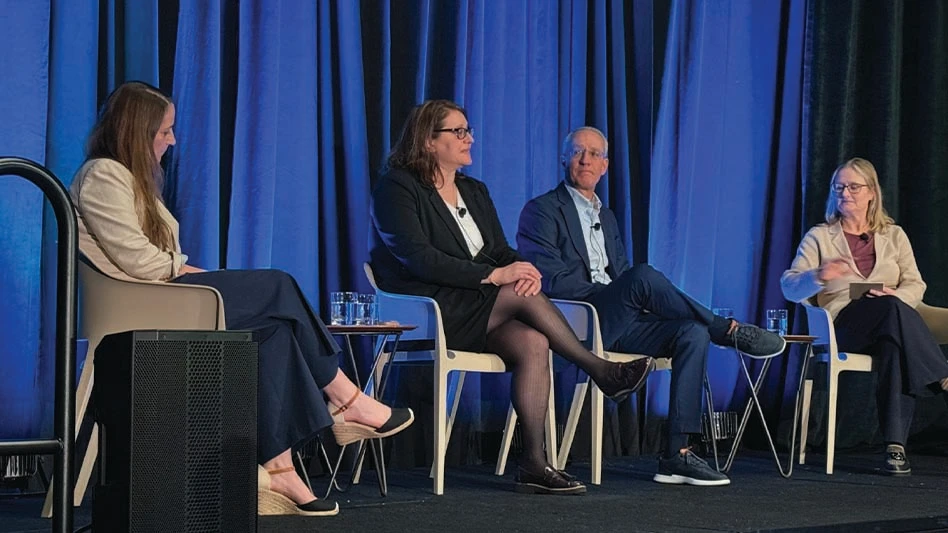
Federal tax credits, PCR mandates within extended producer responsibility (EPR) legislation and firmer PCR commitments from packaging producers are among such considerations. Long-term resin supply contracts are another, and that particular solution was the subject of an industry panel at the 2026 Plastics Recycling Conference in San Diego.
RELATED: 2026 Plastics Recycling Conference: The growing need for systemwide change
During the Feb. 24 session, The State of Long-Term PCR Contracts, Nicole Flaherty, senior manager, Sustainable Sourcing and Recycling at Arlington, Virginia-based Nestle USA, said long-term agreements—described by the panel as three years or longer—bring value back to her business.
“It gives us a consistency of supply and helps us pave the road of our ambitions,” she said.
Details to consider
Marija Massey, strategic sourcing manager, Circular Feedstocks, at Eastman, primarily seeks to buy nonbottle polyethylene terephthalate (PET) scrap such as strapping, chunk, film and fiber to feed the company’s molecular recycling process. She pointed out several benefits of long-term contracts, as well as potential parameters.
“There’s long-term supply and demand,” she said. “We need the supply of feedstocks, but also the offtake security of demand. I also look at the way contracts are structured and whether they’re minimizing the risks of markets going up and down. There’s a processing cost no matter what indices do. PET moves quite a bit, so there needs to be protection for the buyer and the supplier. At Eastman, we know what we need and look for what we want. We want suppliers who want to walk with us as we grow and change.”
However, Massey noted that not all contracts are structured the same.
“I’m a proponent of a long-term structure with value on either end,” she said. “There are things like protection, a floor and a ceiling. Moving between the indices can be part of that contract or can be a certain fixed value, but it depends on what the supplier is looking to do and what works for them.”
Similarly, Flaherty said any contracts Nestle inks account for variability.
Doug Hano, director, Circularity and Decarbonization, at Swiss packaging giant Amcor Plc, added that his company doesn’t sign many long-term supply contracts, opting for shorter deals of a year or two or more informal handshake agreements. But when the company does sign a contract, he said the bale index, freight, fixed processing costs, yield loss and a profit adder are among the terms considered.
“There’s situations that can arise that tests those relationships,” he said. “If you don’t have the contract to fall back on, you might find yourself in a difficult situation. We’ve been fortunate we haven’t had major disruptions that have affected us in the PCR space. We’ve been able to get away with a lot of informal contracts, but I’ve seen situations in the past where it would be better to have those finalized.”
Current issues
With most recycled resin markets struggling to compete with a wave of inexpensive virgin and imported material, as well as the shuttering of a number of reclaimers in the last year, the panel discussed impacts on their procurement strategies.
According to Hano, who focuses on polyolefins, current conditions have made it more difficult to consider long-term contracts and pricing.
“A lot of our customers are so used to being indexed,” he said. “We have great resources for price movements in virgin that have been developed over decades, and while there are products that exist in the PCR space, so much is happening right now with new participants in the commodities space, including some exiting.
“There’s dynamism to these spaces, which makes it hard to stick to and be confident in a particular price. It’s more than supply and demand. It’s hard to compare one person’s HDPE [high-density polyethylene] to another’s. Indexing is a lot more complicated today than it is on the virgin side.”
Massey added that it can be challenging to have a long-term contract when you have significant changes in the market.
“We need to promote innovation and growth,” she said. “If the most important thing is to chase the price, I can see where that can be a challenge. But, when we consider the longevity of the entire value chain, there’s value in that long-term contract. Sometimes you win and lose, but long-term you get that protection.”
Flaherty said market variability has made it more important for Nestle to strive for long-term PCR contracts, and could also help it comply with EPR programs, for example. “We’re making sure we have those partnerships, especially with the regulations we’re about to face.”
In regard to the closure of five recycled PET (rPET) reclaimers in the last year, Flaherty said any such decision can have a huge impact on her company’s daily operations.
“We need that secure supply, so contracts are really important here,” she said.
Said Hano, “It just means that if we don’t have long-term contracts with folks that we know financially are going to be around a long time, we need a broad supply base and to hedge our bets.”
Because of Kingsport, Tennessee-based Eastman’s use of molecular recycling, Massey said she is able to source a larger feedstock slate rather than just rPET bales. However, facility closures still impact her sourcing ability.
“We can use chunk materials from some of these reclamation facilities,” she said. “But also, there’s now a flood in the market of PET bales, which creates pricing instability.”
If supply and demand markets find balance in the future, the panel agreed it could make long-term contracts more likely.
“If something changes legislatively or demand picks up dramatically, I’d scramble to be the first in line for supply,” Hano said. “It’s risky not having those contracts at that moment. We would have to switch on a dime.”
Legislative impact
EPR laws have passed in seven states and a number of bills focused on recycling in the U.S. have been introduced, which, according to the panel, will also impact sourcing and contracts.
“[Legislation] has a profound impact on our strategy,” Flaherty said. “It really helps us look to where we want to go with our contracts to make sure we’re getting enough supply in. It’s really moving some of our ambitions forward. It can be challenging, especially when there’s a lot of people going for that supply and that quality. It has shifted how we’re procuring and who we’re partnering with.”
Hano said that any legislation that can help drive demand and grow PCR markets is beneficial for long-term contracts. “It would be a positive reinforcement for everybody if we can get demand up,” he said. “We can make bigger commitments, our suppliers can make bigger commitments, and we can get more investment into the system.”
Massey said she hasn’t seen legislative impact on sourcing yet, with policies like EPR sill in their infancy in the U.S. compared to other countries.
“I look at the impact [for Eastman] as being in three buckets—a risk, a challenge, a benefit,” she said. “A risk is that if EPR is structured not to recognize molecular recycling as a responsible end market, then that influences my sourcing. A challenge is all of the EPR programs are going to have a requirement for some sort of reporting, and while that isn’t the issue, I would like to know what those parameters are before I start sourcing to know that data is in support of that requirement.”
She said a potential benefit could be the establishment of more than one PET grade, a development in Canada that so far has not made its way to the U.S.
Flaherty said that, among all the legislation currently proposed or enacted, EPR will be the most influential on procurement.
“The EPR bills come out of a need to bring circularity forward and have and end of life for these materials,” she said. “It has been very impactful in helping us develop those goals and have those conversations and [establish] timelines. It’s a good guiding point.”
Ongoing concerns
Looking at PCR supply in the U.S., the panelists considered what keeps them up at night.
For Hano, it was the continually changing markets.
“Again, it’s just hedging bets and looking around the corner as much as possible and having a supply strategy that has a lot of contingencies,” he said. Another thing that keeps me up is we’ve seen such tremendous growth in mechanical recycling in the last couple years, but [PCR] demand is slowing or waning. I’d hate to see all that great investment go for naught.”
Flaherty said she often thinks about the variability of the supply itself.
“It’s about being able to source what’s needed,” she said. “We take our commitments very seriously and to not be able to hit those would be very detrimental for us.”
For suppliers, the panel discussed what they look for when the time comes to negotiate an agreement.
“We’re looking for a long-term partnership and transparency,” Massey said. “We’re in it for the long run of winning for both parties and knowing [markets] are going to change. A forecast I put out is probably going to change the minute I put it out there, but working through those changes is key. We’re looking for feedstock qualifications. It might be strange to say we want to qualify all of the waste, but we do. [Eastman’s process] is a little different than traditional chemical recycling.”
“We have different standards with food-contact material that we need,” Flaherty said. “We want a secure supply partnership looking at those long-term goals and collaborating together.”
Hano said he wouldn’t want to enter into an agreement unless there was real value for both parties.
“There’s got to be a reason behind formalizing it and there’s got to be real value,” he said. “Someday, I hope we can meet our customers’ requests to index their PCR component of a structure just like we can index virgin material costs. It’s something that’s got to be balanced and not create too many extra buffer costs for parties to manage that risk. It’s got to be efficient. Being able to index costs would bring value to us because it would bring value to our end customers.”
Latest from Recycling Today
- CMI, HCPA publish aerosol recycling guide for MRFs
- Remade Institute hosts Circular Economy Tech Summit & Conference in March
- Befesa sees record performance in 2025
- North Carolina county receives FRC foam recycling grant
- Cascades tissue business falls short in Q4
- GFL renews share repurchase programs
- MP Materials selects suburban Dallas site for factory
- Press Metal affected by currency, hedging issues