Photo by Chris Voloschuk
The effort to implement California’s Senate Bill 54, which establishes a statewide extended producer responsibility (EPR) program for packaging and food service ware, can be described as a steady march toward progress, not perfection, according to Zoe Heller, director of the California Department of Resources Recycling and Recovery (CalRecycle).
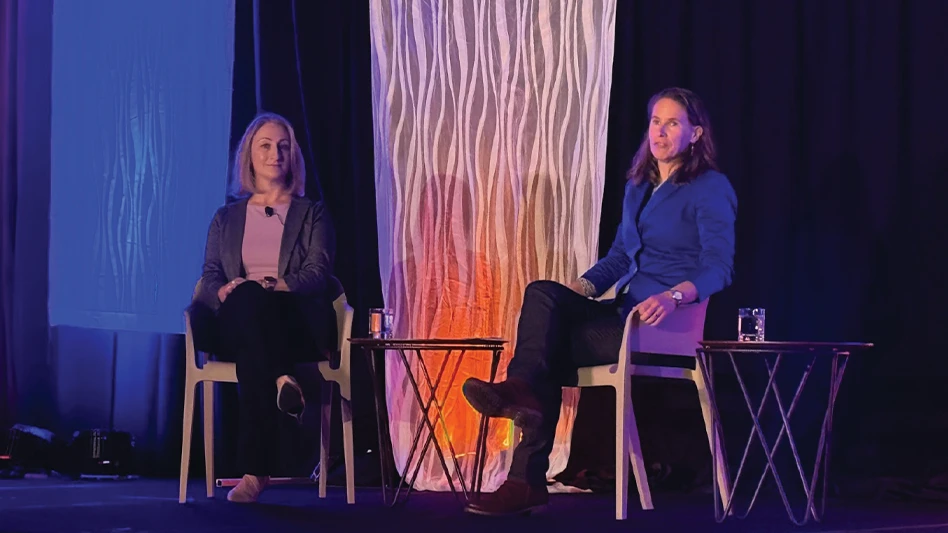
Heller spoke with Kate Bailey, chief policy officer for the Washington-based Association of Plastic Recyclers, during a plenary session, S.B. 54 in California: Countdown to Implementation, Feb. 24 at the 2026 Plastics Recycling Conference in San Diego. During the discussion, Heller pointed out that CalRecycle has experience in rolling out EPR programs for other products and always is looking for the best solutions to achieve goals laid out in the legislation.
RELATED: 2026 Plastics Recycling Conference: Challenges, solutions for reclaimers
The bill, signed in 2022 by Gov. Gavin Newsom, calls for all packaging sold into the state to be recyclable or compostable by 2032. Additionally, that same year, the bill requires a 65 percent recycling rate and 25 percent source reduction rate for plastic packaging and food service ware. Based on the state’s reporting regarding its recycling system, Bailey pointed out that recycling rates for most materials were low, with no material rating higher than 20 percent.
To reach the bill’s intended targets in a relatively short timeframe, Heller said CalRecycle, along with producer responsibility organization Circular Action Alliance (CAA), will continue to push for progress within the rules. Their goal is to have a project plan conditionally approved by January 2027.
“There’s a lot of flexibility baked in [to S.B. 54],” she said. “We don’t know what we don’t know. There are a lot of different ways recycling rates can be achieved. We want to determine what the pathway is to progress and not get caught up in the perception of impossibility. The goals of this law are too important to get caught up in a ridiculous enforcement stance.”
Complications and precedent
Heller said the department aims to identify what recycling infrastructure needs to be built in the state and also build true responsible end markets for material.
“We want to stay focused on progress and not the barriers,” she said. “Let’s figure out how to get through them and see some change in California.”
Heller laid CalRecycle’s task out simply.
“My job is to implement the law, and the law says to make plastic recycling work,” she said. “We’ve seen a lot of success in California on plastic recycling. [S.B.] 54 is a big part of what we’re doing, but we have other programs.”
Heller cited the state’s beverage container recycling program and its deposit return system as examples of recycling success in which it was able to build infrastructure and incentivize the collection and processing of plastic bottles.
“We’ve demonstrated that we can do this before, so I think we can demonstrate we can do this again,” she said. “There will need to be packaging design changes, alternatives to achieve source reduction rates. That will require us to look further upstream and find real solutions for covered material categories, so packages we’re selling into the state achieve circularity.”
Still, Bailey pointed out criticism of S.B. 54, namely its large size and potentially restrictive nature. She noted that the state’s needs assessment, used to help formulate the EPR program, spans thousands of pages. There are 170 pages in the bill that outline additional regulations.
Responding to those who might describe the law as complicated, Heller said it is indeed complex, but the law is “robust” and the many regulations are in place to provide clarity as to how CalRecycle and CAA will implement it.
“As we’ve developed regulations, we’ve found that words on paper are critical for success overall,” Heller said. “I see regulations as guardrails; this is the area we need to stay in to stay within statutory goals. Within that, there’s a lot of room for innovation for ways to get things done. It’s not prescriptive for what the plan needs to look like. The plan will be how CAA and partners develop pathways to the goals in the law.”
Heller noted that “hot topics” discussed about S.B. 54 include exemptions, which are detailed in the regulations, so producers have clarity in what data they need to submit for evaluation by CalRecycle and CAA.
“The amount of info we’ve been able to provide is unprecedented and will be helpful in achieving our goal,” Heller said. “We need to redevelop the needs assessment every five years. We’ve got a really good foundation now. We have regulations that are hopefully almost adopted, then we can move toward what’s needed. We’re working on guidance and easier-to-process updates to the material characterization study. We’re looking to do this collaboratively so we can ensure success.”
Getting residents on board
You can’t recycle what you can’t collect, Bailey said, adding that behavior change will need to take place among California’s residents, who mostly already have access to recycling.
Heller said consumer behavior is something CalRecycle thinks about quite often and used the state’s push to improve organics recycling as an example.
“Where we’re doing active work right now is on the organics recycling front,” she said. “It’s really hard. We’ve put in place infrastructure for organics recycling and people simply aren’t using their organics recycling bins. It harms our ability to pull that material out and sort it.”
Heller said CalRecycle has started a media campaign to focus on Californians who are busy and what they might need to change their behavior.
“The first [way we addressed people] was plain language, simple messaging,” Heller said. “The second was highlighting the value to them for doing the thing. How does this help me, my family, my costs? The third thing is addressing systems that are reliable and that work.
“When National Sword came down and China stopped taking our material, that eroded a lot of confidence in our recycling systems,” Heller continued, citing China’s 2017 policy that banned imports of mixed paper and various grades of postconsumer plastics. “The focus will be on regaining that trust and visibility. If you put this thing in the right bin, it gets turned into something new. It’s good from an environmental perspective and good from an economic perspective. Part of S.B. 54 will be education and outreach. This is critical. Using the right bin leads to less contamination and leads to success overall.”
Upon approval of the plan, Heller said jurisdictions will be required to collect material categories that are deemed recyclable and compostable. For recyclable material categories, she said program planners have looked at existing collection, sorting and end markets.
“Hopefully, that will standardize what’s going into the bin and mitigate some of this contamination,” Heller said. “That’s something that keeps me up at night. If we don’t have behavior change, we won’t be successful.
Collective action
As S.B. 54 inches closer to implementation, Heller stressed progress over perfection.
“Our goal is that we all work together to have a project plan that can be conditionally approved by January 2027,” she said. “We want that plan to be in place in a way where we can see the pathway toward achieving the [2032] goals. That may not be perfect, but I’d argue any EPR plan isn’t perfect because we don’t know the perfect formula to achieve the goals of EPR.”
She added that EPR does provide opportunities for flexibility within its parameters.
“We will continue to revisit [S.B. 54] and collaborate,” she said. “Our approach to enforcement has largely been implementation assistance. If we see gaps, let’s find a compliance action plan to achieve those goals. There’s flexibility in S.B. 54 for certain packaging where collection infrastructure just isn’t there right now. There’s a robust toolbox to ultimately come as close to compliance as we can and work toward more progress each year. By this time next year, I think we’ll have progress to report on.”
As CalRecycle and CAA work to implement the program, Heller emphasized that the organizations “don’t know what we don’t know,” but are eager to learn and better understand producers’ systems and challenges.
“We need to bring all entities to the table,” Heller said. “If CalRecycle can help facilitate these conversations, we want to be part of that. We also want early engagement. There’s going to be a number of other things that are going to be helpful for us if [producers] come to us early.”
Communication is a two-way street, she continued, as CalRecycle is working on reaching stakeholders in ways it hasn’t previously.
“We need to do this together,” Heller said. “A siloed approach isn’t going to work. We want to continue collaboration and [stakeholders] sharing with us and telling us ways we can facilitate ongoing dialogues. That will be very helpful.”
Latest from Recycling Today
- Commentary: Plastic recycling isn’t working; what are we going to do about that?
- Environmental groups urge Indonesia to return e-scrap shipments
- Foodservice Packaging Institute opens applications for 2026 foam recycling grant program
- Worn Again Technologies unveils Accelerator plant to advance polycotton recycling
- Nashville Waste Services launches new digital route system
- Arconic expands in Iowa
- Cascades invests $6.9M in recycled boxboard plant
- Ocean freight interruptions poised to continue