Photo by Chris Voloschuk
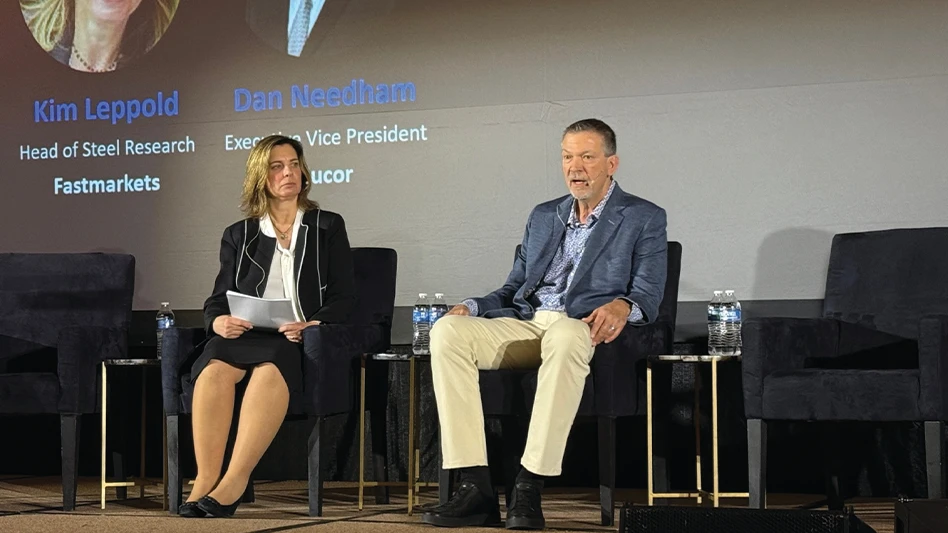
As Dan Needham put it at the 2026 Fastmarkets Circular Steel Summit in Houston, the excitement from reports of marginal growth in the construction sector this year comes when you drill down into the details.
Specifically, during his Keynote Fireside Chat Jan. 29, the executive vice president at Charlotte, North Carolina-based steelmaker Nucor Corp. pointed to a predicted rise in nonresidential construction in the United States.
RELATED: 2026 Circular Steel Summit: Taking stock of tariffs | 2026 Circular Steel Summit: The supplier relationship
“It’s data centers, it’s energy,” Needham said of what could be driving that modest growth. “And it’s not just things like natural gas or LNG, but renewables are still strong today. When you look at energy transmission, anything supporting that market is very good.”
Additionally, he said he sees growth in infrastructure projects, such as bridges, arenas and more. “All of those are good signs and markets where we see things are moving.”
Looking inward
In terms of its own projects, Needham said Nucor entered this year with a backlog 40 percent higher than 2025, adding that some product groups currently have record backlogs.
“There’s excitement about where markets are going,” he said. “Since 2020, Nucor has invested nearly $20 billion, and we’re coming near the investment of that investment campaign.”
Looking at strong markets where Nucor can play a role, Needham used data centers as an example.
“Today, we can do the shell of a data center and have the breadth of capabilities to do that. But we’ve also added insulated metal panels. And if you look at the inside, where a lot of the value is, we have the ability to do coordinated systems today. So, 95 percent or greater of the steel needs going into the data center we have the capabilities of providing.”
Going further, when looking at the transmission of natural gas, for example, Needham pointed to Nucor’s plate mill in Brandenburg, Kentucky, which produces the steel used in line pipe.
“We can go wider and thicker and provide a lot of the line pipe product needs in the market,” he said, adding that the Brandenburg facility allows the company to supply armored plate and other grades for the defense industry.
On the steel sheet side of its operations, Needham highlighted Nucor’s electric arc furnace (EAF) facility in Apple Grove, West Virginia, which he said is expected to come online this year. He noted the company also is investing in the development of galvanizing lines.
“These are really aimed at the automotive market and consumer verticals, and I think when we talk about markets, automotive is one that’s holding its own,” Needham said. “The reason we’re interested is we’re underrepresented in that market and that’s about one-third of the sheet market. We have an opportunity to grow in that market and that’s absolutely a focus that we have.”
The tariff effect
Looking at the international trade landscape and the Trump administration’s tariff regimen, Needham said it was important to look at the macro sense of why such decisions were made regarding duties on imports.
Citing a tariff-oriented panel discussion that had already taken place at the conference that described the disappearance of free trade and free markets in the U.S., Needham said those markets went away a long time ago.
“The U.S. still tried to play by free market conditions, but the rest of the world doesn’t,” he said. “If you look at the world today, we have over 600 million metric tons of excess steel capacity—that’s roughly six times the U.S. market. That’s insane, and that’s continuing to rise.”
Needham said the way to deal with such “nonmarket conditions” are Section 232 tariffs and different trade agreements, which the administration bolstered last February.
“If you look at the 232s, since they’ve been enacted, at the beginning of [2025], about 25 percent of the finished steel market in the U.S. was supported by imports,” he said. “Fast forward to October and that’s down to 16 percent. The estimate for November is 14 percent and it’s continuing to fall. So, the 232 is doing what it’s intended to do.”
Needham said he envisions a continued reduction in imports this year and paid particular attention to trade agreements the administration has announced with several Asian countries.
“You add it up, the total investment committed, verbally, is $9.6 trillion in foreign investment in the United States,” he said. “That’s a lot of money. We haven’t seen what that’s going to be made up of, because that doesn’t exist. Where that gets invested, I think we all have an opportunity to try to put that where it’s needed.”
Assuming that money materializes, Needham suggested it could go toward bringing forging, fabrication and the production of derivatives back to the U.S., for example.
“That’s our opportunity to help engage the administration and others to direct funds where the market needs them,” he said. “We can help push market needs instead of regulatory needs.”
Considering carbon
On the topic of green steel, Needham said the U.S. market is driven by market demand, needs and dynamics, and transparency is paramount.
“We need transparency around what the embodied carbon amount is [in steel products],” he said. “We don’t want to compete with other steel, we want to compete with aluminum, carbon fibers, etc. If we can report embodied carbon, that can provide the transparency we need.”
Years ago, while some companies set ambitious 2030 net-zero targets for their operations, Needham said Nucor opted to let the market dictate where it was headed.
“Four to five years ago, the way to get to net-zero was to offer carbon offsets,” he said. “So, we offered our Econiq product. Somewhere between 20-30 percent of that was going to be offsets, but the market quickly evolved. “We look at sustainability as a journey. It’s not going to happen today; it’s not going to happen next year. It’s going to evolve over the long-term.”
Regarding Nucor’s Econiq offering, Needham said customers “just wanted to have it,” adding that companies can buy carbon offsets or renewable energy credits from the market at around $2 per ton, but that wasn’t a market reflection.
“We didn’t do that,” he said. “We wanted a better product. We only offered the credits we created.”
Needham said he believes the market needs to go where transparency is, and that the industry is headed toward what he described as actionable steps called the “decarb menu.”
“What everybody was saying was that by 2030, 2040, 2050, we’re going to be net-zero,” he said. “I don’t know what that means. I can’t act on that. Frankly, I don’t think they knew what that meant. We’ve got to get to actionable steps. What I can act on is, let’s say that by 2030 you want to go from 1,000 kilograms of CO2 per ton of steel to 600. We can do that today. We can measure that. And you can go to your customers and say, ‘I have a better product for you and here’s what you can look at.’ That’s where we see the markets going, and that’s where we see market-driven decisions making an impact.”
Needham continued that offsets would always have a place, and that decision lies with each individual business considering them. However, he said he sees two types of actors in the markets: those who pivot where the winds blow and those with a specific reason to make a decision.
“We want to make the future better,” he said. “If [customers] want offsets on their journey, we’ll provide them.”
Latest from Recycling Today
- Minespider launches digital marketplace for circular batteries
- SWANA, Fire Rover develop fire incident reporting tool
- Recycle BC launches flexible plastics recycling carts in Vancouver
- Shapiro continues leadership appointments
- Iron Crest forms waste equipment manufacturing platform
- SES opens second zero-waste facility in Kansas City
- Vanguard Renewables acquires E-Z Recycling
- Carton recycling access expands to 2.5M US households