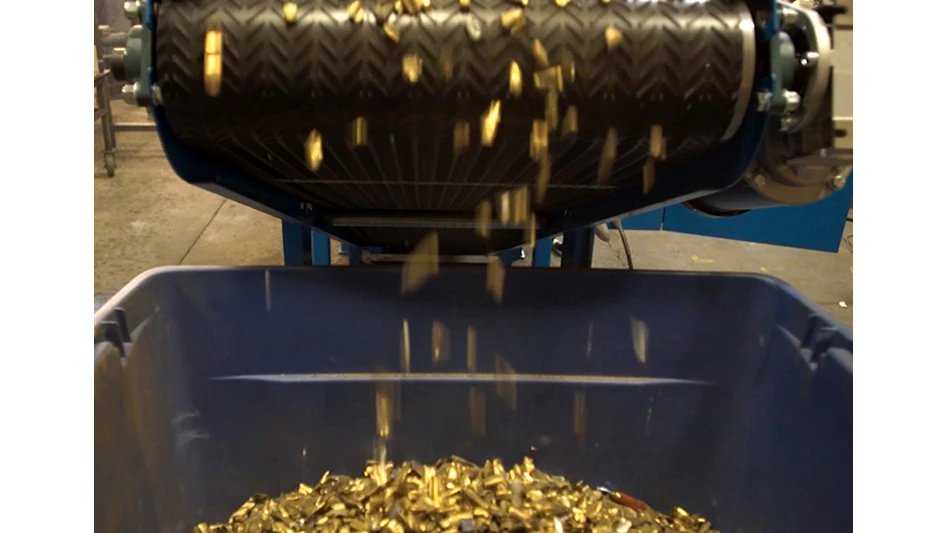
Photo courtesy of BCA Industries
One cumulative effect of live-fire firearms training is a large, continuous stream of spent brass shell casings that need to be recycled, says Milwaukee-based size reduction equipment provider BCA Industries.
Agencies including active-duty and reserve military units, federal agencies, the National Guard, state and local law enforcement, plus commercial firing ranges, can generate thousands of rounds of such casings, says the firm.
For recyclers, crushing the shell casings prior to shipping to melt shops or other downstream recycling operations can add value, depending on how much material they handle, how far it needs to move and what the next buyer wants.
“Although a fired casing is, in simple terms, empty metal, they take up a disproportionate amount of space relative to their weight,” says BCA of the hollowed-out brass objects. “Crushing them reduces volume, which makes them easier to handle, lowers storage demands, and can greatly reduce transportation costs.”
Remarks John Neuens, an industrial consultant at BCA Industries, “For brass recyclers moving large quantities over long distances, crushing cuts the volume way down so you are not shipping air. These efficiencies can result in a reduced number of shipments overall or allow each truckload to be utilized more effectively, maximizing transport value and lowering total logistics costs.”
He says BCA provides custom recycling systems for numerous industrial and commercial applications, including this one.
The company says crushed casings can be easier to feed into hoppers, conveyors, balers or shredders used in scrap processing. The compression of the shells’ size also allows for less expensive freight charges to the recycler.
Additionally, some smelters prefer crushed or compacted brass because it is easier to load when charging a furnace and there can be fewer complications from air pockets.
In some cases, processors that contract directly with agencies or defense-related contractors may be required to crush brass casings as part of the demilitarization (demil) requirements to render casings unfit for reuse.
Such work typically is done with roller mills and other types of crushing equipment used in scrap handling and metal recycling, allowing large volumes of cartridge cases to be processed efficiently.
The possibility that an unfired round could enter the recycling stream is a concern in that a live cartridge could discharge under pressure and create a safety hazard.
According to Neuens, the actual risk is minimal. The consultant says when a round is not confined in a firearm chamber, its energy is limited, and modern roller mills used for this work incorporate design features that contain the event and prevent any release beyond the crushing chamber.
Because they are hollow, resilient, and prone to interlocking, challenges involving uncrushed cartridges retreat after a roller mill collapses the casings’ structure, flattening them or partially cracking them so they behave more like solid scrap, according to BCA.
“The operating principle is straightforward,” says Neuens. “Brass casings are fed continuously into a pair of counter-rotating steel rollers. The rollers are set with a controlled gap that is narrow enough to crush and flatten the casings without excessively fragmenting them.”
In the application, roller mills function more like heavy-duty crushers instead of grinders. The rollers are often hardened and wear-resistant to accommodate brass that may contain dirt, primer remnants or other contaminants, adds the company.
BCA describes its Cartridge Crusher RLLR-4001-0001 Roller Mill as an industrial-grade device engineered to streamline the processing of spent ammunition casings for efficient recycling and material handling.
Built with a dual-roller system, the machine “compresses and crushes spent shells quickly and consistently, significantly reducing their volume for easier storage, transport and metal reclamation,” says BCA Industries.
The crushers, which are manufactured in the United States, feature what BCA calls a generously sized hopper capable of accepting a wide range of casing sizes from .22 caliber through .50 caliber for continuous, uninterrupted processing.
An integrated magnetic separation system has been designed to automatically remove ferrous components before crushing to create a cleaner and more valuable recyclable brass grade.
According to Neuens, safety considerations remain critical in systems handling cartridge brass. However, the equipment is specifically engineered to safely process material even in the presence of live rounds, minimizing risk.
Neuens says the entry area of the roller mill is engineered with internal panels designed to fully contain fragments so no particles can escape.
“Gunpowder in a cartridge is meant to burn and create gas, not explode like a bomb,” says Neuens. “In a gun, the chamber and barrel trap that gas so pressure builds behind the bullet and pushes it to high speed. Without that confinement, the gas expands in all directions. If a round ignites outside a chamber, there’s no strong, focused pressure.”
BCA says many brass recyclers prefer a mobile unit so they can crush casings on-site. The technique can reduce material handling, minimize logistical complexity and substantially decrease overall shipping expenses, according to the firm.
The RLLR-4001-0001 system also is available in a containerized configuration to protect personnel during operation and to simplify transport.
“These configurations are well suited for operations that travel to multiple locations, allowing shells to be crushed at the customer’s site rather than transported between facilities [so] the material can be processed immediately before it’s shipped,” says Neuens.
A video clip of the RLLR-4001-0001 roller mill in action can be viewed on YouTube.
Latest from Recycling Today
- Global Recycling Foundation recognizes Recycling Heroes
- Recycling Today Media Group launches Paper and Plastics Recycling Conference webinar series
- Equipment finance index takes dip in March
- CEPI says recycling sector ready for ‘Made in Europe’ policy
- Nucor guidance points to profitable Q1
- Plastic Energy, TotalEnergies start up chemical recycling plant near Paris
- Sierra International Machinery adds to sales team
- How2Recycle appoints new director