Much has changed since Steve Alexander took the helm at the Association of Plastic Recyclers (APR) in 2005—within the association and in plastics recycling more broadly.
Previously, the APR was a volunteer-run organization with one part-time director and 40-50 member companies.
Over time, Alexander changed that by getting permission from the board to hire full-time employees with full benefits rather than relying on contracted workers. Today, the APR has 18 full-time employees and five independent contractors on staff, he says.
“I’m very proud of the people who work with us and what we’ve been able to achieve.”
He says the APR is looking to strengthen its lobbying efforts on behalf of the industry. “I think what separates APR from other organizations is that [plastics recycling] is all we do. It’s not part of it; it’s what we do.”
While the APR has developed a design guide and testing protocols that are used globally, Alexander expresses frustration that it hasn’t had a bigger impact. “We’re losing the narrative.”
He shares more thoughts on plastic recycling in the following interview.
Q: It’s been alarming to see, particularly in the polyethylene terephthalate (PET) space, all these closures recently when we’re on the threshold of extended producer responsibility (EPR) laws ramping up and there being more levers that would encourage recycled content. Are there going to be any companies around to fulfill that demand the way things are going?
A: People might have that thought, but the fact is, from the recyclers’ side, we have the infrastructure and we have the capacity. Why are we shutting down capacity? Because there are no customers. If we have customers, we will invest in the technology, we will invest in the capacity. So, how do we incentivize that customer base? We need mandated [domestically produced] recycled content because the alternative is, “We’ll just buy from overseas.”
For all this imported material, we have a willing domestic manufacturing operation here, but we can’t get customers. So, we need to incentivize the domestic base.
If the EPR fees are not significant enough, then—we’ve heard this conversation at the executive suite level—“We’ll just pay the fine; we don’t need to use [recycled] content.”
Q: It’s frustrating that more people haven’t realized the benefits of using recycled plastics.
A: The monetization of the system comes from the customer base. So, if you don’t have a customer, all that stuff costs money, and nobody gets paid. If we’re talking about being truly circular, that’s the way it has to work.
We need to provide incentives for the customer base. We give tax credits for everything. Why don’t we give tax credits to the manufacturer of a recycled resin and, more importantly, if you use a certain percentage of recycled resin, you get a tax break.
Q: Do you think a tax credit to use recycled content would be more compelling than a penalty for not using it?
A: It’s all price. What gives a bigger value? That’s really what it’s going to come down to.
We need to decouple the value of using recycled material from the price of virgin because when you use a recycled resin to manufacture a container, that’s additional to the container. It’s an additionality to not just society, but you’re telling your consumer, “You’ve asked us to be more sustainable. Here is a concrete demonstration of our commitment to you to make our products more sustainable.”
Q: How have you seen plastics recycling change over the years?
A: The technology is phenomenal. I’ve been quoted as saying that plastic recycling is like the Silicon Valley of the solid waste management industry.
About 10-12 years ago, you saw optical sorters come into play. Obviously, now we’re seeing robotics and AI [artificial intelligence] having much more impact on the efficiency of sortation.
The infrastructure of the recycling plant, from the wash lines to the delabelers to the melt flow indexing, etc., but more importantly than that, in that industry you’ve seen a tremendous change in the composition of the containers as well. You’re seeing lightweighting of material, using much less plastic today to make the containers. You’re seeing people following the APR design guide, so that you have much less contamination in the system. You have barrier layers that are compatible with recycling. A lot of materials don’t use oxygen scavengers anymore; these inhibitors to the recyclability of the container have declined dramatically, and if new ones come up, they’re solved. There are no more technical challenges relating to the recyclability of a plastic container if you follow the design guide and testing protocols. And if there are, they’re fixed. We have floatable labels now, we have ink levels that don’t contaminate wash water, etc.
Q: Where do you see upcoming opportunities for plastics recycling?
A: It’s got to be EPR, and we’ve got to make it work right. We tend to have this crisis mentality in terms of dealing with issues in this country. And so, we deal with it and we move on to the next issue. But did we deal with it properly?
I’ve been in this business for a long time. There’s obviously never been the attention focused on plastics and the recyclability of plastics as there is now. We need to take advantage of this opportunity to create an infrastructure program like EPR, but we need to make sure it does it right.
For whatever it’s worth, good or bad, people have latched on to the EPR bandwagon. Let’s make sure it works and it solves the issue because I don’t want to have to come back and retrofit it.
Q: When you say it’s important to get it right, is that particularly around ecomodulation and ensuring that there are recycled content mandates?
A: Yes, because first of all, you’ve got to make sure that there’s a market component, because without a market demand component, what is EPR? It’s a supply program. So, you’re supplying material, but if you don’t have a market for it we’re going to stockpile it, and that exacerbates the situation. You’ve got to have a strong market pull, and how do you do that? What’s the lever to do that? And it just seems to be that it’s got to be an ecomodulation fee or fine and it’s got to be strong enough so that you just can’t say, “Well, we’re not going to do that. We’re just going to pay the fine.”
The other thing we would argue is the issue that you deal with in plastic waste is not postindustrial waste, it’s postconsumer waste—it’s the waste we see and use every day—so it’s got to be certified that the material comes from that area.
Q: I know that you recently relaunched the APR Demand Champions program. I was wondering why you thought a relaunch was necessary.
A: I think when we first did the Demand Champions program, we said, “We’ve got an opportunity to get more material in dunnage crates, slip sheets, rolling carts [and] plastic pallets,” and we were too narrow-minded. We have had companies coming out with all sorts of ideas where they could use more content. We didn’t resource it enough, to be honest with you. And then it got a little stale. It didn’t necessarily fall by the wayside, but we weren’t publicizing it enough. And then we did a retrenchment, and we did a survey of what people valued the most of the APR programs. That Demand Champions program was all about expanding people’s paradigm so it’s not just bottle to bottle. One of the largest plastic recyclers in the world is ADS [Advanced Drainage Systems Inc.]. They take [recycled content], and it goes into pipe that can go into the ground for 100 years. Carpeting contains [recycled polyethylene terephthalate]. … But if you had one major manufacturing facility that switched from wood pallets to pallets made with recycled content [plastics], those pallets get used, they get discarded in four months versus eight years or 12 years. We’re trying to promote expanded market use. Why are there recycling carts in this country without recycled content? So, we really want to push that.
It just makes sense for us to tell people how they can use content beyond just bottle to bottle.
Q: Greg Janson of Triton Ties gets very frustrated with why making durable products is considered downcycling. Do you think there’s too much focus on like-for-like circularity and there needs to be a broader definition of what circularity is?
A: Yes, absolutely. Part of the problem is somehow that it is a degradation if you are not going back into the original product, but it doesn’t need to be at all. … We are shortchanging ourselves if we think it’s got to go back into the same product over and over and over again because it’s simply not as economical, but also it deprives you of potential market, which we’re trying to achieve here.
Q: I did not ask you about chemical recycling and the role you think it has to play overall, so I'll leave you with that question.
A: I think that there's been ups and downs. ... I think the chemical industry has found out what the mechanical industry has known for a long time. This isn't something you just snap your fingers at. I think there certainly are spaces where certain forms of chemical recycling could benefit us, but they have the same issues. They have collection issues, they have sortation issues, they have processing issues and they have market issues because it's extraordinarily expensive to utilize a chemical process. So, can it be complementary? Yes. It still remains to be seen how effective it can be.
Fast facts
Name, title: Steve Alexander, president and CEO
Organization, tenure: Association of Plastic Recyclers, which he became head of in 2005
Location: Washington, D.C.
Years in industry: 21
Education: Bachelor’s degree from the University of Rhode Island and an MBA from the Sellenger School of Business at Loyola College in Baltimore
Email: steve@plasticsrecycling.org
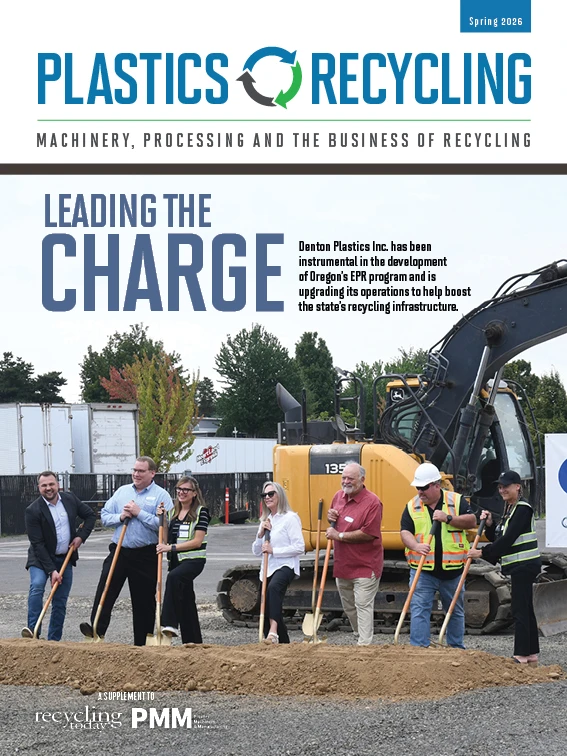
Explore the Spring 2026 Plastics Recycling Issue
Check out more from this issue and find your next story to read.
Latest from Recycling Today
- Presona links up with 2 UK firms
- eFactor3 enters into separation tech partnership
- NRC online event will review plastics survey results
- Novelis’ aluminum sheet receives recognition
- Jay Robinovitz to receive ReMA’s 2026 Lifetime Achievement Award
- Needs assessment surveys for Minnesota EPR law underway
- Poly Coated Paper Alliance adds new members
- Mitsubishi Logisnext Americas to rebrand as Logisnext Americas