Sortera Technologies Inc., headquartered in Markle, Indiana, has closed on $45 million in funding that will help the company expand its sorting capabilities to a second location to be sited in Lebanon, Tennessee.
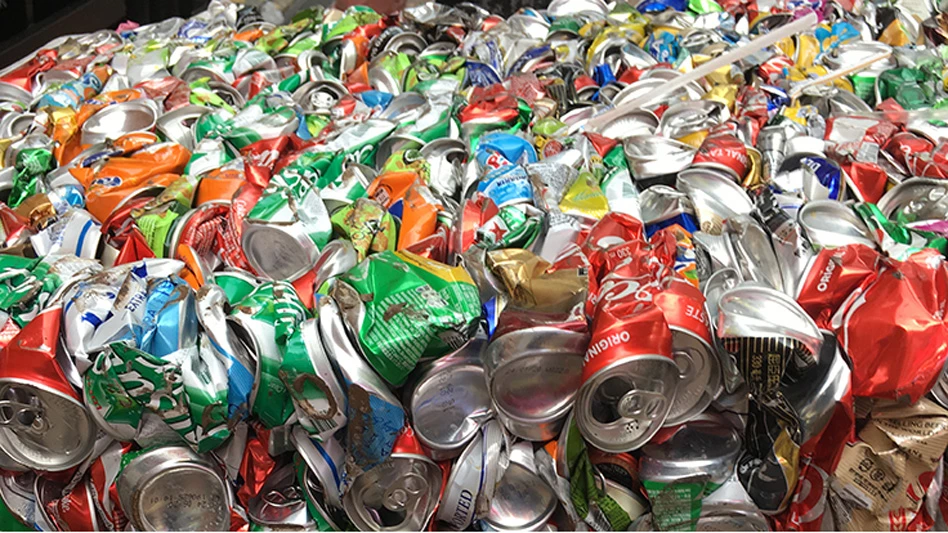
The company uses artificial intelligence (AI) and advanced sensors to sort mixed aluminum scrap into specific alloys that can replace imported primary aluminum.
Since launching operations at its 200,000-square-foot Markle facility early in 2023, Sortera Technologies says it has experienced significant customer demand for its recycled aluminum alloys that this new funding and a second location will help the company to meet.
The funders
Accounts advised by VXI Capital and T. Rowe Price Associates led the funding, with participation from Yamaha Motor Ventures and Overlay Capital and additional equipment funding from Trinity Capital.
Ben Pope, Sortera Technologies senior vice president of operations and commercial development, tells Recycling Today that VXI and T. Rowe Price previously invested in the company.
“VXI partnered with Sortera as part of their continuing focus on addressing significant global problems—in our case, the more efficient sorting and use of scrap metals,” Pope says, while T. Row Price invested in the company through its Metal and Mining team to focus on improving metals circularity.
New funder Overlay Capital shares Sortera’s focus on sustainable innovation and its impact on energy independence, while Yamaha Ventures Funds invested in Sortera as part of a unique opportunity to work together to supply sustainable materials for the transportation industry.
This funding will help fuel Sortera’s next phase of growth, which includes plans for its second processing facility in Lebanon. The company says the expansion is driven by demand for its sorted recovered aluminum as well as its success at its flagship Markle facility.
The new location also will bring Sortera’s recycling solutions closer to its growing customer base.
The new location
Pope says Tennessee offers an ideal central location for aluminum scrap procurement and the sale of the company’s sorted specification products.
Earlier in its history, Sortera established a tolling relationship with Atlanta-based Novelis, which also took a minority position in the company through its Novelis Ventures team, at its Markle facility that saw Sortera begin processing stamping plant scrap for Novelis in the second half of 2022.
Pope says that tolling agreement provided an opportunity to advance the company’s technology with a strategic partner while limiting the company’s need for working capital.
“Today, we target buy/sell business as it is the growth market for Sortera into the future,” he says, adding that the company’s Lebanon location is ideally suited to that business model.
The 25-acre site has rail access for inbound and outbound logistic opportunities and, he continues, being located near Interstate 40 provides plenty of access to the large consumption of aluminum rolling mills, secondary smelters and die casters within a 300-mile radius.
“Our Lebanon facility will have the same capability as our Markle facility,” Pope continues. “We are sorting eight finished items in one pass; this capability can be expanded at both facilities as the product development advances.”
Sortera expects the new facility will be operational by the summer of 2026.
The Markle site can process 120 million pounds per year, Pope says, and the Lebanon facility will match that capacity initially, though it has the potential to increase production if necessary.

Meeting growing demand
Sortera’s proprietary technology enables precise sorting and capture of valuable aluminum from scrap streams, according to the company. It notes its AI-enabled multisensor sorting systems with blending capabilities support customer-specific alloy composition requirements.
The recovered aluminum products Sortera produces include cast alloys 380, 356 and 319, as well as wrought alloys such as 3105. The company says each of its products is designed to match the chemistry of common aluminum casting or rolling alloys.
Sortera also produces low-silicon wrought packages and polished end-of-life aluminum die cast for direct use in 380 applications.
“The performance of our Markle facility and the enthusiastic response from our customers have made it clear: The domestic market is hungry for sustainable, high-quality recycled aluminum,” Sortera Technologies CEO Michael Siemer says in a news release in November 2025 announcing the investment and new facility. “The robust investor confidence that powered this funding, coupled with the proven customer demand that necessitates our expansion into Tennessee, is a direct result of this success.
“This expansion allows us to significantly increase our capacity and establish a presence closer to many of our key customers—particularly in the automotive sector—further streamlining supply chains and enhancing our service capabilities,” Siemer continues.
Pope says demand for Sortera’s sorted aluminum alloys has been robust as the market is increasing its recycled aluminum consumption in the coming years. He adds that an increased use of recovered aluminum is the greatest contributor toward end consumers meeting their sustainability targets.
“Pricing for our sorted products is based on the end-use market the scrap is supporting,” Pope says. “Wrought scrap is going to the rolling slab and billet casting consumers and trading against the USMW [U.S. Midwest] Transaction price, while our cast products are trading [based] off the secondary aluminum alloys they complement.
“Upgraded scrap has many unique values: chemical intrinsic value, higher recoveries based on density and volume supply that currently does not exist in alloy form by other suppliers.”
Pope previously told Recycling Today that Sortera planned to build two new plants in the Southeast in the coming years, with the Lebanon plant being the first the company will realize, and that future growth will be targeted in the Southeast over the next few years.
“Other regions of the country are also possibilities,” he continues. “We are focusing on the increasing demand the Southeast provides.”
Explore the Winter 2026 Scrap Recycling Issue
Check out more from this issue and find your next story to read.