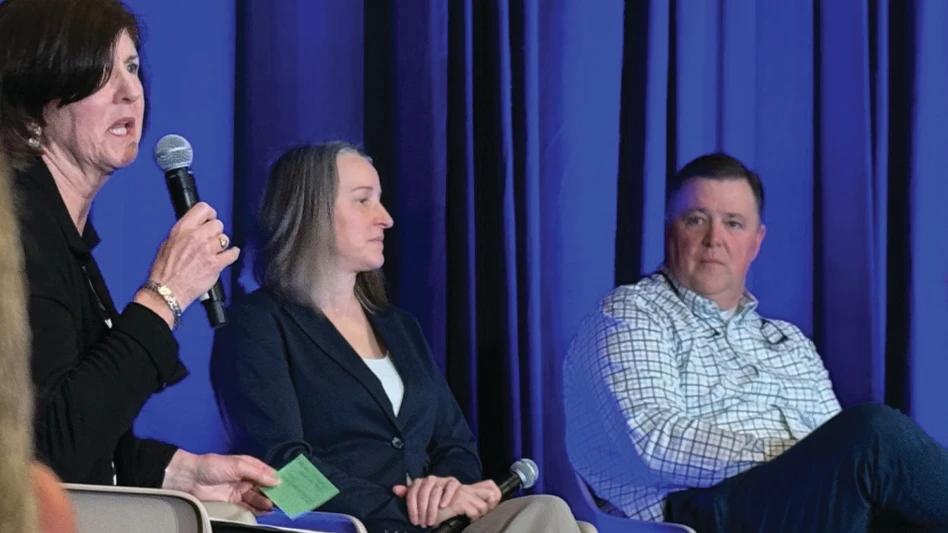
Nathan Campbell is well-acquainted with the challenges facing small and large information management companies alike, having worked for a two-location data protection company called National Safe Depository before the company was purchased by Brambles, the owner of Recall, in 1992. Campbell spent more than two decades with Recall.
Working for the large international firm exposed him to a variety of leadership training and development and operations concepts, he says.
Today, Campbell uses the knowledge he’s acquired over the years in his post as chief operating officer for Livermore, Calif.-based Access, which has made a number of acquisitions in the last two years.
Campbell also serves as president of PRISM International, the nonprofit trade association representing the commercial records and information management (RIM) industry. He has been a member of the organization for more than 20 years, though he says he was not necessarily actively engaged early on. He joined PRISM’s government relations committee and, when urged by Dennis Barnedt, founder of Access, he joined the association’s board.
Campbell shares his goals for PRISM with DeAnne Toto, editor of Storage & Destruction Business (SDB).
SDB: What are your goals for PRISM during your presidency?
Nathan Campbell (NC): We are going to be determined to make sure our international membership continues to grow.
I’m not sure how much you have stayed abreast of what we’ve done, but we held a meeting in Cartagena, Columbia. Our Latin America Regional Advisory Council put that meeting together, and over 50 people attended. We [had] a meeting [in late February] in Brisbane, Australia. On top of that, we have our annual meeting in May that our international members also can attend. Later in the year, we have secured a hotel in Amsterdam where we will be hosting our European conference (the European Information Management Conference, which is held in partnership with the National Association for Information Destruction and ARMA International).
I am also determined to make sure that our board represents the diversity in our membership. We want to have a balanced board of international members and both large and small organizations. I think that leads to a better PRISM. I want to make sure that we are looking at decisions from all vantage points and asking the right questions. Having representation from large and small companies on our board gives us the opportunity to do that.
Probably another thing that I am excited to be a part of is the rebirth of the strategic planning process with PRISM. Over the last few years we have invested a lot of time in the transition to an AMC (association management company) and the development of Privacy+. I feel that now is a good time for us to step back a little bit and determine where we want to be in the next five to 10 years and develop a plan for getting us there. As we head into this process, I think that we are determined that this plan will be the plan not only for PRISM but something that can help benefit the industry as well.
SDB: PRISM has undergone a major transition with the departure of former Executive Director Jim Booth and the association’s staff. What changes have been most visible to members as a result? What changes are less apparent?
NC: I think that the things that our members will see are the improvements to InFocus magazine, which is now digitally shared to thousands. It has improved content that is searchable, and we are translating it into multiple languages, which is critical for our international plan.
Our PRISM Week in Review has been upgraded significantly and reports on important events in the RIM industry.
AMC (Association Management Co. of Chicago) has done a good job of being nimble and responsive, so we are going to host our first ever webinar. An email [went] out [in late February] inviting people to a webinar in March that [talked] about the new HIPAA (Health Insurance Portability and Accountability Act) regulations.
I think people should get excited about the new locations for our conferences, Coconut Point (Bonita Springs, Fla.) this year and Palm Springs (California) next year, which are two locations we haven’t tried before.
From the perspective of what changes are less apparent, AMC brings a lot of knowledge, experience and ability to flex and stretch to respond to events as they come. AMC has a great financial system—that most people wouldn’t know—AMC brings financial expertise that is far greater than what we had in the past. Michael Fructer (PRISM treasurer) just completed an initial audit and was quite impressed with what he reviewed. AMC is committed to the annual audit process and … to total transparency.
SDB: Is there anything in particular you’re looking forward to as the organization’s members prepare to convene for the annual conference in May?
NC: Our last conference was in Vegas, and Vegas is such a difficult location for our conference because people kind of splinter off and they go in a lot of different directions. I think the thing that I am most looking forward to is that Coconut Point is a great location, and, by the way, my advice to everybody would be to book early or you could find yourself at a different hotel, and that’s really not quite as fun as being at the conference one.
I am looking forward to what makes PRISM great, which is meeting with friends in the industry, taking in the exciting sessions—this year we have more sessions than we have ever have had to choose from—and then all the conversations that happen after the sessions are completed.
Overall, the annual conference should be fun, it should be something where you can get good information and you can catch up with old friends. I think this year we are getting back to those basics. I am really looking forward to it, and I hope our members feel the same way.
SDB: Do you have any advice for attendees to ensure they make the most of this year’s event?
NC: Book early! When we have done our surveys, people who attend and stay at the conference hotel tend to have a better experience and participate more in the sessions. So, book early, because many exciting events are planned. And participate. The more you get involved with the conference, the more you get out of it. It is directly proportional in terms of what you give, you get back in equal or greater value.
SDB: How has the Privacy+ Certification program continued to evolve since PRISM first introduced it? How would you describe members’ response to Privacy+?
NC: This year, we are developing the next stage of Privacy+. We are building on the foundation that Chris Pearson (president of Chicago-based Vanguard Archives and PRISM International president in 2011) and the original team has set. Many of those people are still on the committee for this. We want it to be much more robust and tied into the SSAE 16 audit (American Institute of Certified Public Accountants [AICPA] Statement on Standards for Attestation Engagements [SSAE] No. 16, Reporting on Controls at a Service Organization), so that we can make sure we are staying up to date on the needs of our members.
The members’ response to date has been very positive. It seems like we are getting a lot of interest from members; they seem to want it. There is a push to move away from the self-audit that we had in the first year of Privacy+ and move to a third-party audit. I think once that happens, it will start to get included in a lot of RFPs (requests for proposals) and it will start to get a little bit more consumer friendly as consumers find out about it and realize that Privacy+ can really help to support them and that there’s a third-party auditor signing off on a set of certifications that can help them and maybe alleviate some of the auditing process that they have to do. Knowing that we have a certification in place, I think it helps everybody.
SDB: When do you think that third-party auditing will be in place?
NC: I think we will probably start seeing that later this year. And I think it will be implemented fully in 2014.
SDB: How would you characterize the current regulatory climate regarding data security and records retention? Do you foresee any additional legislation or regulation that will affect records management firms?
NC: I think there is a lot occurring with regard to the regulatory climate, both for electronic and hard copy. I think we need to keep a close eye on those regulations. I have to hand it to hand it to the big companies like Iron Mountain and Recall, which have been so supportive over the years and have helped our members with the new HIPAA regulations. I think with information exploding the way it is, everyone wants to pass the onus on to others and not take responsibility for what they need to do. If we’re not careful and we don’t keep a close eye on those rules and regulations, we can get fined. It is a changing environment and it’s moving very quickly.
SDB: Do you see additional regulations like the HIPAA omnibus rule that continues to put the onus on the service provider?
NC: I think there is going to continue to be a push in that direction. I think that is something that we have to participate in and stay close to. I don’t see it changing any time soon. There have been so many changes in regulations over the last 10 years, it is going to be imperative for us to stay close to this. With the explosion of data and information, you see a lot more happening in the market place and every time something big occurs, the government wants to respond by making changes to regulations.
SDB: What do you feel will be the biggest challenge for information management industry in the year ahead?
NC: I think there are a number of challenges in our space, such as figuring out how to play in the digital world, finding ways to grow your business while keeping up with the persistent risks and meeting the compliance challenges of our clients as their information needs expand and become more complex. I think certification is going to be a challenge for some, and I don’t want them to be left behind.
Nathan Campbell is president of PRISM International and COO of Livermore, Calif.-based Access. He can be contacted at ncampbell@accesscorp.com.
Latest from Recycling Today
- Vecoplan to present modular solutions at IFAT 2026
- Terex Ecotec appoints Bradley Equipment as Texas distributor
- Greenwave raises revenue but loses money in Q2 2025
- Recycled steel prices hold steady
- EY says India’s need for scrap imports will continue
- Coming full circle
- Amcor, DCM introduce fertilizer packaging with 35 percent recycled content
- Comstock Metals gets closer to commissioning commercial-scale solar panel recycling facility