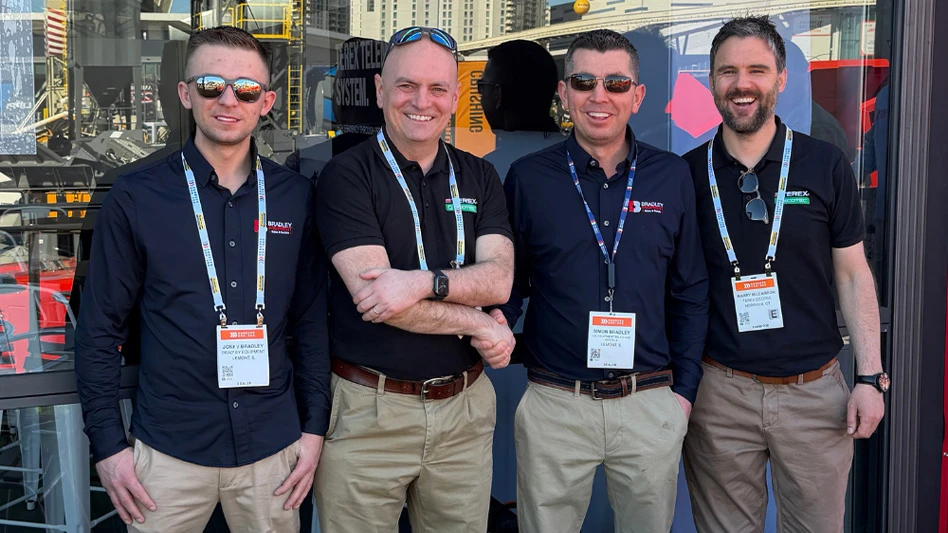
Tom Huth is a familiar name in the information destruction industry, particularly among members of the Phoenix-based National Association for Information Destruction (NAID). The association’s members elected Huth to the post of president in 2012 for a one-year term that begins at the 2013 NAID Annual Convention, March 22-24, in Nashville, Tenn.
Huth serves as senior vice president of operations for Allshred Services, Maumee, Ohio—a position he has held for 10 years.
“Allshred is one of the largest privately held shredding companies in the U.S.,” Huth says. The company serves Ohio, Michigan, Indiana, Kentucky, West Virginia and Pennsylvania from its Toledo-area location, providing off-site and on-site shredding, a lockbox program, purge and on-call services, electronic media destruction, hard drive destruction, electronics recycling and drop-off services.
In terms of his service with NAID, Huth was on the board of directors for a two-year term from 2009 through 2010. He then held the position of secretary of the executive board in 2011. He serves on the Certification Rules Committee and chairs the Membership Task Force Committee. He also has served on the Conference Committee, which he chaired in 2009.
As Huth prepares to take his new leadership role with NAID in 2013, Storage & Destruction Business (SDB) Editor DeAnne Toto asked him to reflect on the current state of the information destruction industry and his goals for the association in the year ahead.
SDB: What are your goals for NAID as you prepare to take the presidency in 2013?
Tom Huth (TH): My primary goal is to keep NAID’s momentum going while strengthening its foundation. NAID has always had a very ambitious and dynamic agenda. I think our biggest challenge is to continue the momentum while making sure members aren’t left behind.
Initiatives like Shred School will be strictly focused on providing training about NAID’s growing number of marketing tools and programs. I would also like to push NAID to expand its sphere of influence around the world.
SDB: What NAID initiatives are you most excited about as the association embarks on a new year?
TH: I am most excited about the roll-out of NAID’s Shred School program. Ray Barry (former president of Total Training services, which sold Shred School to NAID in late 2012) did a wonderful job creating the brand name, and NAID now has a great opportunity to make it the official home of its marketing programs.
Also, I am looking forward to expanding the Certified Secure Destruction Specialist (CSDS) and NAID certification programs.
In addition, our members need to be aware of the benefits they could get with Downstream Data Coverage. Right now Downstream’s success is based on the policy’s superior coverage. That being said, NAID has not done enough to let members know about the long-term benefits associated with Downstream developing into a member-owned, risk-retention group.
SDB: How has NAID’s CSDS program been embraced by the industry? Will there be any new developments in this area?
TH: When you consider that most new programs take a while to grow, the CSDS program has been very well-received. NAID certification, for instance, had less than 50 participants in its first five years and now it has close to 1,000. In the initial year of the CSDS program, more than 100 industry professionals graduated, including some vendor representatives. The program is just about to conclude its third year with close to 200 participants.
This year, we expanded the program into Canada and expect to do the same for Europe and Australia at some point in the next year. Also, the CSDS board of regents is developing an online training program that will make preparing for the CSDS exam much more convenient and effective.
Of course, NAID has not forgotten the real purpose of the CSDS program, which is to create industry professionals who have the confidence and effectiveness of true subject matter experts.
SDB: I understand that NAID is in the process of training an auditor who will certify companies in Asia. Can you tell me more about the status of this and what else might be in the works regarding NAID certification?
TH: I am happy to say that NAID’s Hong Kong auditor is fully trained with several audits under his belt and even more to come in the near future. We were very lucky to find a security professional who not only holds the ASIS Certified Protection Professional (CPP) accreditation but who also has the Certified Information System Security Professional (CISSP) accreditation from (ISC)2 (International Information Systems Security Certification Consortium Inc.), which is being phased in for auditors doing the sanitization operations audits.
In fact, NAID’s Chief Compliance Officer Holly Vandervort is heading to South Africa, where she will be training an auditor for current and growing demand there.
Adding auditors in Hong Kong and South Africa highlight just one of the main strengths of the NAID certification program: its global reach.
We’re also excited about a new Web-based training platform that will help NAID-certified member companies verify their employees’ understanding of everything that is required of them. Not only will the training help employees better comply with the NAID certification standards, it will also ensure they are aware of their basic responsibilities related to regulatory compliance. Since this type of training is not required by law, companies that take advantage of it will be in a much better position from a marketing standpoint.
Lastly, the Certification Rules Committee is working with the Solid State Device (SSD) Task Force, who has now commissioned important research into this area. There is no doubt that much of what they learn will have an important impact on NAID certification standards immediately and for the foreseeable future.
SDB: What do you feel will be the biggest challenge for the information destruction industry in the year ahead? How can NAID help its members address this challenge?
TH: NAID’s challenges are different for different regions of the world. In the United States, NAID’s challenge will be to help members face a maturing market that requires them to better address their customers’ data protection liabilities. In Australia and Asia, where the market is not so mature, our challenge is to gain relevance by helping our members with emerging opportunities. In Europe, NAID needs to help members keep customers focused on security in the face of extreme economic pressures.
The good news is that all these challenges can be addressed by making sure NAID continues to increase its exposure and relevance, which is something it has proven very good at.
SDB: How would you describe the current environment for information destruction services?
TH: Again, it depends on the region of the world you’re talking about.
In the United States, the market has matured and there is excess capacity in the marketplace. Members need to find ways to be as efficient as possible while, at the same time, increasing their ability to understand and address their clients’ growing liabilities. In short, you will need to do more than just own a shredding machine. That being said, for those who embrace that philosophy, there are still untapped markets to infiltrate.
SDB: Do you think additional laws and regulations governing information protection are on the horizon?
TH: The biggest one on the horizon right now is the Health Information for Economic and Clinical Health (HITECH) Act. The U.S. Department of Health and Human Services will release the amended final HITECH rules soon, which will drastically change the data protection industry. (The final omnibus rule was announced in mid-January, after this interview.)
SDB: What role does diversification play in your business? Do you think clients increasingly will be looking for a supplier with a diverse service offering or do you believe specialization will provide the greater draw?
TH: Again, it depends on what you mean by diversification. Diversification is a must if you are talking about the ability to destroy media. As a professional destruction service, you need to be able to address all your clients’ destruction needs, from paper to hard drives to recycling computers. Of course, a significant number of members already offer recycling and records storage services, so they are diversified already.
Diversification is a good thing because it spreads the overhead and allows you offer more to your customers, as long as you do it in a way that fits logically with your current customer base and operational strengths.
SDB: What do you find to be the most rewarding aspect of being involved with the NAID board?
TH: The biggest reward is working with others in the industry to increase NAID’s reach and relevance. The most satisfying aspect is the friendships you make with all the NAID members, because you can listen to their concerns and issues and then do something about it.
Tom Huth is senior vice president of operations for Maumee, Ohio-based Allshred Services (www.allshredservices) and president-elect of the National Association for Information Destruction, Phoenix. He can be contacted at 419-381-7762.
Latest from Recycling Today
- Ocean freight interruptions poised to continue
- Danieli to supply shredder to Australian company
- Equipment from the former Alton Steel to be auctioned
- Novelis resumes operations in Greensboro, Georgia
- Interchange 360 to operate alternative collection program under Washington’s RRA
- Waste Pro files brief supporting pause of FMCSA CDL eligibility rule
- Kuraray America receives APR design recognition for EVOH barrier resin
- Tire Industry Project publishes end-of-life tire management guide