Two major industry conventions held on opposite ends of the globe declared similar messages for the industry: 2015 has been a difficult year thus far for recyclers and traders of secondary commodities.
The reasons seem to be as varied as the industry itself, but with an increasingly networked marketplace for recyclable materials and the desire for circular economies throughout the world, the connections between markets have become more tangible. Not surprisingly, themes addressed at both events focused on the global trade of scrap materials and the opportunities it brings.
Meeting in Dubai
The Bureau of International Recycling (BIR), based in Brussels, hosted its 2015 World Recycling Convention in Dubai, United Arab Emirates, in mid-May. The event attracted some 850 collectors, processors and traders of secondary commodities to the InterContinental Festival City property 17-20 May.
Attendees had access to 12 sessions focusing on metallic and nonmetallic commodities; an exhibit area featuring equipment and technology suppliers; and networking events that included a welcome reception at the Al Badia Golf Club in Dubai.
Two major leadership changes were heralded during the event, including the welcome of new BIR President Ranjit Baxi of J&H Sales International, London. Baxi took over the volunteer leadership post from Björn Grufman of MV Metallvärden AB in Sweden, who has served as BIR president since 2011.
Baxi will serve a two-year term as BIR president with the possibility of another two-year term to follow. In 2011, Baxi was appointed treasurer of the BIR, and from 2007 to 2013 he was president of its Paper Division, for which he remains an honorary president.
A frequent speaker at recycling conferences, Baxi received a Queen’s Award for Enterprise (International Trade) in the U.K. in 2001 and authored the book Recycling Our Future: A Global Strategy, available through Whittles Publishing, in 2014.
“BIR has profiled itself as the sole truly international recycling federation. I am honored to be serving its 800-plus member companies and national recycling federations in the coming years,” he said during his acceptance speech.
The second major leadership change was the appointment of U.S.-based Uni-All Group’s David Chiao to president of the BIR’s Non-Ferrous Division, the group for which he most recently was serving as interim division president.
Chiao was born in Taiwan and came to the United States as a student in 1977. He started trading in scrap metals a few years later and became a member of BIR in 1988. Throughout much of his career, Chiao has specialized in connecting nonferrous scrap recyclers in the United States with consumers in China, including working as a joint venture partner with a Chinese firm.
The Middle East received appropriate attention in Dubai in the form of BIR keynote speaker Rami Khouri, an author and columnist who also addressed delegates to the 2009 BIR Convention in Dubai. He said that although positive changes tied to the 2011 “Arab spring” uprisings may have been restricted to Tunisia, the conditions are still in place for political progress.
“People want to reconfigure their governments in a peaceful way,” Khouri said. The open communication brought about by the Internet and social media, he said, has created “a genuine public sphere,” where Middle East citizens can push for reform.
Khouri also expressed hope that no matter how difficult the path may be in many Middle East nations, that goal is still obtainable in many of them.
Talk of falling ferrous prices and a lack of scrap dominated much of the BIR’s Ferrous Division meeting. Division President William Schmiedel of Sims Metal Management in the United States observed a rough start to the year, and subsequent presentations continued on these themes.
Meanwhile, a different tone was sounded by speakers during the BIR Non-Ferrous Division meeting, chaired by Chiao. Global market reports indicated healthy demand for nonferrous scrap, aluminium in particular, throughout Europe as well as from India and the Middle East. However, speakers also reported on the continued decline in demand for nonferrous metals from China.
Recyclers who ship scrap metal to India were able to discuss breaking news, as that nation’s government released the newest version of its container inspection regimen while the industry was gathered at the event.
India’s Directorate General of Foreign Trade (DGFT) distributed a 10-page document with revisions to its imported scrap metal inspection regimen the day before the BIR’s International Trade Council met in session.
At the same session, the BIR’s Ross Bartley provided an update on global scrap export restrictions, saying, “the number of such restrictions is growing,” and listing 30 nations that regulate ferrous scrap exports. When government agencies are asked why the restrictions are in place, he said, the protection of domestic industries and addressing economic conditions are the most common answers, followed by “preventing illegal activities.”
Also during the BIR meeting, the organization released a new brochure for operators of scrap metal shredding plants spelling out several benefits to mills and foundries that melt shredded ferrous scrap. These include cost savings in the melting stage; time savings in charging shredded scrap into electric arc furnaces (EAFs); improved quality control; and material handling efficiency.
ISRI gathers in British Columbia
 The Institute of Scrap Recycling Industries (ISRI), Washington, may have drawn a lighter crowd for its 2015 Convention & Exhibition compared with the numbers of attendees the organization has seen at its annual conventions in the recent past; however, according to a number of exhibitors and attendees, this allowed more time for quality conversations with key decision-makers at family-owned companies that form the backbone of the recycling industry.
Vancouver, British Columbia, was the setting for the ISRI 2015 Convention & Exposition, held 21-21 April at the Vancouver Convention Centre.
Chuck Carr, ISRI vice president of member services, says the trade organization recognized the global nature of the recycling industry by selecting Vancouver as the site of this year’s event, which marked the first time ISRI has hosted its annual conference outside of the United States.
Roughly 3,100 attendees gathered for the event, which featured the products and services of nearly 300 companies in the exhibit hall in addition to a robust schedule of workshops, educational sessions and interactive panel discussions.
In addition to spotlights on the economy, ferrous, aluminium, copper, nickel/stainless, plastics, paper, electronics and tyres, a number of sessions sought to address the issues and opportunities facing the industry, particularly as they relate to offshore markets.
China is the world’s largest metals-producing nation and is unlikely to relinquish that title anytime soon. However, aspects of the nation’s economy and trade policies are causing uncertainties for scrap recyclers who export materials to the nation. Presenters at the session “China and Beyond: the Future of Copper Scrap” portrayed China as having an economy in transition: one that remains a manufacturing powerhouse but also is exporting some of its manufacturing work to nearby nations.
Freelance journalist Adam Minter, who formerly lived in Shanghai but now resides in Kuala Lumpur, Malaysia, said labor costs are rising in China and some manufacturing work is being shifted to the nearby ASEAN (Association of Southeast Asian Nations) region.
Minter told attendees the 10 ASEAN nations—Indonesia, Malaysia, the Philippines, Singapore, Thailand, Brunei, Cambodia, Laos, Myanmar and Vietnam—have a “pretty impressive GDP (gross domestic product) and potential” and that when combined they will comprise “the fifth largest GDP in the world by 2018.”
Several ASEAN nations border China, which has helped them to benefit from the recent increase in Chinese labor costs, according to Minter. Escalating labor costs are keeping imported copper scrap demand suppressed in China, Minter said, because a common business model relied on intensive hand sorting that used numerous laborers.
With market forces and government minimum wage requirements lifting wages in China, many of these operators are finding “cheaper labor just to the south,” such as in Vietnam, Laos and Cambodia, he added.
Despite the difficulties, Minter pointed to government investments in the “new Silk Road” and by China’s emerging Asian Infrastructure Investment Bank as likely sources of future demand for copper and copper products.
Presenter Chiao of scrap trading firm Uni-All Group Ltd., Atlanta, also listed labor costs as one of several factors affecting the inflow of red metal scrap into China and causing some Chinese nonferrous recyclers to pull back from their scrap importing and sorting activities. In addition, he said environmental controls are steering importers to bring in more intensively presorted materials. Chiao said purity standards for mixed metals grades, such as zorba, are being rigidly enforced in Chinese ports like Ningbo.
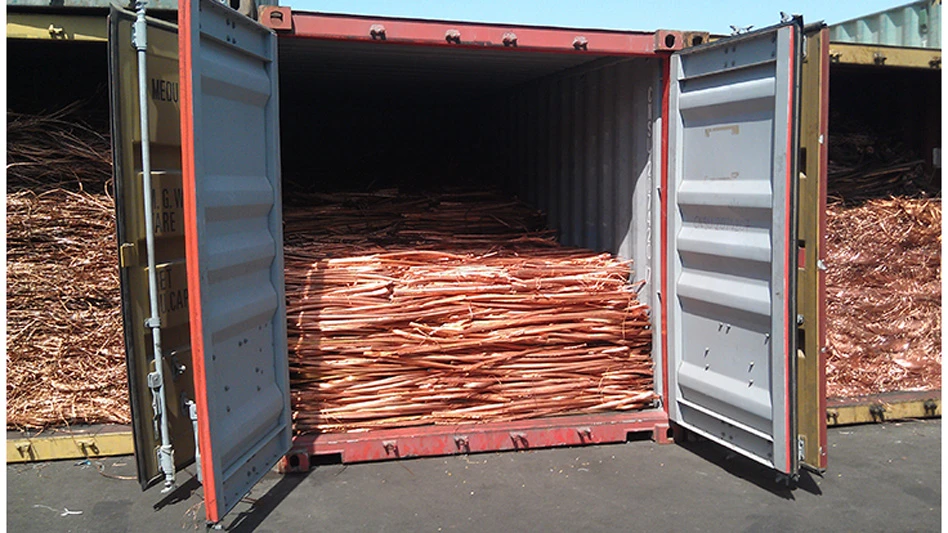
Another disincentive for exporters is theft from sealed containers, which Chiao said is spreading.
During a session titled “International Trade 101: How to Protect the Value of Your Scrap Exports,” Randy Goodman, an executive with Greenland (America) Inc., based in Atlanta, focused much of his discussion on a recent survey conducted for ISRI regarding theft from containers at overseas ports. The survey, he said, would go a long way toward supporting the scrap metal industry when approaching the Chinese government for assistance. Goodman said the biggest problem spots for container thefts are Hong Kong and the Pearl River Delta, where containers from Hong Kong are transported to inland locations.
North America’s transportation infrastructure also presents problems for companies exporting material from the U.S., according to presenters at the session “International Trade 201: How Are Domestic Issues Reducing the Value of Your Scrap Exports.”
Joseph Bonney of the Journal of Commerce (JOC) said 21 of the JOC’s 2013 top 100 U.S. export shippers were “primarily scrap products exporters.” He also said the U.S. port infrastructure hasn’t kept pace.
Latest from Recycling Today
- 2026 Plastics Recycling Conference: Diving into SB 54
- Commentary: Plastic recycling isn’t working; what are we going to do about that?
- Environmental groups urge Indonesia to return e-scrap shipments
- Foodservice Packaging Institute opens applications for 2026 foam recycling grant program
- Worn Again Technologies unveils Accelerator plant to advance polycotton recycling
- Nashville Waste Services launches new digital route system
- Arconic expands in Iowa
- Cascades invests $6.9M in recycled boxboard plant