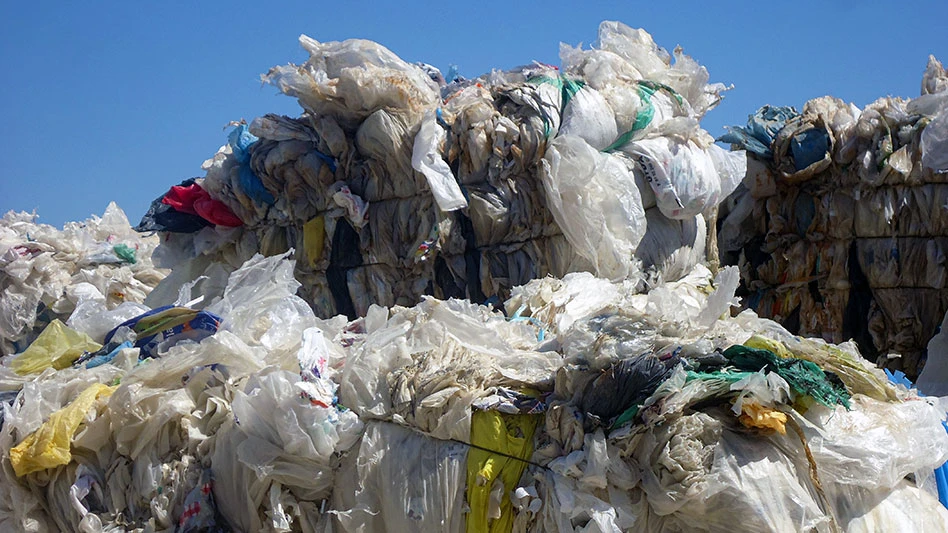
The European plastic scrap market has been buffeted by a flurry of negative news that has put the industry on notice that even the largest plastics recycling companies are not immune from market challenges that are roiling the markets.
On one hand, low oil prices are pushing down resin prices, which ultimately is making it difficult for many European plastics recyclers to compete for end markets.
At the same time, the supply of resin on the continent is creating a growing concern by plastics consumers that they will end up without sufficient material.
A third challenge has been the economic malaise that has affected many countries, most notably China.
The high-profile collapse of EcoPlastics’ U.K.-based PET (polyethylene terephthalate) plastics recycling facility late last year was the most recent hit for the plastic scrap market in Europe, although market problems also are impacting other U.K. plastics recyclers. Because of financial losses over the past several years, the company entered into administration in late 2014, and was acquired by the German investment firm Aurelius.
At its peak, the company was capable of sorting around 150,000 tonnes of PET bottles per year.
Unfortunately EcoPlastics has not been an isolated case. Closed Loop Recycling (CLR), which claims to be the largest HDPE (high-density polyethylene) plastics recycler in the U.K., has been teetering on the brink of closing as a result of both low prices and slowing demand.
Magnifying the problems, an article in the U.K.’s The Guardian, notes that CLR was faced with the possibility of closing because of slumping plastics prices and a drop in demand from the U.K. dairy industry, its primary end market.
The Guardian article also states that prices for recycled material have dropped by close to 40% over the past nine months.
In response to concerns over the company’s viability, CLR CEO Chris Dow says while the company is struggling with pricing problems, CLR is discussing possible solutions.
In a statement, Dow refers indications of overwhelming support for paying slightly more for recycled-content plastics to be used to make bottles. “We are the most vulnerable part of the supply chain, yet are shouldering all of the risk,” he says.

While markets have definitely cast a bit of a cloud over the markets, there are some positive signs, according to other plastics recyclers.
One European broker says because of the lack of availability, prime grades of plastic scrap have been in much higher demand, leading to a modest upswing in prices. As for supply, March figures brought a welcomed uptick in the availability, resulting from some seasonal increases, although April figures dipped a bit, he points out.
With prime grades in better shape, there are signals that several other grades of scrap plastics are finding better markets, which is helping with the flow of material.
The LDPE (low-density polyethylene) market continues to be one of the better plastic markets at the present time, one source points out. Price and demand remain strong for the grade throughout most of Europe.
For end markets, the strong U.S. dollar has strengthened the hand of many European handlers. Several sources say that China and India are both buying decent amounts from Europe in light of the changes. Additionally, one source says consumers in Vietnam also are buying more.
While there are some promising signs about the flow of plastic scrap to China, there are indicators that the country may step up inspections, possibly resulting in some lower grades of plastic scrap being turned away or redirected to other sources.
However, supply shortages in the European Union (EU) are a rising concern. One organisation, the European Plastics Converters (EuPC), has expressed alarm on the impact that force majeure declarations would have on European plastics markets.
Similarly, Philip Law, director-general of the British Plastics Federation (BPF) observes in a statement, “It certainly appears that some processors, particularly low-density polyethylene, linear low-density polyethylene (LLDPE) and high-density polyethylene, are on allocation. This threatens their ability to fulfill contracts.”
Latest from Recycling Today
- Ocean freight interruptions poised to continue
- Danieli to supply shredder to Australian company
- Equipment from the former Alton Steel to be auctioned
- Novelis resumes operations in Greensboro, Georgia
- Interchange 360 to operate alternative collection program under Washington’s RRA
- Waste Pro files brief supporting pause of FMCSA CDL eligibility rule
- Kuraray America receives APR design recognition for EVOH barrier resin
- Tire Industry Project publishes end-of-life tire management guide