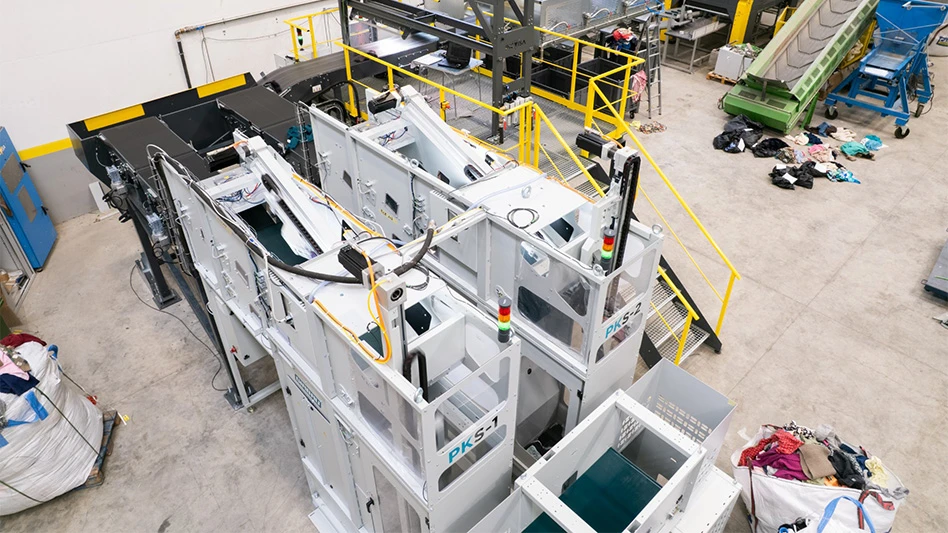
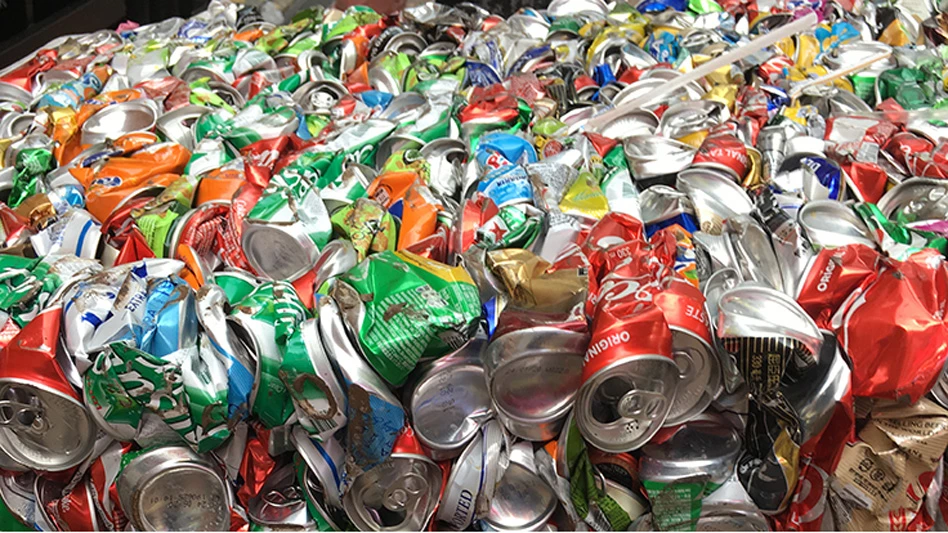
In response to growing demand for high-purity, ready-to-melt recycled metal packages, recyclers are investing in equipment and technology designed to help deliver these materials. Such investments also provide processors with the flexibility to respond to changing market dynamics, according to speakers at Scrap Expo 2025.
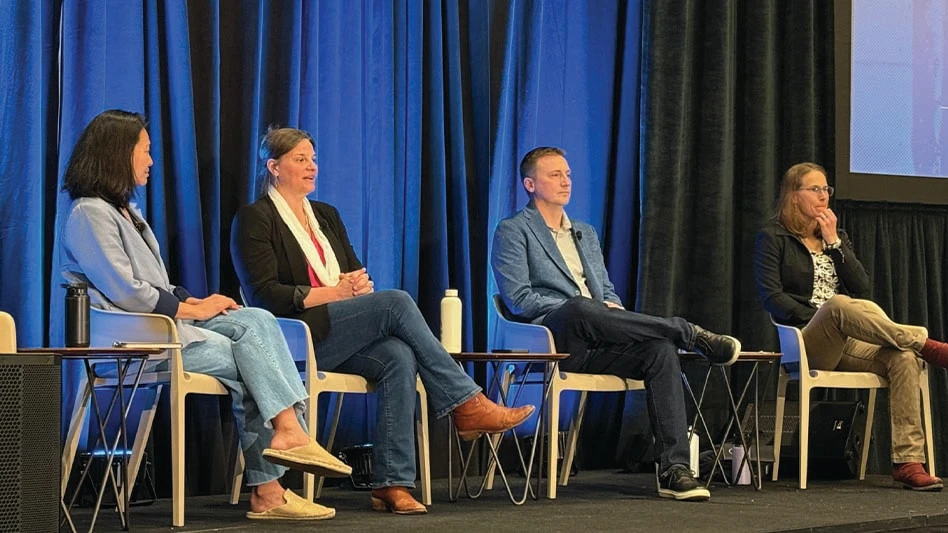
Technology providers and recycled metals processors shared their perspectives across back-to-back sessions at Scrap Expo last September: Technology Spotlight: Refining Recovered Metal (Part 1) – The Supplier Perspective and Technology Spotlight: Refining Recovered Metal (Part 2) – The Processor Perspective. Ronak Shah, CEO of New Caney, Texas-based Levitated Metals, moderated.

Growing interest
“Over the last two years, we’ve certainly seen an increased interest from customers in not just recovering but also refining metals, producing ready-to-melt products,” said Ernesto Tirado, vice president of engineering at SGM Magnetics, headquartered in Italy with U.S. operations in Sarasota, Florida. “Customers are pushing equipment suppliers not just to achieve high-quality products but also to be able to run high throughput.”
He added that advancements in LIBS, or laser-induced breakdown spectroscopy, technology used in aluminum sorting applications have improved processing speed from 1-2 tons per hour to 10 or more tons per hour.
Kyle Rice, solution sales manager at Steinert, which is based in Germany with a U.S. subsidiary in Walton, Kentucky, added that the need to sell to domestic producers is driving the trend toward scrap refinement.
“You have those domestic drivers, but you also have export markets changing the traditional markets that our customers could go to,” added Tom Wendt, president of Buffalo, new York-based Wendt Corp. “So those two things combined with the fact that new technology is becoming available to do things that were not possible more than a year or two ago create a heck of a time to be in the business and opportunity all over the place. The trick is to put the puzzle together and figure out how to do that for each situation.”

Notable technologies
Rice said X-ray-based and LIBS technologies have outperformed the traditional maturity curve and should be attracting the attention of processors.
“I think that’s where you see the zorba upgrade potential be the highest,” he continued. “Whether that’s X-ray transmission focused on the aluminum side separating heavies away from light metals, even magnesium removal, there’s a lot of opportunity there.”
He added that X-ray fluorescence is useful for the separation of heavy metals, while LIBS is ideal for further refining vesper, which the Recycled Materials Association’s ISRI Specifications define as “aluminum sheet, extrusion and/or plate grades (wrought aluminum) segregated from zorba or twitch” by alloy series or specific alloy.
In the processors panel, Tommy Bishop, vice president of Recycle WV in Princeton, West Virginia, said sensor technology and the computing behind it have improved significantly in recent years. He noted that when the company installed its first sensor-based sorter 15 years ago, it did a binary sort.
“Now, it’s such a more complicated set of decisions,” Bishop said. “And not only is it more complicated, it tends to be right more often than it’s wrong, which is really nice. … And the data we’re getting is so much better than it was.”
Wade Conner, founder and CEO of Trinity Metals LLC in Indianapolis, agreed that sorting technology is improving.
“When the technicians come out and they play with the machines, we’re getting better throughput with cleaner product, even on a machine that’s five years old.”
When it comes to upgrading ferrous scrap, Mike Shattuck, recycling market manager at Erie, Pennsylvania-based Eriez, said that while low-copper shred has been around for a while, the technology hasn’t really changed. “[But] the process behind it has changed, and we’ve really figured out how to fine-tune it in and produce the products that people are looking for now,” he added.
Felix Hottenstein, sales director at optical sorting technology company MSS LLC, Nashville, Tennessee, said artificial intelligence- (AI-) based sensing equipment has been around for a while and is maturing in metals recycling applications.
“Obviously, it’s not just the sensor itself. It’s packaging it into a machine and making it work for the application.”
Thomas Brooks, the chief technology officer at Bulk Handling Systems (BHS), Eugene, Oregon, said combining various technologies likely will deliver the refined packages and optimization recyclers need.
“We’ll see some disruptive approaches in which we’re seeing those different technologies combined together in a cost- effective way,” he said. “And I think part of what will bridge that is the ability to use AI from both the design perspective and then also from a sortation perspective, which is really opening up some doors to solve not only what we’re talking about from the refinement perspective but then some of the operational issues that we’ve been seeing for a while.”
When it comes to investing in new technology, Kevin Gershowitz, president of Gershow Recycling in Medford, New York, said that as an operator of a single shredder, he waits to invest until the technology has been proven effective.
“When it comes to really new processes and new technology, for me, that’s a bit of a waiting game,” he said.
Operators of multiple shredders likely are better positioned to invest in research and development, Gershowitz added.

To optimize recovery or refine?
Should operators prioritize refinement over recovery?
For Gershowitz, the answer is no.
“We want revenue now, so we’re going to invest money to recover metals instead of landfill metals, and that has been our primary goal,” he said, adding that for 25 years, Gershow has been analyzing its waste streams across the spectrum of sizes the company produces.
“While a lot of operators will tell you they’re under 2 percent or under 1 percent … in the aggregate, if you were to analyze by waste size, you’d find 4 or 5 percent in certain areas. And that’s what we targeted, which is why we’ve got 19 eddy currents, and so we’ve been focused on recovery. … Recovery generates revenue.”
“It was almost an obligation of ours to shift the conversation back to, ‘If you’re going to spend some money, why don’t we recover this metal that you’re currently sending to the landfill rather than taking this product that you’re recovering and trying to find a new home for it; it’s already in demand,’” Wendt said.
However, he said that conversation has changed more recently.
“Some of those homes for some of those commodities either no longer exist, or the prices that are being paid are no longer high value compared to their intrinsic makeup,” Wendt explained.
“Refining can create margin. It can create margin through new customers [and] a broader customer base. And all of that translates to the potential to procure more material because you’re driving more value out of it.”
Tirado agreed, adding, “Yes, refining opens up new potential revenue streams. For example, you’re making zorba—your typical market would be Asia. If you take that zorba and upgrade it, now you’re making twitch. You’re opening up new potential markets here in North America with smelters making cast ingots. … It’s all about finding new revenue streams.”
Rice added that flexibility in processing can help to ensure market access as well.
“The flexible processor is the one who can react quickly and capture the premium on the upslope of adoption, perhaps,” he said. “And if it no longer makes sense, a tariff changes or global regulations change, you can shift. You can turn a machine off. You can turn a machine on and do different things. And that flexibility is really what a lot of processors are after when they’re talking about refinement.”

Harnessing data from their operations can help processors make informed investment decisions, according to Brooks.
“While you think you may have a certain amount of available material, in reality, that may not be [the case],” he said.
With data, processors also have insight into the quality of their shipments before they reach consumers, Hottenstein said.
“Instead of just making a big pile and waiting for the mill to tell you what your quality is and possibly downgrade you, you can provide or at least monitor and store the data in real time of what’s going on and what’s going through your system,” he added. “You can then adjust in real time your settings on the machinery.”
Wendt noted that understanding the composition or metallurgy of what’s being produced is important when going direct to a furnace. “Whether it’s a spectral analysis of material, or whether it’s AI with some sort of vision system, I think the data, the information, is going to be there to allow that consistency that the end user is going to be looking for.”
The more refined the metal package, the more value and liquidity it could have for a processor, according to Shattuck.
“But even if you don’t get a good premium on it, you have a high-quality, consistent-quality product that is desirable to the steel mill,” he said. “So, when the market softens up and they stop buying as many tons, the best quality is usually the last guy to go.”
In the processors panel, Gershow said investing to produce low-copper ferrous shred didn’t pencil out until more recently.
“We could have done it as an industry 30 years ago,” he said, but the product was not in demand. “We weren’t going to get paid for it. It wasn’t going to create more liquidity to have better sales. But, today, that’s different.”
However, not all shredder operators share that experience.
“Nobody has offered me more money for low-copper shred,” said George Adams, CEO of SA Recycling, based in Orange, California. “If you look at our Savannah [Georgia] operation, which is close [the] to Nucor Berkeley [site in Huger, South Carolina], they’ve installed their own ballistic separators, and so they’re not offering us a premium for us to do it. … They’d rather do it themselves. But if someone offered me more money, I would.”
Operators must evaluate whether to invest in improving recovery or further refining the metals they produce based on factors unique to their operations.
Explore the Winter 2026 Scrap Recycling Issue
Check out more from this issue and find your next story to read.
Latest from Recycling Today
- Press Metal affected by currency, hedging issues
- Steel output rises in top economies in January
- Thommen Group announces personnel changes
- International Paper to close South Carolina container plant
- A look inside WM’s new $90M south Florida MRF
- Waste to Resource Ontario announces new co-chairs
- WIH Resource Group adds senior associate
- BlueScope rejects recent SGH, SDI bid and notes terms for additional engagement